Showing posts with label stitched paintings. Show all posts

Monday, February 6, 2017

Colleen Heslin

girl friday 2016 colleen heslin dye on linen
Colleen Heslin's exhibition Needles and Pins
McMichael Canadian Art Collection Gallery  June 4 2016 - February 20 2017
organized by the Esker Foundation in Calgary
curator Naomi Potter
girl friday detail colleen heslin
sewn paintings
constructed colour fields
false start 2016 colleen heslin dye on linen
Colleen Heslin won the 2013 RBC Canadian Painting Prize
earth be earth 2015 colleen heslin dye on linen
Colour field paintings or modern quilts?
A Jack Bush solo exhibition runs concurrently at the McMichael
earth be earth detail colleen heslin
Art equals craft, Craft equals art.
The importance and meaning of materials
monochrome 2016 colleen heslin dye on  linen
 Colleen Heslin soaks fabric in dye, and then skillfully cuts and pieces these striking compositions.
They 'resonate with the tension of material and gestural complexity.'  (wall text)
dash 2015 colleen heslin ink and dye on cotton and linen
The work in this exhibition is recent, most from 2016.
Those from 2015 give more evidence about her mark making process.
She allows the fabrics that she stains with dye or ink to dry naturally, and then responds to the marks left behind without her hand touching them.
Not paintings then.
dash 2015 colleen heslin detail
Yet the viewer feels touched.
This artist is exploring and using cloth as a language and cloth is intimate.
counterpose 2015 colleen heslin ink and dye on cotton and linen
 We understand cloth.
log cabin 2016 colleen heslin dye on canvas
Cloth is like the human body.
It's malleable.
runaay 2016 colleen heslin dye on canvas
Most of the pieces are human scale.
The cloth is pulled around stretcher bars. 
seafoam 2016 colleen heslin dye on canvas
Not quilts then.  

Monday, May 5, 2014

Dorothy Caldwell

Flying Over Salt Lakes,
stitching on cotton with earth ochre, approximately 13" x 16",  2013
Dorothy Caldwell has become an icon for textile artists, exhibiting and teaching around the world.  We Canadians claim her as our own, as she has lived in Ontario since the mid seventies, relocating here from the USA.   The images in this post are of Dorothy Caldwell's latest exhibition, Silent Ice, Deep Patience, installed in the Art Gallery of Peterborough March 21 until June 22, 2014.
Left: Map Without Words
9 feet, 4 inches, x 8 feet, 5 inches, Right: Silent Ice/Deep Patience, 23" x 23". both 2013
Upon entering, the viewer descends a long ramp towards the main exhibition space, welcomed by five small paintings made with hand stitch and earth ochres (see top photo) on the ramp's wall.  Then, through an opening in that wall, the two pieces shown above beckon.  Large scale, empty space, intimate marks.   We are in Caldwell country.
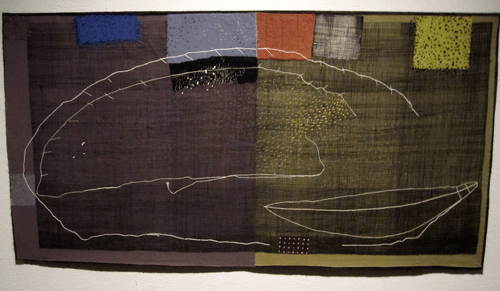
Wandering Time,
approximately 24" x 18", wax and silkscreen resist on cotton with stitching, 2011
In many of her pieces, Caldwell lines up coloured patches along edges.  She draws our eye up to the sky, then over to the west and the east, and then brings it back to the centre.  Line drawings are couched onto the surfaces, like trails.  Archetypal vessel shapes resonate.
wandering time, 2011, detail
Dorothy Caldwell's stitches recall the random repetition of the small marks we are familiar with in nature. Leaves fluttering in the wind, ripples in the water.  Some large, some small, some linear, some a splotch, some widely spaced, others packed together.  Footprints on a beach.
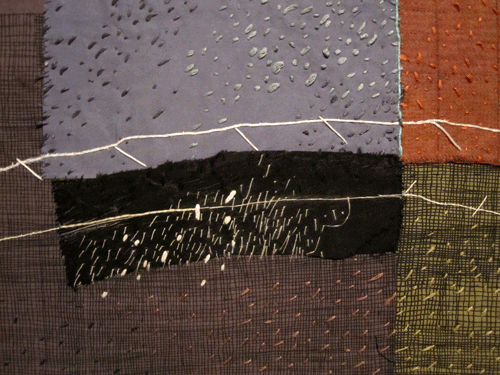
wandering time,  2011, detail

"My work is an ongoing investigation of the meaning of place.  I investigate how  humans mark and shape the land and how those human marks interact with the natural geology."  Dorothy Caldwell
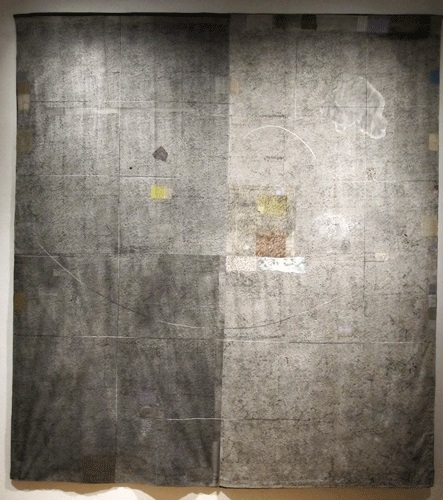
Map Without Words,
wax and silk screen resist on cotton, stitching, applique, 9'4" x 8'5", 2013
We often meet in the centre in Dorothy Caldwell's world.  Four corners, four patch, grids, crosses, grid the large unknown to make sense of it. There is order within chaos here.  Human geography.  

This body of work is the result of the artist's travels to the Australian Outback and the Canadian Arctic. Interested for decades in how humans mark the land, (previous exhibitions Field Notes (1998) and Ground Cover (2000) this current exploration of wilderness landscapes is a continuation for the artist.  
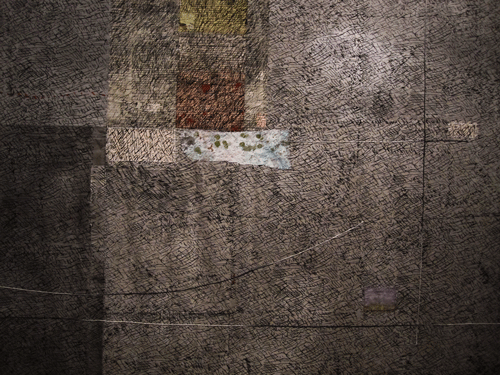
Map without Words, detail
Dorothy Caldwell uses cloth as a vehicle to translate her observations because cloth is like the land. Cloth reacts as land does to human intervention.  Simple actions like wearing, mending, stitching and patching make marks on cloth just as farming, road building, and daily walks mark the earth.
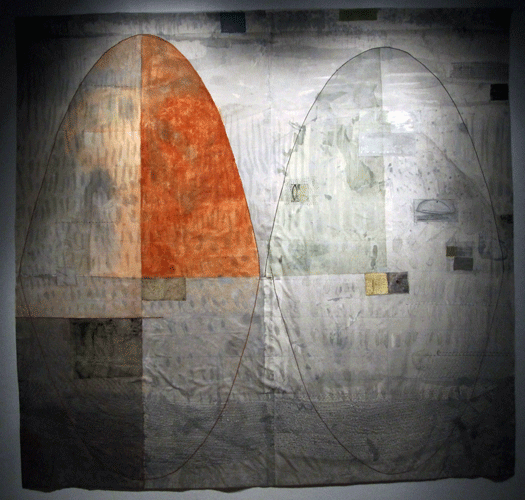
A Red Hill, A Green Hill,
 ink wash, earth ochre on cotton with stitching and applique, 9'4" x 9'8" 2012
In the large scale tactile painting shown above, Caldwell applied ink wash and earth pigments to the cloth as a change from her usual resisted dye or discharge methods.   Thoughtfulness is evident.  The aesthetics of time and touch, evident.
A Red Hill, A Green Hill, detail
Small patches and marks that drift into atmospheric hazes when seen at a distance, are unique and very real human habitations upon close inspection.  The big thread used in the waves of rugged stitching along the lower quarter of this wall piece was rubbed with earth and connects with the viewer on many levels.
A Red Hill, A Green Hill , detail
"I am intrigued by maps and by the organization of land through patterns of settlement and agriculture.  I have come to see the dichotomy between conventional mapping that identifies intimate landmarks and simplifies them into abstract shapes and textures."  Dorothy Caldwell
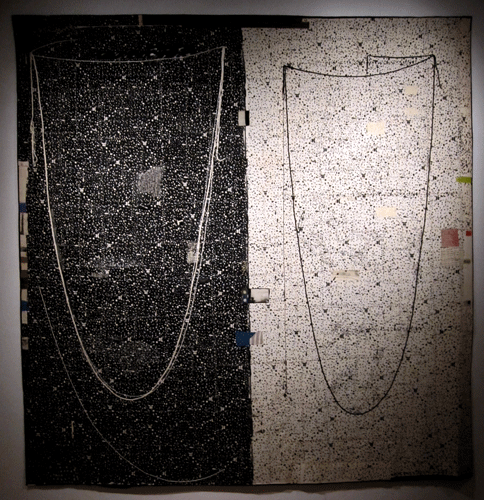
How Do We Know When It Is Night?
wax and silkscreen resist on cotton, stitch and applique, 10 feet by 9 feet 6 inches, 2010
Little patches along each edge and down the centre,
bowls drawn as if with a giant pencil,
duality, in and out
How Do We Know It' Night?  detail
"Caldwell tells students that what an artist needs to learn more than anything is how to make time for their art"  Ann Jaeger
How Do We Know It's Night?  Detail
Caldwell's large pieces have balance, stillness
They cause us to think beyond the gallery
about the vastness of nature and how nature has its own system.
The larger seasonal cycles, the many small parts within vastness.
That human marks are revealed by time and accumulation,
then erased by wind, eroded by water, hazed over by weather.
Stain of earth, footprint of man, animal tracks through the forest,
like poetry, these things occur one by one and resonate with personal experiences that don't always have anything to do with land, more with relationships.
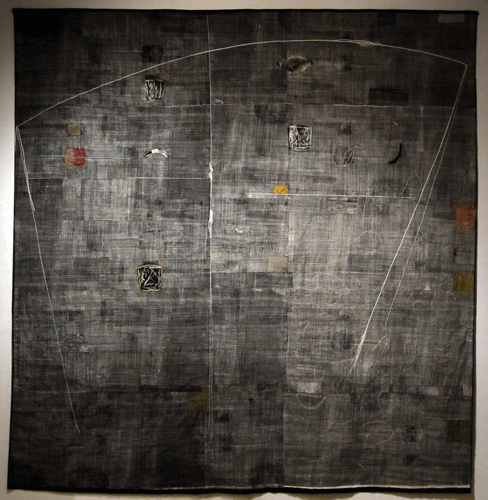
Signs,
wax and silkscreen resist on cotton,stitching, applique,  8'9" x 8'0", 2014
The artist's most recent large work returns to her preferred methods of marking large pieces of cloth with resist techniques.  The subtle grid of the ground, a new linear shape, and the painted squares and crescents dotting the interior are atmospheric.

"Maps give a viewpoint of the land filtered through what is important to the mapmaker.  I am mapping unfamiliar territory, identifying my personal landmarks through gathering, touching and recording the contents of the landscape.  In this way I form a sense of place for myself."  Dorothy Caldwell
Signs, detail
This post is about the large scale work but there are also many small pieces exhibited as well as an entire room devoted to the artist's collections of shells, lichens, bones, rusty wires, journal pages, iron nails, and her many books of marks and collected earth pigments.  How the artist works with the land to make these 'maps' deserves its own write up.  The video of Dorothy Caldwell (click here) perhaps fills the gap.

Other internet sources for this artist:
Ann Jaeger's informative review of Caldwell;s life and work on trout and plaid online journal,
Barbara Lee Smith's curated exhibition catalog Traces ,
as well as Caldwell's own website and the CCCA artist profile .

Caldwell's exhibition was shown at the Idea Exchange in winter 2015 and went on to St Mary's University gallery in Halifax for March and April of the same year.  This review by akimbo halifax correspondent Daniel Higham was published april 7 2015.  Good to see some writing about this artist.  Joe Lewis also wrote a review in Fibre quarterly....have to find that for you and shall insert it here when I do. xx

The Dorothy Caldwell quotes in this post are from her statement found in Barbara Lee Smith's essay in the Traces catalog.  All photos are from the exhibition and are by Judy Martin with permission from Dorothy Caldwell.

Friday, September 30, 2011

Polly Binns

Intimacy and space blend in the immensity of the landscape. The whole is imbued with the memories of my body within the landscape; my step, pace and sight-line. Serial Shimmers and Shades, 1996 Acrylic paint and thread on linen canvas 185 x 125 cm, collection of Nottingham Castle museum

Polly Binns, a member of England's prestigious 62 group, is considered a 'maverick' in the embroidery community. She grew up in a house of artists; her father used grids to size up his modernist design work and her mother painted the surrounding landscape. Untitled 1982 black cotton with coloured thread, smocking technique. 50 x 45 x 5 cm

She started her art career in clay, but soon studied weaving as a way to understand the material essence of cloth. When she eventually began exploring artist's canvas she was influenced by minimalists like Donald Judd and Carl Andre who worked with ordinary materials for their own sake. How did canvas behave when it wasn't stretched, when it wasn't covered with oil paint? She folded, pleated, stitched the cloth to raise the surface. She worked the cloth from both sides. Sand Surface and
Shadows, Winter 1996
1996 artist canvas, acrylic paint, threads, surface treatments. 7 panels 280 x 210 cm

The vertical elongated rectangles in the above piece relate directly to the body and seem to represent humans within the landscape. Polly Binns says about this piece that it is "a memory of the surface from where my feet stood to the far horizon. "
Her work from the mid 90's can be termed "post minimalist", as along with the grid geometry and attention to materials, there is also a kind of poetry.
The Poetics of Space by Gaston Bachelard is an influence. He wrote about "two kinds of space, intimacy and world space. When human solitude deepens, these two immensities touch and become identical. "
Although her work has become more poetic, it is never autobiographical. Her work is about observation and about memory of place. Before Polly Binns does any work in her studio, she walks. She repeats the same walk each time, at low tide, in the Blakeney Channel on the north Norfolk coast of England. No walk - no work.

This is a phenomenological approach. Walking immerses her in a direct experience. Mud, sand, water, bird marks, light are observed and felt with all her senses. There is a tension between order and intuition, between rational knowledge and the not quite known. Inshore Curve 1996 185 x 125 cm

Polly Binns had a daughter in 1986. During the first five years of Katy's life, the artist mounted a solo exhibition, joined the craft council and started full time teaching. However, about those years between 1986 and 1991, the artist says that she "closed down" and that her "balance had gone".

She took time off from making art and looked at more art by others, including that of Agnes Martin. Even more important, she took her little girl on long walks in the landscape, and together they observed things closely. All of a sudden, she realized that the land had seeped into her material knowledge and she knew what to do next in her career. Study 1 1996 27 x 28 cm collection Pamela Johnson

"My intention is to pare down the image: to reduce the pictorial elements of my memory landscape:
to focus on my interior vision
to recall and reference the glimpse, the half caught image,
the layered textures of memory." Polly Binns

In 1998, she received a PhD from England's University of Teesside for her new body of work entitled Vision and Process in Textile Art: a Personal Response to a Particular Landscape.
In 2001 she represented Britain at the 10th International Triennial in Lodz Poland.

The images in this post are from Surfacing, a monograph of Polly Binns that accompanied her 2003 exhibition at Bury St Edmunds art gallery. The information is gleaned from Pamela Johnson's excellent essay and the timeline of Polly Binn's career and life that is included in that book. The quotations are from Polly Binns's artist statement from the catalogue for Texture and Memory, an exhibition curated by Pamela Johnson and Peninna Barnett in 1999.

Monday, July 13, 2009

Sue Hammond West

Wisdom Nerve paint, wool, silk, thread, objects on felt 72" x 72" 2006-2007 In 2007, I took a four day workshop with Sue Hammond West at the Surface Design Association conference in Kansas City. The class was called "Art as Quiet" and I loved it. Each session began with meditation. We painted with acrylic on scraps of upholstry material and stitched into them afterwards. We did not make small talk while creating and this encouraged each of us to work with inner passion. Abundance Magnent paint, silk yarn stitching, gold leaf on industrial felt , 72" x 72" 2006 Sue Hammond West also had an exhibition in Kansas City at that time and I was very impressed with seeing her work. It is very large and simple with barely tangible circles and organic shapes surrounded by large quanities of space. I found myself emotionally gripped by her work. numina paint, paper, mica, stitching on cloth 49" x 50" 1999 - 2004 She currently teaches at Naropa, the Bhuddist University in Boulder, Colorado. Tacit Longing paint, paper, rocks, flower petals on industrial upholstry cloth 59" x 60" 2003-2004 These images of her work are from her 2007 self published catalog of mixed media textile paintings as well as from an article about her work by Ginger Knowlton that I read in the spring 2007 Surface Design Journal. Nectarian Moonlight paint and stitch on industrial upholstery, 79" x 38.5", 2006