Showing posts with label quotes by poets. Show all posts

Sunday, May 22, 2016

April Anne Martin MFA graduate exhibition Art Institute of Chicago 2016

The Sun Had Not Yet Risen   2016   copper blind, 3 feet wide, 10 feet high
The Sea Was Indistinguishable from the Sky  2016
  tupperware with cyanotype printmaking in process
MFA exhibition, April Anne Martin


Simplicity is the core
pared down to the essence
not removing the poetry,
but pared down
not removing the connective tissue between all the elements
not diminishing that quality that compels us to look again
and again and again
but pared down

in the far left  window sill, The Sea Rose 2016 paper sculpture, 
on the floor, The Sea Was Indistinguishable from the Sky,
 in front of the window, The Sun Had Not Yet Risen,
(this photo taken around 6 pm) 
simplified
pared down
every unnecessary element discarded
spare
elegant
sumptuous
April Anne Martin's MFA graduate exhibition Art Institute of Chicago,
Sullivan Galleries April 29 - May 18, 2016
Like Eva Hesse,
Martin uses a complicated minimalism marked with fantasy
Like Roni Horn,
she pays attention to the physical qualities of her material
Like Mark Rothko,
she uses a vertical format marked with shimmering horizontals
Like a poet,
she wants to elicit emotional response
Like a scientist,
she asks questions about what would happen in nature and records the process
Like an artist,
she doesn't want to know the answer ahead of time

She allows nature to be her equal partner
April Martin works with the changeable daily elements that each of us experience and think we know. Water.  Air.  Natural light.  Time.

The objects in this exhibition hold the time of day within them.
Inspired by modernist women artists and poets, Martin quotes Virginia Woolf's 1931 novel The Waves, in her titles.  Quoted below are the first few lines of that poem-novel.
The sun had not yet risen.  The sea was indistinguishable from the sky, except that the sea was slightly creased as if a cloth had wrinkles in it.  Gradually as the sky whitened a dark line lay on the horizon dividing the sea from the sky and the grey cloth became barred with thick strokes moving, one after another, beneath the surface, following each other, pursuing each other, perpetually.
As they  neared the shore each bar rose, heaped itself, broke and swept a thin veil of white water across the sand.  The wave paused, and then drew out again, sighing like a sleeper whose breath comes and goes unconsciously.            Virginia Woolf
In the above photo,  Martin is installing lengths of watercolour paper that she has treated with a cyanotype process over a period of twenty days.
Nine papers were each washed and exposed simultaneously in the tub in the middle of her space. This happened every two days at times that correspond to the nine interludes in Woolf's novel where she described the coastal scene at various times of day.  April Martin isolated the first few words of each of Woolf's interludes to create titles for her cyanotypes.
The interludes were not put into the space until the final day as during most of the exhibition they were drying in her studio.  In fact there was a performance every other day as part of the exhibition.
Follow this link to see photos.

"During the 20 day exhibition I will make 10 cyano type prints that respond to the sun's changing position in the sky, using sun and water.  The prints wash and expose themselves in the gallery and then are moved to my studio in another building where they are dried and displayed."  April Martin

On May 16 (graduation day), she moved the last of the cyanotypes into the gallery..
My studio is a scaled down space to observe the perpetual motion and aliveness of things. I set up physical exchanges between dry and wet materials that appear if only for an instant, to slow or stop time. Formally it is a container for activity, and sculpturally many of my works address this contained boundary, threatening to overflow, to flood and leak. 

Outside where the scale shifts, and the permeable drywall boundaries of my studio fall away, everything is different. Weather stacks itself into the present daily form made from dry/wet and hot/cold exchanges. We experience it in the moment we spend with it, it blows our body, it drips down, burns the back of our neck; it moves itself inside of us. April Anne Martin
from left to right, The sun had not yet risen, The sun rose higher, The sun rose, The sun, risen, no longer couched on a green mattress darting a fitful glance through watery jewels, bared its face and looked straight over the waves. The sun had risen to its full height, The sun no longer stood in the middle of the sky, The sun had now sunk lower in the sky, The sun was sinking, Now the sun had sunk. 

The Sea Rose 2016  pad of graph paper with evaporated salt and miracle gro' 11" h 
Another modernist woman writer, H.D. (Hilda Doolittle)'s poem Sea Rose gave the artist a title for her paper sculpture in the window.   (shown above)
The Sun Had Not Yet Risen  2016  copper  10 ' h x 3 ' w, April Martin
this photo taken around 8 pm, the blind is closed
The vertical copper sculpture reacts to and holds the light and heat of the sun.  It changes with the time of day, but it seems to be timeless.  I will close this post with one more quote by a modernist poet.  This is from Marianne Moore's poem When I Buy Pictures

"It must be lit with piercing glances into the life of things; 
It must acknowledge the spiritual forces which have made it"

Friday, February 7, 2014

Chiyoko Tanaka

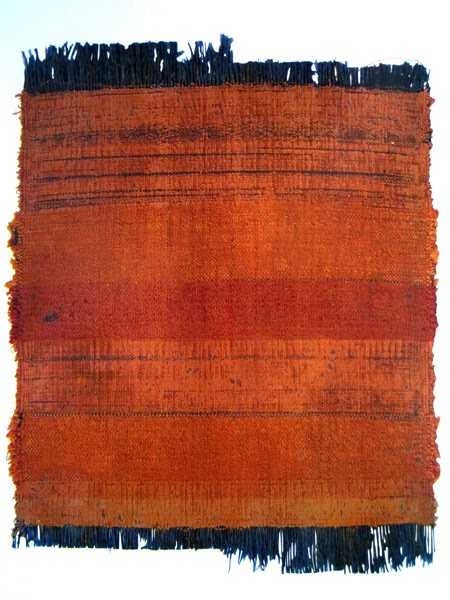
red stripe #262 1988  24 x 18 cm, hand woven ramie, linen, silk, rubbed with brick
"Many of my pieces, once woven by hand, are laid down outdoors on the ground or on a rock.  I then rub them carefully with a stone or brick.  I want to touch the earth through this process, to trace the texture of the ground".  Chiyoko Tanaka

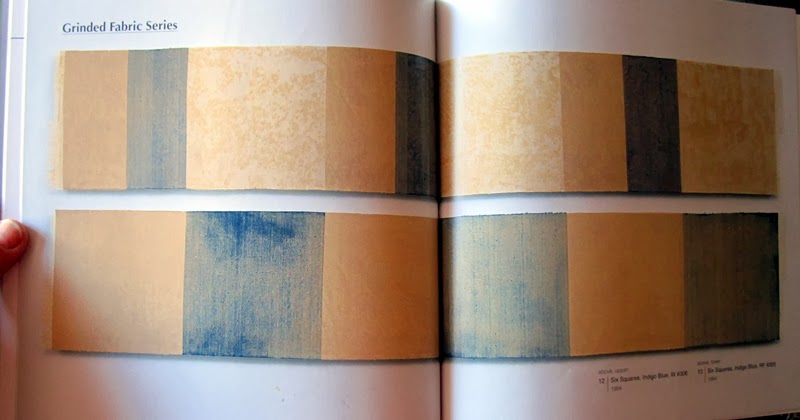
 upper: six squares, indigo blue, W #306 1994  lower: six squares, indigo blue, RF #305 1994
Chiyoko Tanaka, born 1941 Kyoto Japan, is a weaver who thinks about her work philosophically, comparing it to the human condition.   British curator, Lesley Millar's, essay about Tanaka is included in the Telos portfolio about the artist and informs this post.  The images of Tanaka's work are from that portfolio and from Art Textiles of the World Japan also published by Telos.  
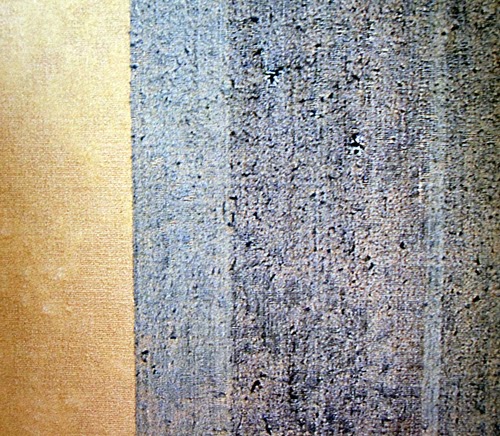
six squares indigo blue W #306 detail
Chiyoko Tanaka uses linen, silk, and ramie threads.  She lays out a long warp which gradually disappears during the weaving process, covered by the weft.

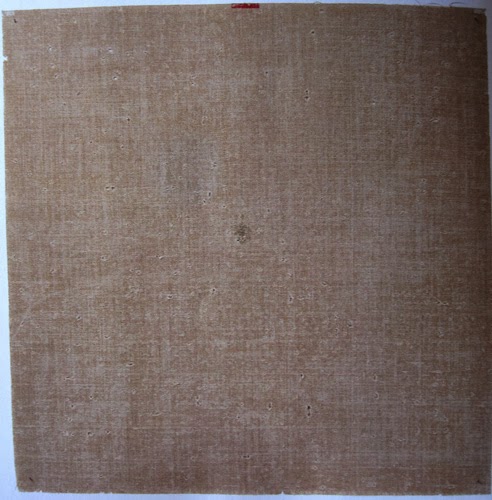
Trace of a Leaf #151 1988

She considers the vertical warp threads to represent time and the horizontal weft threads to represent space.
The crossing points of warp and weft physically disappear from view, but continue to exist as integral to the fabric.  The accumulation of the weft threads represents time passing.  When she weaves, she thinks about the process as one of transformation.
Trace of a Leaf #151 detail

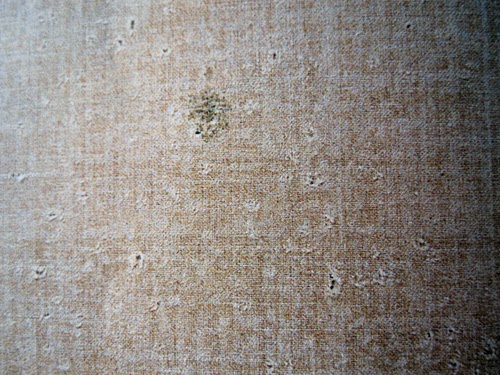
By grinding her newly woven cloth with earth, she exposes that original warp.  She unveils the essence of the fabric. "I feel that my woven work is about time and the human condition."  Chiyoko Tanaka
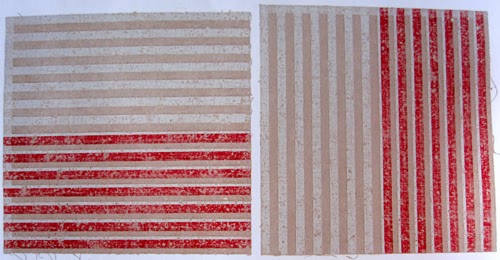
red stripes on white stripes #646 and #647. both 1985
Sometimes, instead of grinding her finished fabrics, she permeates them with mud or oil.  Tanaka distresses her fabrics, as if they were human beings going through a life time of both happy days and days filled with hard ships.
Trace of White Line #641 above, White Line #642 below, both 1985
"I want to see a spirituality behind a piece of my work."  Chiyoko Tanaka
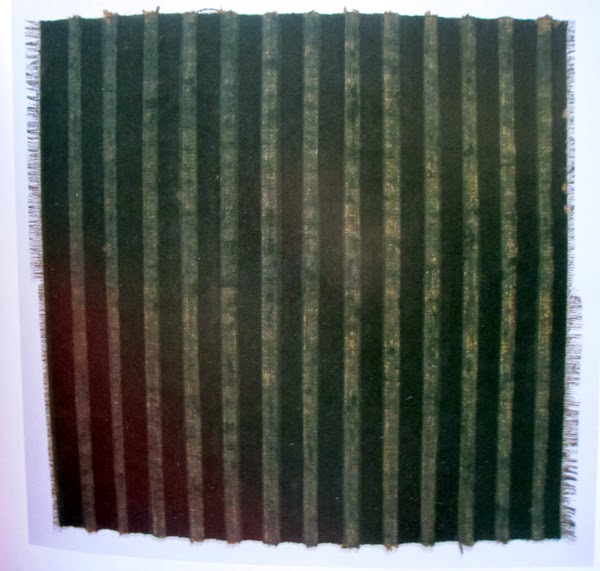
Black Stains on Deep Green Stripes #52 1990
Tanaka uses bricks of clay from different parts of the world.  The brick is rubbed into the back of the fabric until it changes colour and at the same time, the face of the material takes on the patina of the ground.
It's like a performance. 
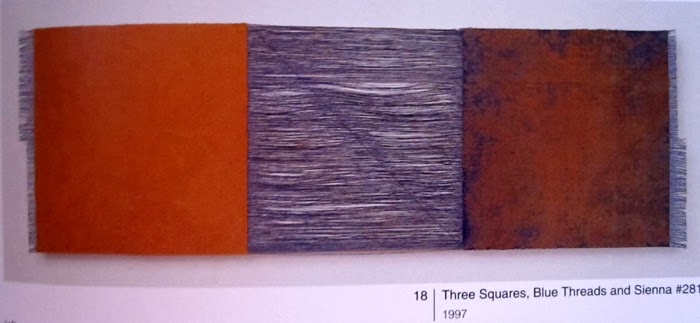
Three Squares, Blue Threads, Sienna #281 1997
The structural integrity of the warp and weft is revealed.   We can see time passing with the erosion of materials, but it is all done in the present moment. 
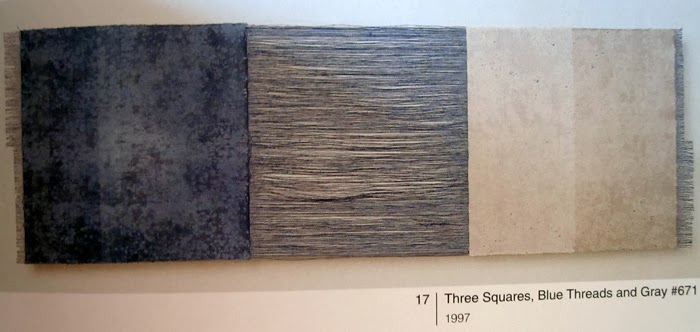
Three Squares, Blue Threads and Gray, #671 1997
Tanaka's work makes us aware of time passing, "neither looking for death, nor denying it, but accepting its place in the cycle of renewal"  Lesley Millar
left: red earthy clay #200 1985, right: permeated black #400 1986
Chiyoko Tanaka has an intimacy with nature.  She lives on the outskirts of Kyoto, close to natural space.  She has an awareness of the tempo of the natural world and this is the basis of her work.
Permeated Black #400  1986
When mud is used as a dye, it is left for a period of time so that it can 'permeate' the cloth.  Time is one of Tanaka's most important materials.
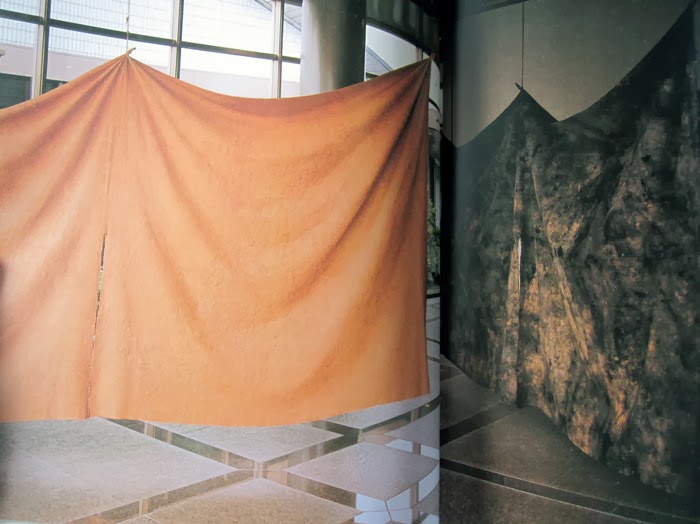
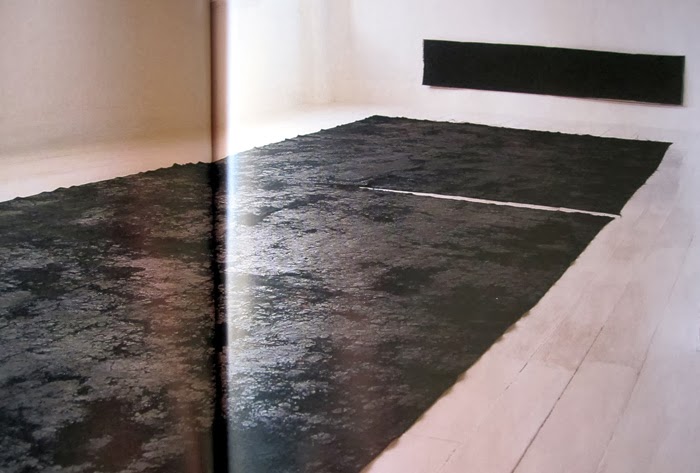
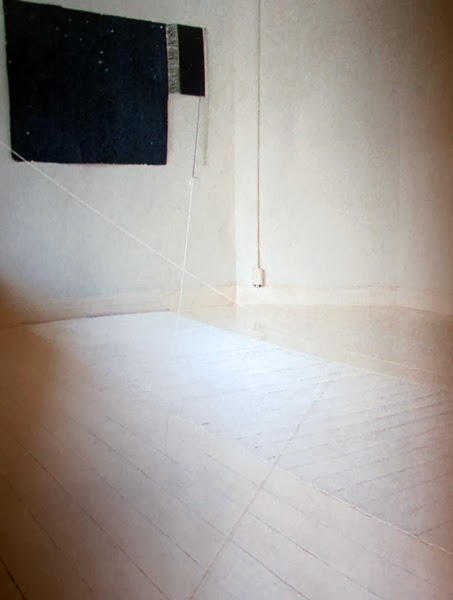
wall:  Blue #100-2 1983,  floor:  White, B #100-1 2983
What are you weaving, Chiyoko?
"I am weaving time"
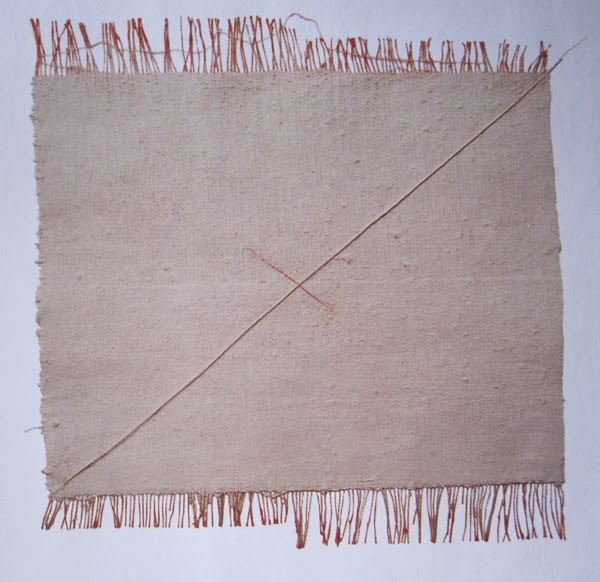
 white mud cross, red thread #652 1992 19 x 19 cm hand woven ramie
"At the still point of the turning world.
...neither from nor towards.
At the still point, there the dance is."  T S Eliot

Chiyoko Tanaka was profiled in 2003 on Culturebase and again in 2010 by Kate Barber who visited her. 

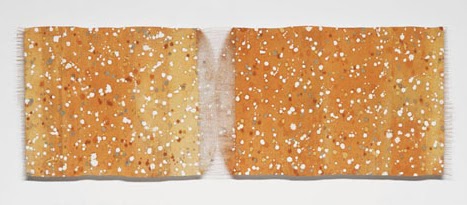
mud dots on brown stripes #742, hand woven linen, ramie, dyed with mud  2009
She is represented by Brown Grotta  source of the above image.  (the most recent I could find)