 |
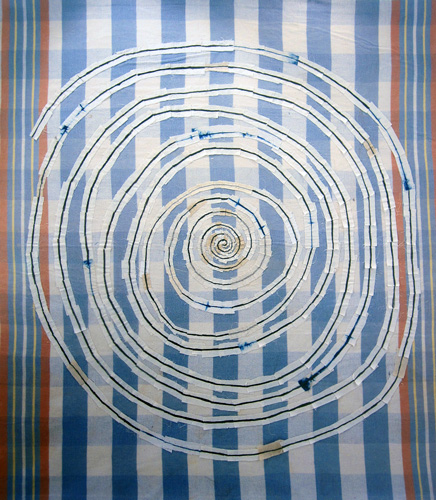
| the found child 2004 |
Classical statues made of permanent materials awaken our feelings of mortality as we realize they will outlive us.
A sculpture made from soft, perishable textiles, evokes the body's vulnerability much more directly, arousing our latent awareness that we are all essentially sacks of skin hung around a structure of bones and stuffed with blood and organs.
Ralph Rugoff (director of the Hayward Gallery in London, England)
For Bourgeois, sewing goes beyond restoration. Instead, it is a metaphor for psychological repair and for exploring the complexity of human relationships.
Bourgeois renews her allegiance to the truth of her female history and its origins in her child self. Size, scale, and the monumental can be arrived at, stitched together, organically built up, as in her series of tall fabric pillar shapes, both assertive and resolutely handmade.
"I cannot renounce the past. I cannot and do not want to forget it." Louise Bourgeois
I would like to embroider and put everything in place and in a proper and predictable manner. To simplify, reduce, organize, round up and retire after being sure of the method.
Sewing implies repairing.
My subject is the rawness of the emotions, the devastating effect of the emotions you go through. Louise Bourgeois
Bourgeois' sculptures, at once baroque and schematic, subvert any possible association with platonic completeness. Female forms simultaneously subvert and implicate a voyeuristic gaze. At the same time, through its use of materials that we are accustomed to feeling against our skin, a dimension of haptic sensation and tactile association is opened up, beyond purely visual engagement.
 |
| untitled 1999 |
For Bourgeois, sewing goes beyond restoration. Instead, it is a metaphor for psychological repair and for exploring the complexity of human relationships.
In her artworks, repairs become conspicuous scars. Sewing is a subtle form of communication and atonement. The gesture and labour involved evokes complex feelings in another person. Sewing, the act of reparation, was a defence against fragmentation and disintegration.
Julienne Lorz, chief curator 2018-2021. Gropius Bau, Berlin.
Louise Bourgeois makes her passage through the intimate terrain of private and chaotic experience without being destabilized by its violent emotion. Her triumph lies in the retaining of artistic objectivity in the face of the most fiercely subjective materials.
 |
| couple IV 1997 |
Louise Bourgeois makes her passage through the intimate terrain of private and chaotic experience without being destabilized by its violent emotion. Her triumph lies in the retaining of artistic objectivity in the face of the most fiercely subjective materials.
Rachel Cusk, novelist
 |
| untitled 2001 |
Bourgeois renews her allegiance to the truth of her female history and its origins in her child self. Size, scale, and the monumental can be arrived at, stitched together, organically built up, as in her series of tall fabric pillar shapes, both assertive and resolutely handmade.
Rachel Cusk, author of several works of fiction and non fiction
 |
| the cold of anxiety 2001 |
"I cannot renounce the past. I cannot and do not want to forget it." Louise Bourgeois
 |
| the cold of anxiety detail, 2001 |
 |
| untitled 2005 |
I would like to embroider and put everything in place and in a proper and predictable manner. To simplify, reduce, organize, round up and retire after being sure of the method.
Drawn in and concentric I would like to be. Louise Bourgeois
 |
| untitled, 2006 |
Sewing implies repairing.
When you mend things, it allows you to have your hands occupied. To look intensely and never meet the eyes of other people. You can even be moral about it.
You can appear to do things for others.
You can say, "I am repairing your clothes." Louise Bourgeois
 |
| untitled, 2002 |
My subject is the rawness of the emotions, the devastating effect of the emotions you go through. Louise Bourgeois
 |
| untitled, 2004 |
Bourgeois' sculptures, at once baroque and schematic, subvert any possible association with platonic completeness. Female forms simultaneously subvert and implicate a voyeuristic gaze. At the same time, through its use of materials that we are accustomed to feeling against our skin, a dimension of haptic sensation and tactile association is opened up, beyond purely visual engagement.
Ralph Rugoff (director of the Venice Biennale 2019)
 |
| the mute, 2002 |
This final body of work counts as one of the greatest late-career chapters in the history of art. A body of work in which lifelong concerns of Bourgeois: destabilising of boundaries, ambiguous sexuality, and a sliding register of meaning / identity, are revisited in profoundly enlivening ways. Ralph Rugoff
All images and text in this post are from the catalogue that documented Louise Bourgeois: The Woven Child, an exhibition that was presented at the Hayward Gallery, London England and Gropius Bau, Berlin, Germany in 2022. All the works in the exhibition were made from LB's personal saved clothing and domestic textiles when the artist was in her 80's and 90's. (Bourgeois died age 99 in 2010.)






 Posts

