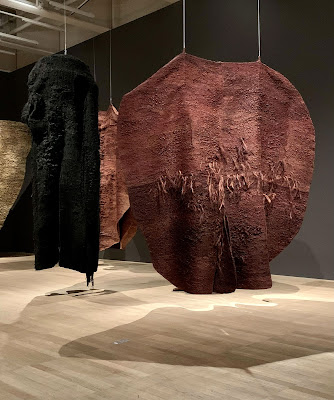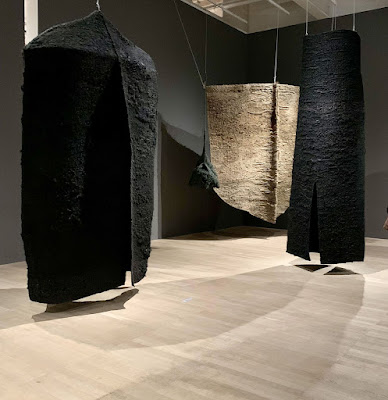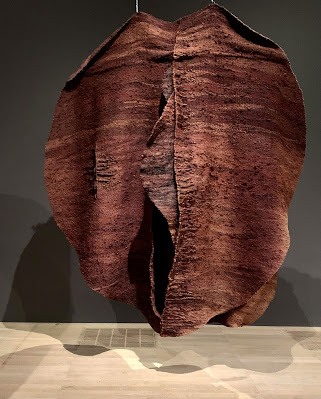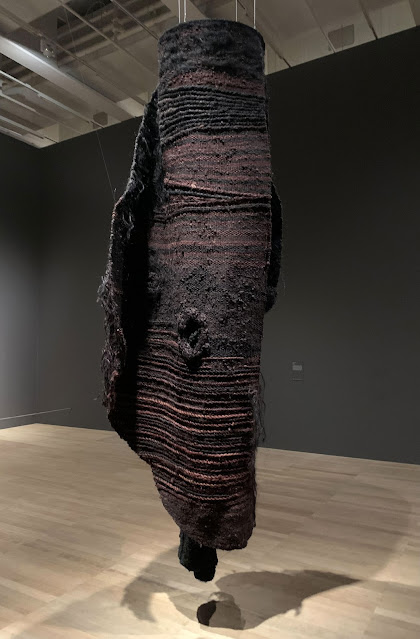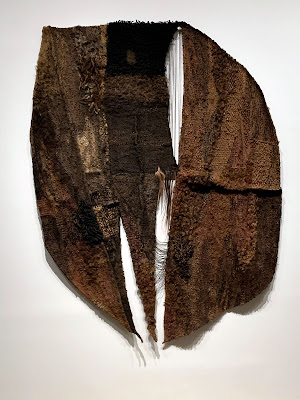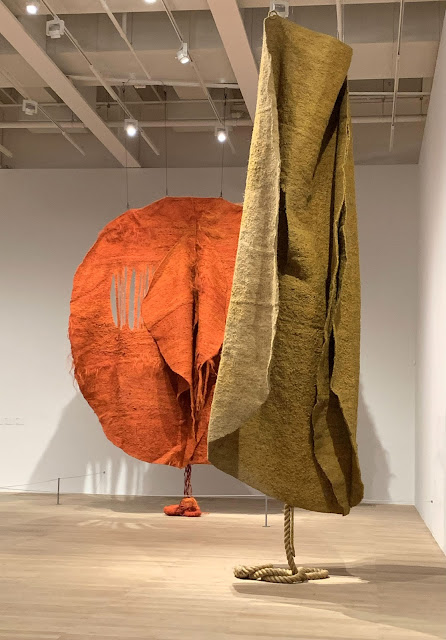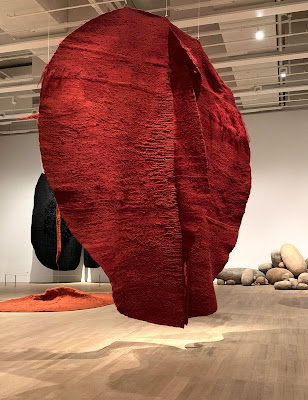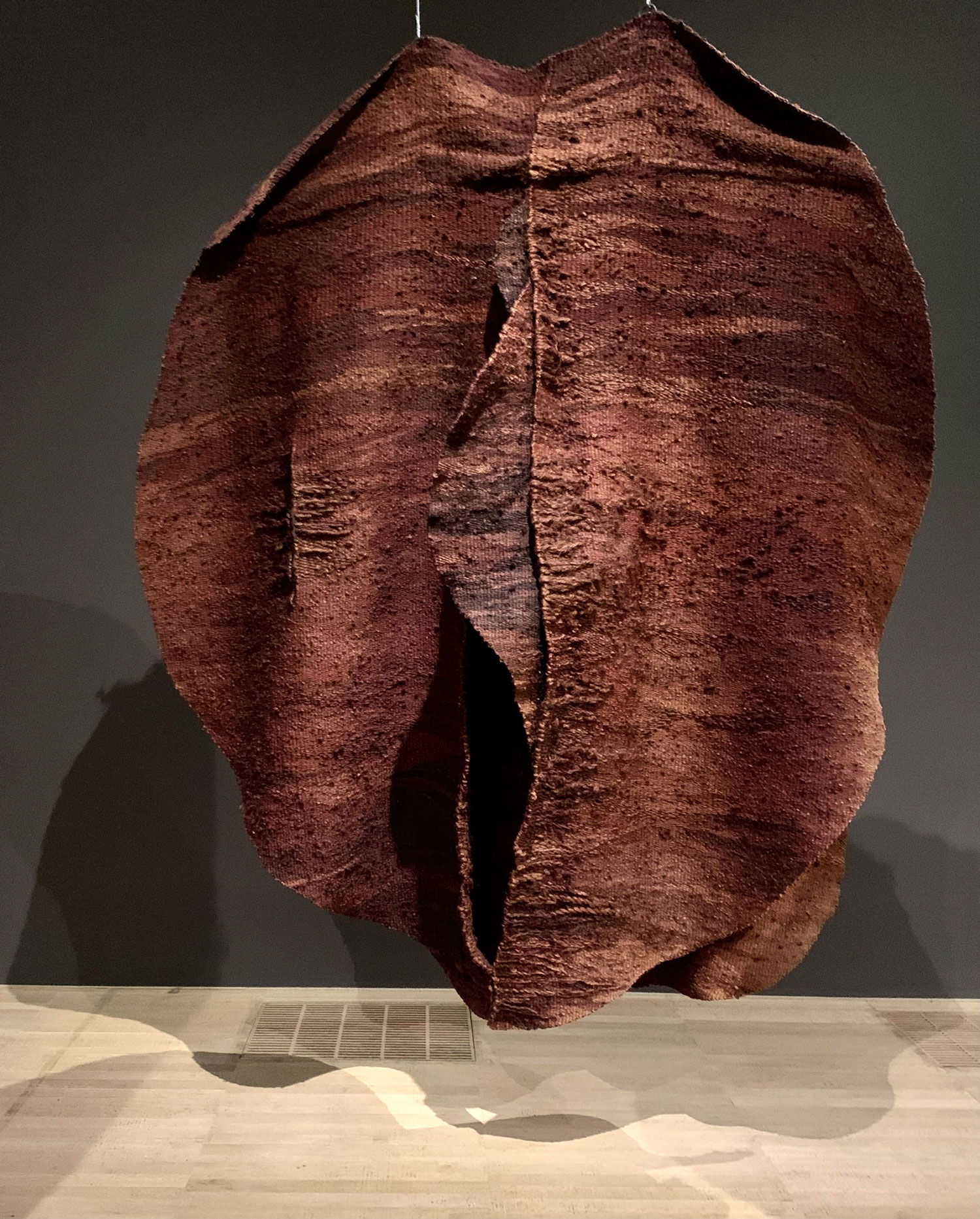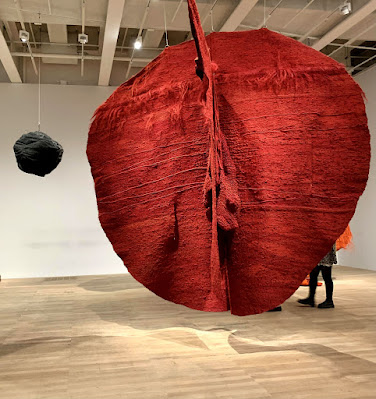
Left: Wool, Silk and Thread 2010, wool blankets, silk threads, nails, woven, 91 inches diameter
Right: Good Morning Midnight, 2010, burlap, dye, twine, nails, woven, 91 inches diameter
Installed together in the Quiet Zone exhibition, World of Threads festival, November 2012.
They are different from each other.
They are the same as each other.
They are opposite colours.
They are both neutrals..
detail of wool, silk and thread
"My work usually holds some element of gesture"
detail of good morning midnight
"I think art should demonstrate the immediate on some level."
Misty Shapes, burlap, dye, thread, glue, 45" diameter
" I am inspired by literature"
Lisa speaks of the clown as an underlying theme for much of her work. She says that clowns are about our own self consciousness. They are both foolish and wise, aggressive and passive.
Ruff, cotton, dirt, thread, 45" diameter
How does the repeated use of the circle in Lisa di Quinzio's textile work connect to her concerns about immediacy, gesture and the dualities personified in clowns?
Pussy Willow, pussy willows, thread, pins 25" diameter
Jung thought of the circle as an archetype of the psyche and the square as an archetype of the body.
Pussy willow detail
Note that Lisa's circles are not set within squares but are pinned directly to the wall. The unprotected and solitary large circles exude a kind of strength.
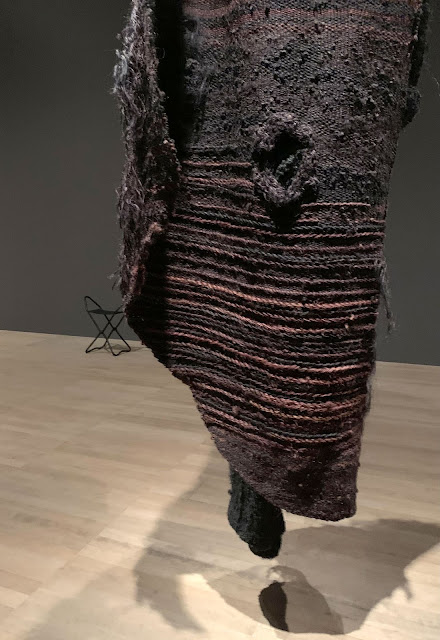
Dummies, 67" h, cotton, foam and wire by Lisa di Quinzio
aggression and passivity
wise and foolish
white and black
frayed
smudged
archetypal form
dualities in life
Spill, jute with metal base, 1985 by Claire Zeisler, (1903 - 1981)
Lisa di Quinzio sites Claire Ziesler (above) as an influence. More images of Zeisler's are here.
All quotes and many of the images in this post are from the World of Threads interview with the artist.
Friday, January 11, 2013
Thursday, August 16, 2012
John Paul Morabito
![]() |
| tonal warp stripe, 2010, linen, ramie, weaving, burning, 96" x 27" see artist's website, john paul morabito |
![]() |
| tonal warp stripe, 2010 |
![]() |
| Plain weave with stripes, 2009, see artist's website |
![]() |
| plain weave with stripes, detail 2009 |
The patterns of dots on the neutrally coloured hand woven grounds are intriguing. On some pieces they seem like a natural kind of dis-colouring, like mold or insect holes. On other pieces, they are measured and precisely placed. But however beautiful they are, these marks are definitely not decoration. There is a depth in this work that hits you in the heart.
"Perhaps left over from when we first realized our mortality, we
have built into us a yearning for all things impermanent. To be
human is not only to create but also to destroy. Called Thanatos,
the death drive draws us to the end. I find myself in some ways
ruled by Thanatos.
There is a need to make and a need to destroy,
neither can be ignored. " John Paul Morabito
![]() |
| strip construction, 2010 silk, rayon, handwoven, burned 33 x 69. image from fibrearts magazine spring 2011 |
But this young man isn't going so far. He creates in order to destroy and stops there. He says: " Humanness lies in the failure. The work then becomes a quiescent space of penance and finally acceptance."
It is compelling to think about this. My body thinks about it.
![]() |
| burned textile, detail of strip construction, 2010 |
![]() |
| Warp Faced Plain Weave, 2009, cotton, linen paper, weaving, burning, 55" x 47" from Fiberart international 2010 catalog |
Drawn by the simple beauty of the marks, I respond emotionally to the
slow, determined method the artist used to create them, one by one. It is then that
the philosophical ideas inherent in those marks work their way into my
head. It's all about human mortality. This work is calm acceptance of that undeniable fact.
![]() |
| After Penelope 2011 |
No. John Paul Morabito abandoned this project. See more images on his website.
"I work in repetition. Finding inspiration in the devotional mindsets of religion and masochism I undertake monumental tasks often impossible to complete. Simple, seemingly useless actions are repeated to the point of absurdity and stopped only when the possibility of going on without end is suggested. The work is concerned with the impossibility of eternity."
Tuesday, March 13, 2012
Anna Torma's transverbal series
Transverbal 3, 2010, hand embroidery on three layers of silk, silk threads, 143 x 130 cm.Anna Torma's densely embroidered wall pieces have been inspiring Canadian textile artists since she moved to Canada from Hungary in 1988. The Transverbal series highlighted in this post have recently returned from their showing at the Rijswijk Textile Biennial at the Museum Rijswijk in the Netherlands.
Transverbal 4, 2010, hand embroidery on three layers of silk, silk theads, 144 x 132 cm. Detail. These pieces seem different than the artist's previous embroideries which juxtaposed her own children's wild and wonderful drawings with traditional stitches and tumultuous colours and shapes. Those marvelous and menacing drawings appear in these pieces more like ghosts. Crowded and connected with lines and circles, they seem to be in the process of becoming something other, as if in transformation.
Transverbal 2, 2010, hand embroidery on three layers of silk, silk threads, 130 x 132 cm.Anna Torma's transverbal series uses line. Lines that cross big spaces, outlines of circles that join to each other and linear abstract imagery. It seems as if the artist has made large doodles - (the works all measure about 5 feet square). Dream-like, confident, masterful these pieces are more than ever on the threshold of inner/outer. They are liminal. Perhaps even sublime.
With this work, Anna Torma enters the magic realm of Paul Klee, Cy Twombly, or Jackson Pollock. The specifics of the drawings are not as important as the general feeling of energy we feel from the whole thing. There is a kind of distraction because the eye cannot settle that carries the viewer into their own world of memory and dream.
Transverbal 1, 2010, hand embroidery on three layers of silk, silk threads. 142 x 128 cm. The wonder that impresses the most in these artworks however, is not just that the swirling lines have been so beautifully and intuitively drawn in a transverbal manner, but that they were then stitched. One stitch at a time, in an out with the needle. In and out, like breathing. The artist used her hands and touched these pieces repetitively for hours and hours and hours. This careful and caring touch to commit a line to soft cloth makes these pieces very powerful. It's as if the line that came straight from her inner self was made true and real with slowness and intent.
Transverbal 5, 2010, hand embroidery on three layers of silk, silk threads. 142 x 128 cm. Anna Torma's embroideries are all over the internet. Googling her name will bring up many blogs and galleries that highlight her work. Here and here and here are just three of those. Her own website may be the best place to start.
All of these images are from the Rijswijk Textile Biennial 2011 catalog published by Museum Rijswijk.
Monday, February 13, 2012
Mark Rothko
No. 12, 1951 57" x 52"Mark Rothko's paintings from the 50's are probably the most obvious artwork to feature in this blog about the modernist aesthetic. Certainly, his work has inspired generations of artists and moved countless art lovers for seventy years. When we think of high modernism, his name is one of the first mentioned.
Around 1940, he took a year long break from painting to continue his intensive self study of philosophy and myth. His paintings at the time were figurative, but his writing of that time shows that he was honing his personal understanding of the colour field work in which he would eventually reign supreme.
No. 8, 1952 81" x 68" He wrote a book which remained in manuscript form for over thirty years. It was never really edited by Rothko himself, but he held onto it through a divorce and second marriage, two children, house moves, and his own phenomenal success, probably thinking that someday he would have enough time to do so. His son, Christopher Rothko, has edited his father's manuscript and writes a lengthy introduction about the difficulties of doing so.
Christopher's respect for his father's legacy is evident. "Rothko had no patience for anything that did not aspire to the highest ideals."
Yellow and Blue, 1955, 102" x 67"In the book, it is amazing to read that Mark Rothko was searching at that time for a way to introduce the tactile sense into his painting. He feels this can be done with the use of light.
And, he wanted to have emotion in his work, identifying the tragic emotions like fear and anger as being the most important, (although artists working today have added a more positive emotion, wonder, to that list). As well, Rothko wanted to mix the subjective with the objective and come to a kind of universality.
These are the ideas of phenomenology, but Rothko never refers to Merleau Ponty, or Gaston Bachelard in his writing. He probably was not aware of them although they were working at the same time. (Merleau Ponty's Phenomenology of Perception was published in 1945, Bachelard's Poetics of Space in 1958.) For me, this makes me understand why Rothko's work has never lost its ability to move viewers to tears. He is able to connect to the immensity within (Bachelard's term) through the body's tactile senses, strong emotion, and a kind of universal intimacy.
It is tough going to find this essence of Rothko in his writing however, because his ideas are often buried in a pile of repetitive complaints. While I am glad that Christopher Rothko did not remove any of his father's words, it would be a service to the art world if someone was able to summarize the great man's book into a simply understood essay.
No. 7, 1953 91" x 55"When Rothko was painting his most famous pieces during the 50's and 60's, he did not say very much, although he was often interviewed. His words from that time have been oft-quoted but they are so mysterious. This book makes those ideas clear.
It's as if Rothko had internalized his ideas so much, he didn't feel it was necessary to spell them out for those of us who were so eager.
Orange and Red on Red, 1957 69" x 67"Rothko quotes or summaries from the book:
"The painter must be likened to the philosopher rather than to the scientist. Philosophers are verbal., they use numerical logic to sort out ethics. But the artist is more concerned with human sensuality." page 22
"Our eyes, our ears, all of our senses, are simply the indications of the existence of a veritable reality that will ultimately resolve itself to our sense of touch." page 25
In the Renaissance, there were three breakthroughs for the visual artist. Linear perspective, oil paints, and chiaroscuro. But sensuality could not be expressed with these. Light was necessary, to produce the quality of emotion. page 35
Untitled, 1955 92" x 69"While writing this book, Rothko was reading Nietzsche who believed that the entire function of art is to produce a way to endure man's insecurity. He was also reading about primitive art, and came to his own conclusion that it was closer to the emotional.
Rothko felt that the Renaissance and all that came after it, was more about the "outer reality" of perspective, light and shadow, while in Gothic times, Egypt, or Africa, art had been more about our 'inner reality'. Rothko wanted to go back to that timeless period, and terms it the artist's reality.
Untitled, 1958 16" x 17"All of these images are from the 2001 Beyeler gallery monograph of Mark Rothko. The text was inspired by The Artist's Reality: Philosphies of Art by Mark Rothko, edited by Christopher Rothko and published in 2004. There is a lot of information about Mark Rothko on the web. Here and here are good starts. Christopher Rothko talks about the book in this video.
Monday, October 24, 2011
Jane Whiteley
quilt for a sleeping person detail, silk and cotton gauze, hand stitched, dyed with indigo and acid dye 1991
the hands know,
the materials too,
quite apart from your imaginings,
less or more than your intentions -
following the pattern that emerges,
the story as it tells.
Jane Whiteley
Sides to the Middle, Fingers to the Bone, silk and cotton gauze quilt, indigo dyed. 2009 stitched with red thread on the 'worn areas' Born in England, Jane Whitely has lived in Freemantle, Australia since 1988.
She works with the stuff of bandages. Hand stitched gauze.
She works with the idea of reparation. Of extending life.
She darns. She mends.
Her quilt, Sides to the Middle, Fingers to the Bone references the English domestic practice of turning the sheets in order to prolong their life and was included in the important 2010 exhibition at the Victoria and Albert museum in London England, Quilts 1700-2010 Hidden Histories, Untold Stories.
Large Red Cross, cotton bedsheet, flannelette and gauze. 1998 She works with the ideas behind the cloth. Under the covers, wrapped up with bandages. The intimacy of cloth. The memories of the body.
She is a poet.
In Art Textiles of the World Australia volume 2, her writing is given nearly the same amount of space as images of her work.
I use cloth because it has a powerful human presence and has the capacity to express humanity, human endeavor, emotion. It is as if cloth takes on the imprint of energy, the memory, of the body through years of use and wear.
down cotton gauze, cotton blanket, canvas, hand and machine stitched, eucalyptus dyed, 2006Her work employs used domestic textiles in a very courageous way. With simplicity.
The human body's mark.
What would usually be thrown away, is made into art by Jane Whitely. Her work asks us to think about what is really important.
Her work is almost sculptural. It suggests the body's absence. It recalls the body's presence.
Her textiles breathe.
Like passing footsteps.
a story unfolding
Leave no shadow, no stone unturned hand pieced silk, acid dye, cotton threads 2006Most of these images are from Art Textiles of the World Australia, Volume two. The Powerhouse museum in Sydney, Australia mounted a solo exhibition of her work in 1999, but there are no images available on their website. The catalog for that exhibit, From Within is unavailable to purchase.
I hope that this blog post brings more attention to this artist's work.
Labels:
art quilts,
Australia,
domestic,
England,
hand stitch,
recycled cloth
Friday, September 30, 2011
Polly Binns
Intimacy and space blend in the immensity of the landscape. The whole is imbued with the memories of my body within the landscape; my step, pace and sight-line.
Serial Shimmers and Shades, 1996 Acrylic paint and thread on linen canvas 185 x 125 cm, collection of Nottingham Castle museumPolly Binns, a member of England's prestigious 62 group, is considered a 'maverick' in the embroidery community. She grew up in a house of artists; her father used grids to size up his modernist design work and her mother painted the surrounding landscape.
Untitled 1982 black cotton with coloured thread, smocking technique. 50 x 45 x 5 cm She started her art career in clay, but soon studied weaving as a way to understand the material essence of cloth. When she eventually began exploring artist's canvas she was influenced by minimalists like Donald Judd and Carl Andre who worked with ordinary materials for their own sake. How did canvas behave when it wasn't stretched, when it wasn't covered with oil paint? She folded, pleated, stitched the cloth to raise the surface. She worked the cloth from both sides.
Sand Surface and Shadows, Winter 1996 1996 artist canvas, acrylic paint, threads, surface treatments. 7 panels 280 x 210 cm
The vertical elongated rectangles in the above piece relate directly to the body and seem to represent humans within the landscape. Polly Binns says about this piece that it is "a memory of the surface from where my feet stood to the far horizon. "
Her work from the mid 90's can be termed "post minimalist", as along with the grid geometry and attention to materials, there is also a kind of poetry. The Poetics of Space by Gaston Bachelard is an influence. He wrote about "two kinds of space, intimacy and world space. When human solitude deepens, these two immensities touch and become identical. "
Although her work has become more poetic, it is never autobiographical. Her work is about observation and about memory of place.
Before Polly Binns does any work in her studio, she walks. She repeats the same walk each time, at low tide, in the Blakeney Channel on the north Norfolk coast of England. No walk - no work. This is a phenomenological approach. Walking immerses her in a direct experience. Mud, sand, water, bird marks, light are observed and felt with all her senses. There is a tension between order and intuition, between rational knowledge and the not quite known.
Inshore Curve 1996 185 x 125 cmPolly Binns had a daughter in 1986. During the first five years of Katy's life, the artist mounted a solo exhibition, joined the craft council and started full time teaching. However, about those years between 1986 and 1991, the artist says that she "closed down" and that her "balance had gone".
She took time off from making art and looked at more art by others, including that of Agnes Martin. Even more important, she took her little girl on long walks in the landscape, and together they observed things closely. All of a sudden, she realized that the land had seeped into her material knowledge and she knew what to do next in her career.
Study 1 1996 27 x 28 cm collection Pamela Johnson "My intention is to pare down the image: to reduce the pictorial elements of my memory landscape:
to focus on my interior vision
to recall and reference the glimpse, the half caught image,
the layered textures of memory." Polly Binns
In 1998, she received a PhD from England's University of Teesside for her new body of work entitled Vision and Process in Textile Art: a Personal Response to a Particular Landscape.
In 2001 she represented Britain at the 10th International Triennial in Lodz Poland.
The images in this post are from Surfacing, a monograph of Polly Binns that accompanied her 2003 exhibition at Bury St Edmunds art gallery. The information is gleaned from Pamela Johnson's excellent essay and the timeline of Polly Binn's career and life that is included in that book. The quotations are from Polly Binns's artist statement from the catalogue for Texture and Memory, an exhibition curated by Pamela Johnson and Peninna Barnett in 1999.
Wednesday, June 15, 2011
Louise Bourgeois
Once I was beset by anxiety.I couldn't tell right from left.
I could have cried out with terror at being lost.
But I pushed the fear away by studying the sky, determining where the moon would come out, where the sun would appear in the morning.
2007 untitledI saw myself in relation to the stars.
Louise Bourgeois 1911 - 2010
2005 untitledAt the age of 40, Louise Bourgeois, wife and mother, exhibited a group of painted abstract wooden figures in a gallery in New York and one of them was purchased by the Museum of Modern Art.
2008 untitledThat she did this was a challenge to the status quo of society in the late 40’s and 50’s. Her work was a challenge to modernism. Even then.
2002 The Woven ChildLouise Bourgeois’ work was looked at with renewed interest by the feminist movement in the early 1970’s. Renowned feminist art critic Lucy R. Lippard wrote: “Rarely has an abstract art been so directly and honestly informed by its maker’s psyche. It can’t be categorised. Can’t be art historicised”.
2006 untitledOver her 70 year career Louise Bourgeois has not had a signature material and has managed to remain ‘contemporary’ for three separate generations. Famously neurotic she has been an undeniable influence on younger women artist. "Art is the guarantee of sanity" was her mantra.
Her early work was made from wood and house paint and her late work was made from cloth and thread. Using these ‘low’ materials, she worked subversively from within the formal modernist language of abstract form. She insisted that her work was always about her own personal memories. She believed that the needle is magical and has a restorative power. “It’s a claim to forgiveness”
2001 RejectionHer most recent work was made from her own and found domestic textiles. The hand sewn fabric figurative pieces are stitched so crudely that they look mended rather than constructed. Placed in vulnerable and intimate positions they connect with the viewer on an emotional level.
2001 untitledIn 2001 she created a series of three eight foot high fabric towers. They relate to her early wooden pieces, slender and vertical, installed alone but are part of a group. One of the towers is stitched from the antique tapestry fabric that references her childhood. Louise Bourgeois has often said that all of her work is an attempt to reconcile with that traumatic childhood. Just before creating these towers she also made portraits of her parents, depicting her father as a small chair and her mother as the now famous Maman, a massive metal spider with eggs in a basket.
The evident stitching adds hands on emotional quality to this lonely narrow structure, and one reads it as an erect old lady standing stiffly alone, an
abstracted portrait of Louise Bourgeois herself, 90 years old in 2001.
2006 untitledThe pieces shown here are new, created in the last years of her long life. They seem purified.
They seem resigned.
2002 untitledUnlike many women of her generation, there are no shortages of web sites that showcase Louise Bourgeois. click here for example. She is collected by nearly every major art gallery world wide. These images are from two books. Louise Bourgeois 2008edited by Frances Morris and Louise Bourgeois The Fabric Works 2010 edited by Germano Celant.
Labels:
France,
hand stitch,
mother artists,
three dimensional,
USA
Subscribe to:
Posts (Atom)