Showing posts with label hand stitch. Show all posts

Tuesday, October 26, 2021

Penny Berens In The Middle Of The World

Whispering Cairns
plant dyes on silk, wool, cotton, linen
 hand stitched  35 x 49 inches 2019

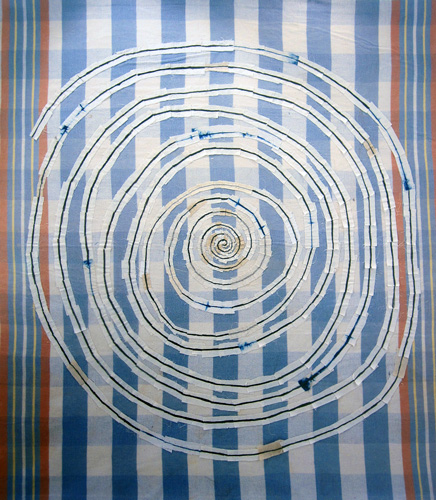
Chasing the Moon
plant dyes on damask, silk, cotton
hand stitched 40 x 50 inches 2020

Penny's artist statement for this new body of work begins with these words:  "For many years now I have taken to heart the words of Peter London in his book ‘Drawing Closer to Nature"

Resting Between Tides
  plant dyes and discharge on silk, wool, cotton, linen
hand stitched  43 x 42.5 inches 2019

“Find a portion of the world that is close at hand and adopt it. Become acquainted with it. Draw closer to it by staying with it over a long course of time. In all seasons, all times of the day, all weathers, all circumstances of your own life. The more often you return to this chosen portion of Nature, the more finely you will be able to perceive its more delicate features, as well the slow-to-emerge pattern and rhythms.”    Peter London

Resting Between Night and Day
plant dyes and discharge on silk, cotton, linen, wool,
hand stitched 2019 43 x 49 inches

Holding Deep Memory
hand stitch and shibori on reclaimed denim dress and old table linen
 44.5 x 39.5 inches 2021

Woodland Berries
plant dyes on silk, wool, cotton 
hand stitched 43 x 42 inches 2019

My process starts with daily wanderings in the wooded coastal landscape of Nova Scotia,  slowly becoming more and more familiar with those seasonal rhythms and changing patterns.  Penny Berens


from left to right 
A Stream Runs Through It, The Edge of the Woods, Woodpeckers Live Here
Plant dyes on cotton, silk, wool, hand stitched.
various sizes, approximately 21 x 15 or 20 inches 2015

When Autumn Leaves Fall 
plant dyes on silk, linen, cotton
hand stitched,  30 x 24 inches 2017


During the warmer months these walks become foraging expeditions for dye stuff with which to colour the fabrics I use. This plant dyed cloth is then hand stitched and embroidered in response to these walks.
Penny Berens

Walking on Stoney Ground
plant dye and rust on linen, cotton, silk, wool
hand stitched 29.9 x 24 inches 2019

Stoney Island Memories 
plant dye on linen, cotton, silk, wool
hand stitched  42.9 x 31.5 inches 2019


Working by hand is a slow and tactile practice spread over long periods of time which deepens and clarifies my understanding of the story the piece wishes to tell.   Penny Berens


Beaver Moon Dreaming
plant dye and discharge on cotton and linen
hand stitched  43.3 x 43.3 inches 2020

I would hope that my process and the final embroideries inspire others to slow down and become inspired by daily observations in their own chosen landscapes. (Penny Berens)

Chasing The Moon
hand stitch on silk, cotton, damask
40 x 50 inches 2020

Dancing In The Wind 
plant dyes on linen, silk velvet, cotton, wool
hand stitched 41.5 x 31 inches  2020

Walking With Dogs
plant dyes on silk, cotton, wool
hand stitched 53 x 12 inches x 2 panels, 2021

Currently on display until December 18, 2021, the venue for this exhibition is a unique heritage building.  The Mississippi Valley Textile Museum used to be a woolen mill, located in the small Ontario town of Almonte and the waterfall that powered the old mill still flows through this town.  Please note that the walls behind many of Penny's wall pieces are original to this mill.   Like most textile art, it is nice to see details.  Please visit oPenny's Tanglewoods Thread blog or instagram to see close ups of Penny's work.  

In The Middle Of The World is a two person exhibition with Judy Martin, guest curated by our dedicated young freelance curator, Miranda Bouchard.    A post about Judy's work in the exhibition is on Judy's Updates, click here

Monday, October 24, 2011

Jane Whiteley

quilt for a sleeping person detail, silk and cotton gauze, hand stitched, dyed with indigo and acid dye 1991

the hands know,
the materials too,
quite apart from your imaginings,
less or more than your intentions -
following the pattern that emerges,
the story as it tells.

Jane Whiteley
Sides to the Middle, Fingers to the Bone, silk and cotton gauze quilt, indigo dyed. 2009 stitched with red thread on the 'worn areas'

Born in England, Jane Whitely has lived in Freemantle, Australia since 1988.

She works with the stuff of bandages. Hand stitched gauze.
She works with the idea of reparation. Of extending life.
She darns. She mends.

Her quilt, Sides to the Middle, Fingers to the Bone references the English domestic practice of turning the sheets in order to prolong their life and was included in the important 2010 exhibition at the Victoria and Albert museum in London England, Quilts 1700-2010 Hidden Histories, Untold Stories. Large Red Cross, cotton bedsheet, flannelette and gauze. 1998

She works with the ideas behind the cloth. Under the covers, wrapped up with bandages. The intimacy of cloth. The memories of the body.

She is a poet.
In Art Textiles of the World Australia volume 2, her writing is given nearly the same amount of space as images of her work.

I use cloth because it has a powerful human presence and has the capacity to express humanity, human endeavor, emotion. It is as if cloth takes on the imprint of energy, the memory, of the body through years of use and wear.
down cotton gauze, cotton blanket, canvas, hand and machine stitched, eucalyptus dyed, 2006

Her work employs used domestic textiles in a very courageous way. With simplicity.
The human body's mark.
What would usually be thrown away, is made into art by Jane Whitely. Her work asks us to think about what is really important.

Her work is almost sculptural. It suggests the body's absence. It recalls the body's presence.
Her textiles breathe.
Like passing footsteps.

a story unfolding
Leave no shadow, no stone unturned hand pieced silk, acid dye, cotton threads 2006

Most of these images are from Art Textiles of the World Australia, Volume two. The Powerhouse museum in Sydney, Australia mounted a solo exhibition of her work in 1999, but there are no images available on their website. The catalog for that exhibit, From Within is unavailable to purchase.

I hope that this blog post brings more attention to this artist's work.

Wednesday, June 15, 2011

Louise Bourgeois

Once I was beset by anxiety.
I couldn't tell right from left.
I could have cried out with terror at being lost.
But I pushed the fear away by studying the sky, determining where the moon would come out, where the sun would appear in the morning.
2007 untitled

I saw myself in relation to the stars.

Louise Bourgeois 1911 - 2010
2005 untitled

At the age of 40, Louise Bourgeois, wife and mother, exhibited a group of painted abstract wooden figures in a gallery in New York and one of them was purchased by the Museum of Modern Art. 2008 untitled
That she did this was a challenge to the status quo of society in the late 40’s and 50’s. Her work was a challenge to modernism. Even then. 2002 The Woven Child
Louise Bourgeois’ work was looked at with renewed interest by the feminist movement in the early 1970’s. Renowned feminist art critic Lucy R. Lippard wrote: “Rarely has an abstract art been so directly and honestly informed by its maker’s psyche. It can’t be categorised. Can’t be art historicised”. 2006 untitled
Over her 70 year career Louise Bourgeois has not had a signature material and has managed to remain ‘contemporary’ for three separate generations. Famously neurotic she has been an undeniable influence on younger women artist. "Art is the guarantee of sanity" was her mantra. Her early work was made from wood and house paint and her late work was made from cloth and thread. Using these ‘low’ materials, she worked subversively from within the formal modernist
language of abstract form. She insisted that her work was always about her own personal memories. She believed that the needle is magical and has a restorative power. “It’s a claim to forgiveness” 2001 Rejection
Her most recent work was made from her own and found domestic textiles. The hand sewn fabric figurative pieces are stitched so crudely that they look mended rather than constructed. Placed in vulnerable and intimate positions they connect with the viewer on an emotional level. 2001 untitled
In 2001 she created a series of three eight foot high fabric towers. They relate to her early wooden pieces, slender and vertical, installed alone but are part of a group. One of the towers is stitched from the antique tapestry fabric that references her childhood. Louise Bourgeois has often said that all of her work is an attempt to reconcile with that traumatic childhood. Just before creating these towers she also made portraits of her parents, depicting her father as a small chair and her mother as the now famous Maman, a massive metal spider with eggs in a basket.

The evident stitching adds hands on emotional quality to this lonely narrow structure, and one reads it as an erect old lady standing stiffly alone, an
abstracted portrait of Louise Bourgeois herself, 90 years old in 2001. 2006 untitled
The pieces shown here are new, created in the last years of her long life. They seem purified. They seem resigned. 2002 untitled
Unlike many women of her generation, there are no shortages of web sites that showcase Louise Bourgeois. click here for example. She is collected by nearly every major art gallery world wide. These images are from two books. Louise Bourgeois 2008edited by Frances Morris and Louise Bourgeois The Fabric Works 2010 edited by Germano Celant.

Sunday, October 24, 2010

Piila Saksela

Working in the Garden 2000 synthetic silk, newspaper, sewing thread, smocking

Piila Saksela lives in Finland. She is 72 years old now, and has been a maker of textile art all her life. She began her career as a weaver, devoting many years to that craft. She thought that she would weave her entire life but around the age of 50 she became unsatisfied with the restrictions of warp and weft and searched for a new way. She felt fearful of the 'catastrophes that might lie ahead" but after years of searching, through trial and error, she developed a unique new style. Orlando steel, rust, knitting 2001

"Bringing one's own studio to life is an arduous task" she says. "It feels as if all originality will flee at any moment."


Her technique involves preparing synthetic silk-like fabrics with oils and lacquers in order to make them translucent. She then layers this prepared fabric on top of tissue paper or newspaper, which then transfer their colours and markings to the fabric. The result is pleated and hand-smocked.


Ninive II 2002 synthetic silk, newspaper, sewing thread, stitching, smocking Ninive II (detail) 2002
I love the colour and the little bits of text and image that I glimpse in Piila's work, but more than that, I am comforted and intrigued by the repetition and texture of Piila's hand stitch and manipulation. Smocking is an age-old technique that crosses many cultures and perhaps this is what gives it such power. ( Piila says that the technique is from Hungarian national dress, but my Canadian mother (half English, half Irish) smocked dresses for me.) Land Ahead 2000 synthetic silk, newspaper, sewing thread, smocking

Piila Saksela has done something rare. She has succeeded in making a domestic technique leap into the fine art world. I found all these images as well as a very small amount of Pilla's statement in Art Textiles of the World Scandinavia published by Telos Art Publishing. Land Ahead (detail)
Matthew Koumis says about Piila Saksela "Her hangings recall a Japanese aesthetic, and convey both her desire to harness light and to express 'fortuity' allowing of happy accidents in the creative process." Circling 2001 wrapped steel, rust, wood
I find it so unfortunate that artists of Piila's generation slip away from our web-based research. If her work was not brought to my attention by the Telos series, I would not have known about it. I could not access any images of this artist's work in the "new museum of cyber space". (which is where students today go first when they look for role models) Part of the reason I am writing this blog is to try to give women textile artists who came of age and did most of their work before the internet revolution some deserved attention.

Tuesday, January 26, 2010

Patti Roberts Pizzuto

Last Days Before Dying, 2007, acrylic, ink,embroidery, hand made paper

Patti Roberts Pizzuto uses an earthy combination of acrylic, embroidery stitches and hand made paper to create poetic works that ponder the big questions about life's meaning. All images in this post are from an article about the artist by Lynn Cornelius Jablonski I found in Fiberarts, April May 2008. Waiting Vessel, 2007, acrylic, collage, beads, embroidery, handmade paper

Her imagery is empty space in combination with one or two common objects such as a bowl, bed or boat and the texture of hand stitching. The recent work shown in this article had either the form of a primitive house shape or a simple rectangle. For me, the house shape is evocative of our personal longing for the simple quietness of childhood, and I would bet that Patti Roberts Pizzuto has read The Poetics of Space by Gaston Bachelard. The artist says that the house image symbolizes comfort family, sense of self and belonging. Finding Home, 2006, acrylic, beeswax, embroidery, handmade paper

The artist worked in the library of an art and design college in Flordia for 25 years, and it was the art books she handled every day that were her inspiration (and I would guess, her education). A recent move to South Dakota in 2005 changed her palette, and fostered an interest in her own family history and the history of mid Western United States. Dance of Chance, 2007, acrylic, ink, collage, beads, handmade paper

Objects that are from our daily lives act like witnesses in her work. They are like things that occur in our dreams, meaningful and with narrative. She rarely depicts figures, but when she does they wear medieval dress.
Each Leaf a Universe, Each Night a Dream, 2007, acrylic, embroidery, collage, handmade paper

Natural items like seeds, flowers and leaves occur. The seeds are symbols of possibility, of birth, renwal and even death. She contemplates the sacred and the mundane at the same time. Existential work. Quiet Compositions.

Patti Robertsw Pizzuto has her own web site - you need Adobe flash to view it, and so I was not able to visit it. Still on dial up here on Manitoulin Island, Canada.

Monday, August 17, 2009

Yoshiko Jinzenji

Star Connection, nylon, natural dyes, 68 x 83 inches

Yoshiko Jinzenji lives and works in Japan and in Bali. Her quilts are simple and to the point. They are spiritual, covered with hand work and attention to detail. They are like prayers. Baby quilts, bamboo dyed silk, hand stitch

She began quilting after she came upon quilts made by Canada's Mennonite people in the 70's and was moved by their resonant, sacred quality. When she attended the Mennonite Relief Sale she realized that the Waterloo area Quiltmakers played a role of global significance. "Women's handwork was making a huge contribution to the welfare of humanity, and that helped inspire my eventual decision to devote my own life to quilting." Ten Thousand piece quilt, Natural dye, cotton, 72 inches square

The energy in the repeated texture of the many seams and the understated colour make Ten Thousand Piece Quilt a minimalist masterpiece. All images in this post are from Quilt Artistry: Inspired Designs from the East, a book published in 2002 about Yoshiko Jinzenji's work. Versification II

Yoshiko calls the method used for the above quilt 'spiral block', a technique similar to the traditional log cabin technique in that the fabrics are stitched around a central square. What's different is the use of innovative materials such as titanic coated nylon and rubber in combination with silk, wool and cotton and the artist's use of piping cord to strengthen and enhance the wide variety of textures.
Dew II, silk, cotton, wool, linen, natural dyes including bamboo, 75 x 77 inches

"What I am striving for is to bring out and add to the essential textures of the cloth" she says. "to create shadows and light, to find a balance between minimalism and a sense of richness."


white repose
hand stitched bamboo dyed silk quilt 85 x 102 inches

Thursday, May 28, 2009

Ase Ljones

Thread Suns, 1999

Ase Ljones is from Norway. She uses hand stitching to make very contemplative surfaces relating to nature. I read about her work in Embroidery magazine Sept-Oct 2008 in an article by Jessica Hemmings.

Wandering Towards the South, 1999, 288 x 255 cm, cut rubber

The things she makes have a material beauty that she is able to combine with an ethical stance. She often uses recycled materials such as old inner tube rubber. Her work shows an extraordinary committment of time that is directly related to labour.
Intention is prioritised over speed.