Showing posts with label installation. Show all posts

Sunday, April 23, 2023

Magdalena Abakanowicz, the Abakans

Black Ball 1975, Sisal, 140 x 110 x 100 cm
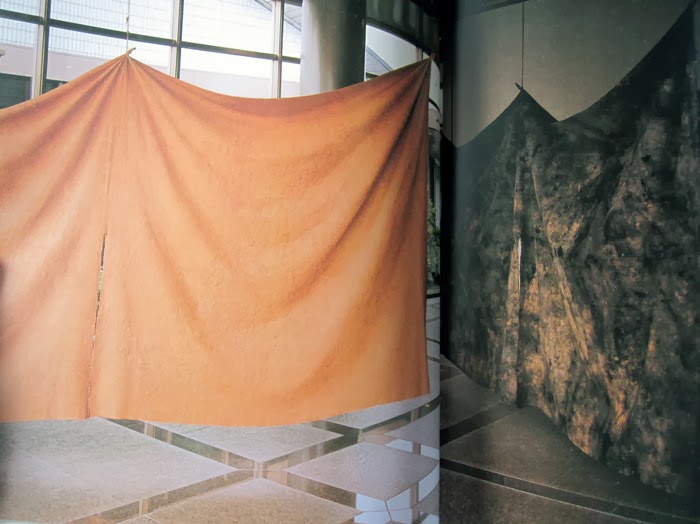
and Abakan Red 1969, Sisal 405 x 382 x 400 cm

Polish artist, Magdalena Abakanowicz (1930-2017), created and displayed monumental woven textile sculptures in site specific environments so that people could move around in as if in a forest of large cloaked figures.   

The sculptures were named Abakans, after the artist's own name.   

Created in the late 1960's and early 70's, they remain hugely influential. They show how soft objects can have great expressive power.  When we move through them, there is a feeling of breath and touch, of fertility and decay, of connection between humanity and all living things, animal or plant.   

in foreground Abakan Festival 1972 Sisal 370 x 100 x 100
and Abakan Brown IV 1969-84 Sisal 290 x 300 x 30 cm 

I see fiber as the basic element constructing the organic world on our planet, as the greatest mystery of our environment.  It is from fiber that all the living organisms are built, the tissue of plants, leaves and ourselves.  

Our nerves, our genetic code, the canals of our veins, our muscles.

We are fibrous structures.  Our heart is surrounded by the coronary plexus, the plexus of most vital threads.

Black Garment VI 1976 Sisal 330 x 220 x 100, Abakan vert 1967-68 sisal 260 x 60 x 30,
Winter 1975 - 80, sisal 320 x 360, and Abakan Festival 1971 370 x 100 x 100

Handling fiber we handle mystery.

What is fabric?  We weave it, sew it.  We shape it into forms.
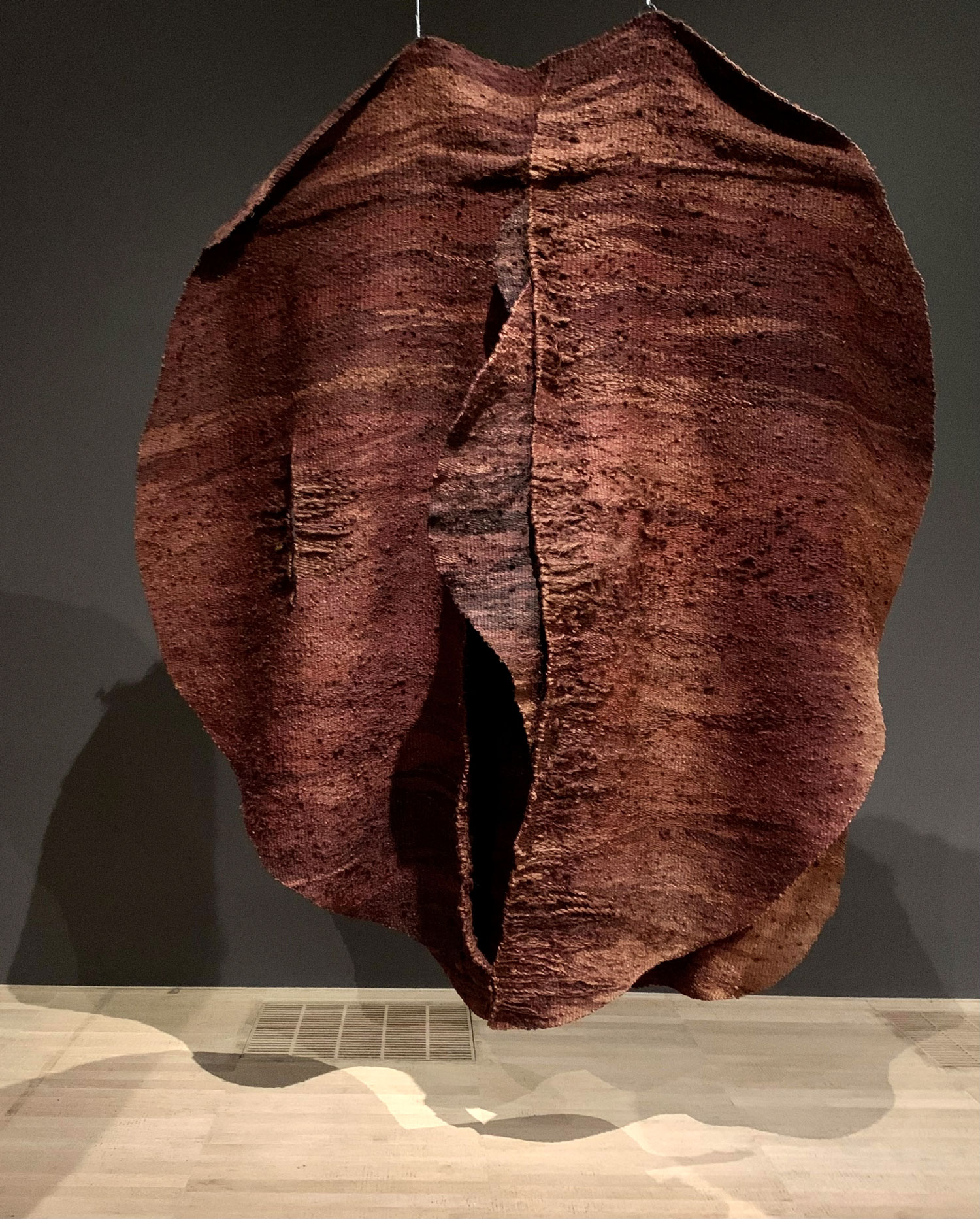
Abakan Brown 1969 Sisal 300 x 300 x 150 cm

When the biology  of our body breaks down, the skin has to be cut so as to give access to the inside.

Later it has to be sewn, like fabric.


Abakan etroit 1967-68 sisal and wool 320 x 100 x 100 cm

Fabric is our covering and our attire.

Made with our hands, it is a record of our souls.


sisal and wool abakan

My works are organic like creations of nature.

And like creations of nature, they will eventually turn into earth.


Assemblage noir 1966  sisal, wool, hemp and horsehair 300 x 220

They are born from the effort of my fingers, wrists and muscles.

Only in this way can I pass on to them my energy and my secrets.

Only in this way can I learn their secrets.


Brown Coat 1968 sisal 300 x 180 x 60 cm

The threads I weave make up homogeneous fabric, the expression of which depends on the tension or the relaxation of my nerves.


Abakan - Situation Variable II 1971  sisal and rope 400 x 250 x 100

Forms result from everyday emotions, like a diary.

They are a product and the record of my time, with its experiences, disappointments, longings and fears.


sisal and rope 1971 detail

My forms change as time goes by like my face.


Abakan Yellow 1970  sisal and rope  380 x 380 x 70

My Abakans are a protest against the weaving conventions.

A need to guide people into a world different from that of a noisy street and a brutal technique.

They are a cry of despair in the face of the ailments of civilization.


Abakan Orange 1968 sisal 360 x 360 cm  and Abakan Yellow 1970  sisal and rope 380 x 380 x 70 cm 

They are, like sweat, a symptom of my existence.


background, abakan orange on floor, abakan january february 1972 behind it, and some of the 800  embryology bundles.  Foreground is Abakan Red 1969  Sisal 405 x 382 x 400 cm

The text in italics is from Magdalena Abakanowicz's presentation at Fiberworks: Symposium on Contemporary Textile Art in Oakland California, May 1978.  The images are from the exhibition Every Tangle of Thread and Rope, curated by Ann Coxon, the Tate Modern, London, England for winter/spring  2022-23.   An excellent video produced by the Tate: click here! 

Monday, March 1, 2021

Lawrence Carroll

Tom
1985-86 oil, canvas, wood, wax, staples
 13" x 10.5" x 6" 

Untitled
 1985 oil,, wax, canvas on wood
18" x 10" 

Penance
1987-88   oil, wax, canvas, staples on wood 
 9" x 9" x 7.6"
I was painting thin pieces of paper with black house paint that I would place on the white canvas.  I used staples because it allowed me to remove the painted lines and shapes if I was not satisfied, altering the composition as needed.
Breathing In
1988 89 oil, wax and paper collage on canvas on wood
  12" x  11" x 10"
Yes, like Matisse at the end of his beautiful life.  This was before I started cutting my paintings apart and using wax and other things.  

I was looking at Donald Judd. I was interested in the way that his wall and floor sculptures would come out of the wall and into the space.

Dependence
1990   oil wax, staples, canvas, wood
33" x 15" x 10"
This physical relationship between the work and the viewer started to influence how I started to think about my painting.

It slowed down the viewer.

Heaven Picasso 
1994-95 oil wax house paint newspaper, canvas on wood
55" x 42" x 3"
You could not see the painting entirely in one view.  

You could not grasp it.

Untitled
2017 oil, wax, staples, canvas on wood
19" x 1/2" x 11"
It added psychology to looking.  It opened up a world to me.

I looked at Carl Andre too - How and where to place the painting and how the placement changes the psychology of an entire room.

I felt I had everything.

installation at museo vincenzo vela in 2017
I thought of the canvas as a skin and wax as an ointment

and that there was a body of memory under the skin where things were buried for years and then for some reason they reappeared.

Lawrence Carroll 
I Have Longed to Move Away  works 1985-2017
edited by Gianna A. Mina
I started to think about cutting a painting completely apart.

And then about the futility of trying to put something that was once whole back together again, exposing all its imperfections. 

There was the revelation.   Painting does not have to be perfect

untitled  2017 
house paint and wax on canvas
19" x 19" 16"

Paintings can be flawed and vulnerable and imperfect and human.

Maybe my paintings are about my broken life.

untitled
2016 - 17  stain, house paint, wood pieces, canvas on wood 
67.7" x 108" x 1.5"
And that I'm trying to piece my life back together.

At certain times in your life, things appear.  Things come.

You look back on your life and examine it.

Last night I thought of different possibilities of what some of my paintings could be about and it shook me.

untitled 
stain, house paint, wood pieces, canvas on wood
118" x 75" x 1.5"
It's impossible for me to always know and understand exactly what I'm doing.

I need time and distance.

The gift that I have been given is to be able to explore these things and to give comfort to myself in knowing that I have a place to express things that some people may bury inside themselves and carry away with them all through their lives.

untitled 
oil, wax, house paint ,staples, canvas on wood
114" x 85" x 4" 
I like the idea that the painting can convey some of life's weight.

We all carry the weight of an imperfect life, some far greater than others.


Lawrence Carroll
I Have Longed To Move Away
Installation in Museo Vincenzo Vela, Switzerland

So what do you expose?  You have to risk.   You can't hide.   Lawrence Carroll  1954 - 2019


All text is from a Lawrence Carroll's interview with Barbara Catoir, entitled "Carry On the Light" .  

It is in the catalogue of the exhibition  I Have Longed to Move Away which was curated by Roberto Borghi for the Museo Vincenzo Vela in Switzerland during the spring of 2017.

Thursday, February 19, 2015

Reiko Sudo and Nuno

A post about the recent exhibition at the Mississippi Valley Textile Museum, Almonte Ontario, Reiko Sudo and Nuno: Textiles from Japan
Curated by Alan C. Elder from the Canadian Museum of Civilization, the exhibition was designed by Reiko Sudo in the wabi sabi - beautiful  Norah Rosamond Hughes Gallery, a re-configured space in what used used to be a working woolen weaving factory .    In the above photo, one of the twenty -two columns is wrapped red polyester fabric, Paper Roll 2002, a chemical lace embroidery designed by Reiko Sudo in 2002.
When Alan C, Elder showed Reiko Sudo images of the gallery, she focused her attention on the columns that line up in the temporary exhibition space and dressed them in her original fabrics.  The white pleated and slashed polyester screen on one of the walls is named Tanabata, and was designed in 2004 by Reiko Sudo and Hiroko Suwa.  (Tanabata is a traditional annual festival.  On the seventh day of the seventh lunar month, girls pray to become good at sewing by decorating bamboo with folded paper charms.
 Scrapyard, 1994 designed by Reiko Sudo and Hiroko Suwa.  Rust dyeing, 100% rayon and iron.
This exhibition was not only serenely beautiful, it was also very informative for those of us interested in surface design.  A dedicated wall of samples served to explain the variety of processes used to create the fabrics was an integral part of the exhibit.   Scrapyard was made by laying damp fabric on a square of rusty iron, shown above.
 Length of time was the variable in how densely the material would be coloured.
The exhibition was in Canada from July 11 - November 22, 2014) and celebrated the 30th anniversary of NUNO, the Tokyo based textile studio, and Reiko Sudo's association with it.
The natural light and the decrepit stone walls of the historic building added to the elegance and mystery of these minimalist yet sensuous fabrics.  Above, Cracked Denim Rounds, 2010 designed by Reiko Sudo and Hiroko Suwa. Burnout and bonding, cotton and polyester.
Denim was originally a French twill called serge de Nimes.
 Flower Almanac , 2006 designed by Reiko Sudo.  Jacquard weave, 100 percent cotton.
A double weave in threads of different hefts and twists.
detail of Skylights, 2012 designed by Reiko Sudo.  Another double weave.  98% cotton, 2% polyurethane.
left: Kamaboko Stripe, 2014  Designed by Reiko Sudo, jacquard weave, 100% cotton, Right: Skylights 2012.
Visitors were invited to touch the samples.
 By handling the cloth and reading the details, we learn.
Congratulations to Michael Rikley-Lancaster, Executive Director and Curator of the Mississippi Valley Textile Museum, and to all of the many who were involved in bringing such an important international exhibition to Almonte.    A catalog of the exhibition is available from the museum, with essays by Alen C. Elder, Naomi Pollock and Yoko Imai accompanying photographs of each cloth.

Friday, February 7, 2014

Chiyoko Tanaka

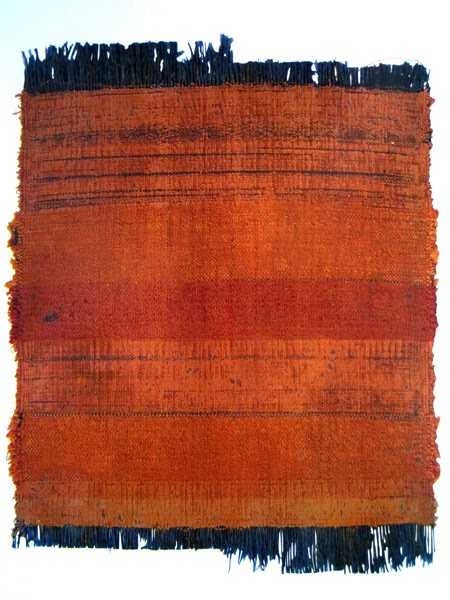
red stripe #262 1988  24 x 18 cm, hand woven ramie, linen, silk, rubbed with brick
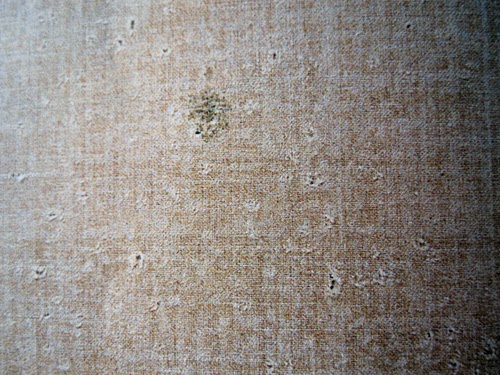
"Many of my pieces, once woven by hand, are laid down outdoors on the ground or on a rock.  I then rub them carefully with a stone or brick.  I want to touch the earth through this process, to trace the texture of the ground".  Chiyoko Tanaka

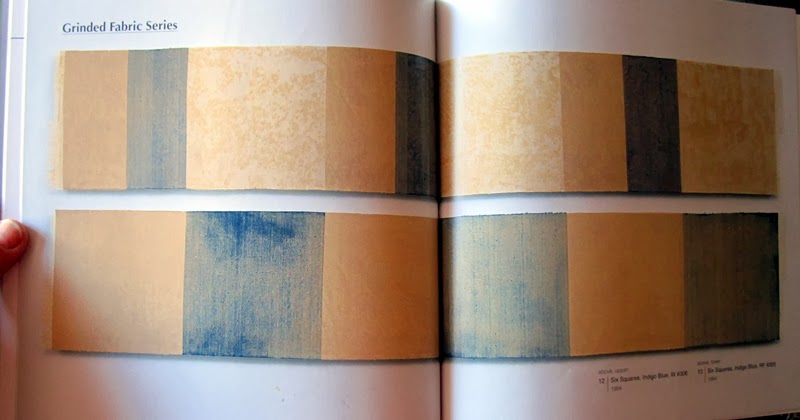
 upper: six squares, indigo blue, W #306 1994  lower: six squares, indigo blue, RF #305 1994
Chiyoko Tanaka, born 1941 Kyoto Japan, is a weaver who thinks about her work philosophically, comparing it to the human condition.   British curator, Lesley Millar's, essay about Tanaka is included in the Telos portfolio about the artist and informs this post.  The images of Tanaka's work are from that portfolio and from Art Textiles of the World Japan also published by Telos.  
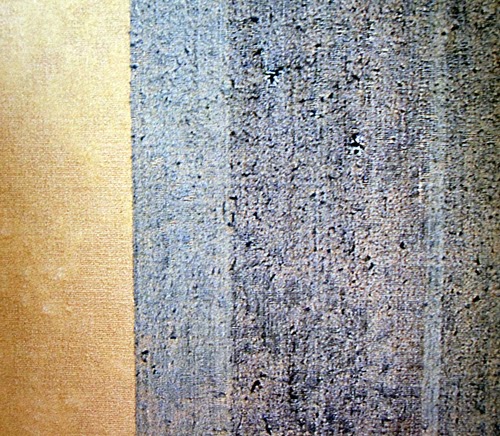
six squares indigo blue W #306 detail
Chiyoko Tanaka uses linen, silk, and ramie threads.  She lays out a long warp which gradually disappears during the weaving process, covered by the weft.

Trace of a Leaf #151 1988

She considers the vertical warp threads to represent time and the horizontal weft threads to represent space.
The crossing points of warp and weft physically disappear from view, but continue to exist as integral to the fabric.  The accumulation of the weft threads represents time passing.  When she weaves, she thinks about the process as one of transformation.
Trace of a Leaf #151 detail

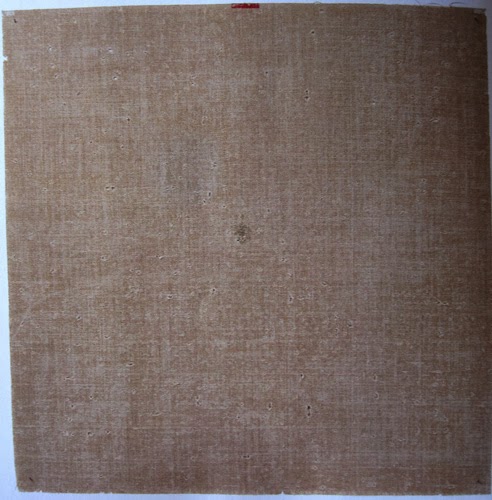
By grinding her newly woven cloth with earth, she exposes that original warp.  She unveils the essence of the fabric. "I feel that my woven work is about time and the human condition."  Chiyoko Tanaka
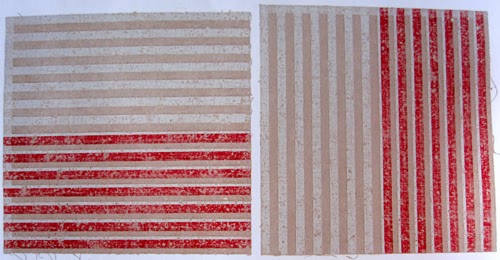
red stripes on white stripes #646 and #647. both 1985
Sometimes, instead of grinding her finished fabrics, she permeates them with mud or oil.  Tanaka distresses her fabrics, as if they were human beings going through a life time of both happy days and days filled with hard ships.
Trace of White Line #641 above, White Line #642 below, both 1985
"I want to see a spirituality behind a piece of my work."  Chiyoko Tanaka
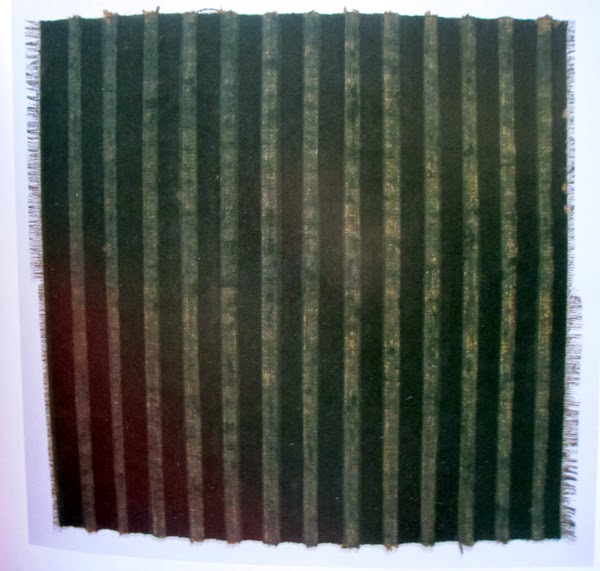
Black Stains on Deep Green Stripes #52 1990
Tanaka uses bricks of clay from different parts of the world.  The brick is rubbed into the back of the fabric until it changes colour and at the same time, the face of the material takes on the patina of the ground.
It's like a performance. 
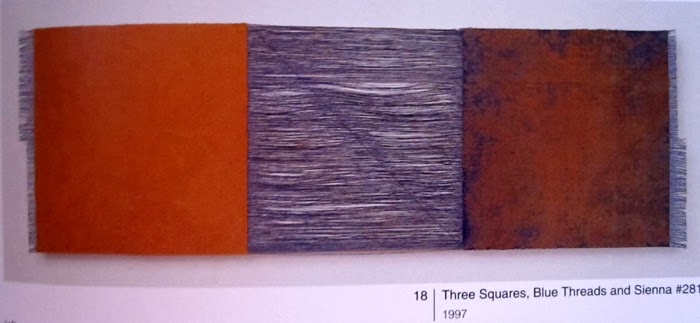
Three Squares, Blue Threads, Sienna #281 1997
The structural integrity of the warp and weft is revealed.   We can see time passing with the erosion of materials, but it is all done in the present moment. 
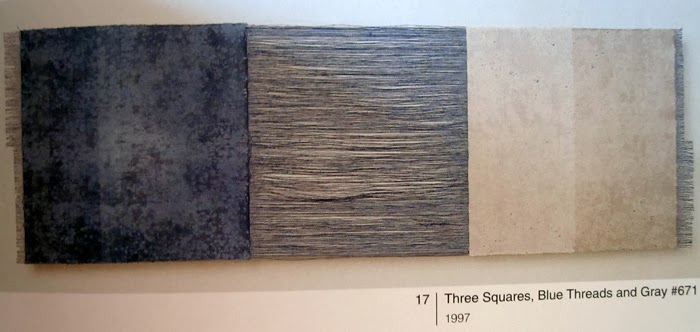
Three Squares, Blue Threads and Gray, #671 1997
Tanaka's work makes us aware of time passing, "neither looking for death, nor denying it, but accepting its place in the cycle of renewal"  Lesley Millar
left: red earthy clay #200 1985, right: permeated black #400 1986
Chiyoko Tanaka has an intimacy with nature.  She lives on the outskirts of Kyoto, close to natural space.  She has an awareness of the tempo of the natural world and this is the basis of her work.
Permeated Black #400  1986
When mud is used as a dye, it is left for a period of time so that it can 'permeate' the cloth.  Time is one of Tanaka's most important materials.
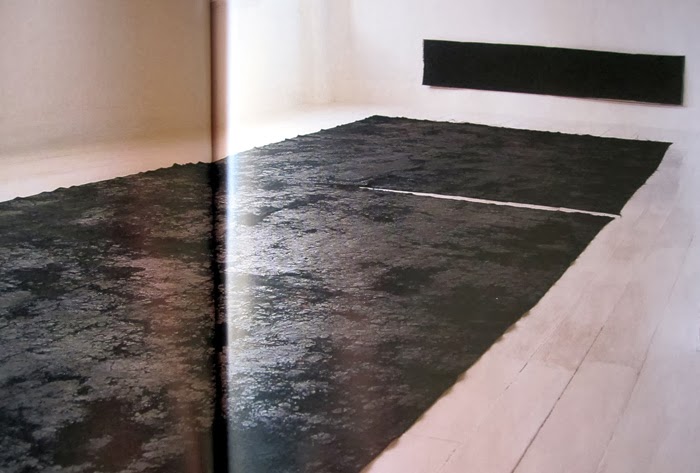
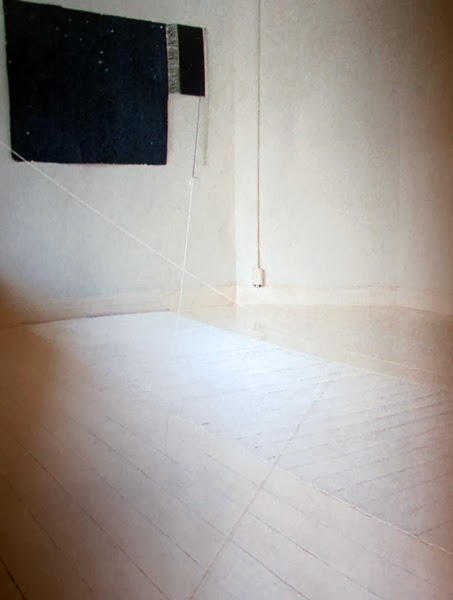
wall:  Blue #100-2 1983,  floor:  White, B #100-1 2983
What are you weaving, Chiyoko?
"I am weaving time"
 white mud cross, red thread #652 1992 19 x 19 cm hand woven ramie
"At the still point of the turning world.
...neither from nor towards.
At the still point, there the dance is."  T S Eliot

Chiyoko Tanaka was profiled in 2003 on Culturebase and again in 2010 by Kate Barber who visited her. 

mud dots on brown stripes #742, hand woven linen, ramie, dyed with mud  2009
She is represented by Brown Grotta  source of the above image.  (the most recent I could find)