Showing posts with label Finland. Show all posts

Thursday, June 16, 2022

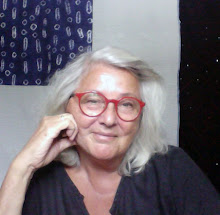
Kirsti Rantanen


Kirsti Rantanen

A strong woman textile artist from Finland.   

She is having a retrospective exhibition this year at the Craft Museum of Finland in Jyvaskyla entitled The Space of Textiles.  It continues until the end of August 2022.

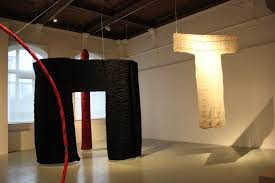
Although she was well known in her native Finland, she is almost unknown in other parts of the world.  The images in this post are from the exhibition of her work that took place at Helsinki's Design Museum of Finland in  2016-2017 that was simply entitled Kirsti Rantanen. 

Thank you to Camille who wrote a blog post about Helsinki's design district in 2017.

The above photo and the one below are from Camille's blog.  


Several circles and zig zags float through the exhibition space and guide us through the space.  

Kirsti Rantanen was born in 1930.

She graduated from the Department of Textile Art at the School of Art and Design in Helsinki in 1952 and during the 50's taught art and design there. 

During this time she also designed Rya rugs and furnishing textiles.

During the 1970's she began to experiment with sculptural textiles and also to advocate for women artists.

After the age of 40, her work became three-dimensional.
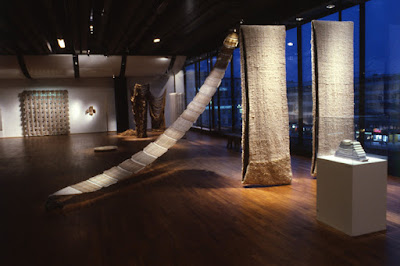
It takes up space.  

We move around it, yearn to touch it.  

The scale is awesome.  

Rantanen's textiles are large and in this way they mimic nature.

trees      mountains     clouds 
 

In 1983, Kirsti Rantanen won an award that allowed her to take time off teaching and be a free lance artist for five years. 
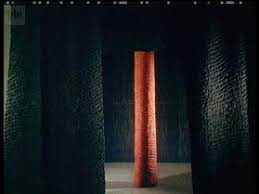
She moved out of Helsinki to the medieval town of Porvoo and began the most fertile period of her career.  She started to use the ancient Sumak method of weaving on a vertical warp that hangs from the ceiling.  To weave large scale on a free vertical warp means that she had to work on a ladder sometimes while weaving.  Yes, she was a strong woman artist.  

Her monumental weavings were made between 1984 and 1993 when she was in her 50’s and early 60’s. 

In 2017, after the exhibition of this body of work at the Design Museum, Kirsti Rantanen donated the collection to the museum.  
Women artists from pre-internet times are being discovered by curators today.  It's exciting.

It is good that the Design Museum is taking care of her work and that her work is being shared with other museums.  
Apologies that I have not been able to find the titles of most of Rantanen's sculptural pieces. I will keep looking.  I will be paying attention to her name.
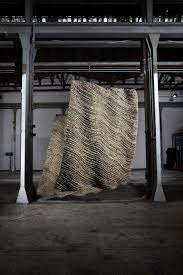
Her name is Kirsti Rantanen.  (1930-2020)
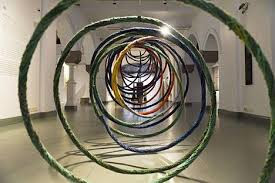
She has a Wikipedia page that you can look up.  She has a daughter who is a respected artist named Silja Rantanen.  

A review of the Design Museum exhibition is available through this link.   The article is written by Satu-Lotta Peltola
   
Kirsti went on to make more sculptural work that involved wire and the spiral as a form.  
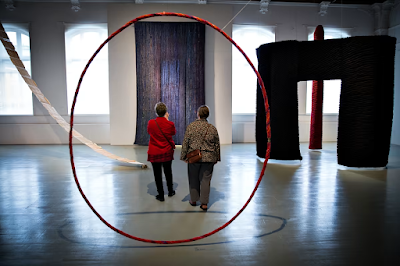
Requiem is the title of the blue piece, Abandoned Stage is the title of the black portal,  all work by Kirsti Rantanen


Friday, November 3, 2017

Britta Marakatt -Labba

This post is an introduction to Britta Marakatt Labba's incredible embroidered wool on linen tapestry about the history of the Sami people in northern Norway, Sweden and Finland.  In Finland, the area that these people live in is called Lapland.
The entire embroidery is 24 metres long and can be read in either direction.
The artist speaks here about each of the panels.  She speaks about the Goddess mythology that is so important to this culture.  You will also find images at the same link for the entire panel.  
The tapestry was shown at Documenta 14 in Kassel Germany in October 2017. 
I humbly write this to encourage readers to go to Beatrijs Sterk's post on the Textile Forum blog.

Tuesday, December 28, 2010

Aino Kajiniemi

Aino Kajaniemi (born 1953) lives with her family in the beautiful central lake district of Finland. It is the house that she grew up in, and her studio is in the cellar. The rhythms of nature and everyday life influence her work. Her images of female protagonists, shown in the midst of thought or caught in interior monologues, are as assured as the line drawings of women made by modernist painter, Henri Matisse.

“The subjects of my work usually originate from the innermost heart of a human being; sorrow, joy, uncertainty, guilt, tenderness, memories, and so forth.” The eyes of her subjects look down, off to the side, or into themselves. This invites the viewer to consider beyond the picture and build a narrative that passes through and between the woman in the tapestry and the interiority of the viewer. Kajaniemi’s subjects are not passive women offering themselves up to be gazed upon, they are intently involved with their inner lives and this self involvement inspires a similar participation within the viewer. Kajaniemi usually produces eight to ten small tapestries that are displayed together in order to give multiple perspectives. She uses the difficult and labour intensive technique of tapestry weaving. She selects which aspects of her narrative will be hidden and which will be revealed. Yarns are interwoven and carefully considered and the process is painstaking. Craftsmanship is important to Aino Kajaniemi. Her line is controlled, yet dramatic, nervous, and spontaneous.

“My textiles are my way of thinking. I appreciate simplicity, but I work things out in a complicated way. " Yet her work has a swift and easy look, as if it was just a sketch. To achieve this casual look, she does many pre-sketches beforehand. She may draw the same idea over and over, ensuring that the composition is interesting and that the subtle glance of the subject is emotional. Eventually she translates the sketch to the loom and uses a single line of black wool to weave her idea into white or natural backgrounds always allowing for changes that may arise.
Her work never loses the feeling that it is just an easy sketch, made quickly when the subject was caught unaware in a reflective moment. The idea of lace or lace-like pattern appears often in her work. These spaces, lines, curves and floral shapes translate a feminine, fragile sensibility and contrast with the pared down, almost tough, tapestry weave. Out of place colours and different weights of yarns are added and disrupt the even warp and weft. We remember that cloth eventually wears out after time because this work seems to hold its own destruction within itself. It appears to be something old that has been mended, and eventually, some time in the future, it will wear away.

“I get all my threads from flea markets now” she said in 2008 which explains the surprising tones and materials that enliven her new work. This up-cycling of used or surplus materials is an ethical decision. Our current material culture is ‘awash in plenty’. Kajaniemi’s pared down imagery and slow intent sings of order within the disorder of our wasteful world. A sense of isolation is palpable in her work, relating perhaps to the loneliness of the beautiful Finnish language, unique in Europe.

“Weaving is finding”

After 30 years she still allows the weaving itself to make unexpected decisions and avoids complete mastery. If, as Rilke proposes, poetry’s purpose is to address the natural growth of a human’s inner life then these weavings are poems.


All images are from the artist's website.
Text is from my 2010 BFA dissertation, "The Immensity Within Ourselves" for Julia Caprara School of Textile Arts.

Sunday, October 24, 2010

Piila Saksela

Working in the Garden 2000 synthetic silk, newspaper, sewing thread, smocking

Piila Saksela lives in Finland. She is 72 years old now, and has been a maker of textile art all her life. She began her career as a weaver, devoting many years to that craft. She thought that she would weave her entire life but around the age of 50 she became unsatisfied with the restrictions of warp and weft and searched for a new way. She felt fearful of the 'catastrophes that might lie ahead" but after years of searching, through trial and error, she developed a unique new style. Orlando steel, rust, knitting 2001

"Bringing one's own studio to life is an arduous task" she says. "It feels as if all originality will flee at any moment."


Her technique involves preparing synthetic silk-like fabrics with oils and lacquers in order to make them translucent. She then layers this prepared fabric on top of tissue paper or newspaper, which then transfer their colours and markings to the fabric. The result is pleated and hand-smocked.


Ninive II 2002 synthetic silk, newspaper, sewing thread, stitching, smocking Ninive II (detail) 2002
I love the colour and the little bits of text and image that I glimpse in Piila's work, but more than that, I am comforted and intrigued by the repetition and texture of Piila's hand stitch and manipulation. Smocking is an age-old technique that crosses many cultures and perhaps this is what gives it such power. ( Piila says that the technique is from Hungarian national dress, but my Canadian mother (half English, half Irish) smocked dresses for me.) Land Ahead 2000 synthetic silk, newspaper, sewing thread, smocking

Piila Saksela has done something rare. She has succeeded in making a domestic technique leap into the fine art world. I found all these images as well as a very small amount of Pilla's statement in Art Textiles of the World Scandinavia published by Telos Art Publishing. Land Ahead (detail)
Matthew Koumis says about Piila Saksela "Her hangings recall a Japanese aesthetic, and convey both her desire to harness light and to express 'fortuity' allowing of happy accidents in the creative process." Circling 2001 wrapped steel, rust, wood
I find it so unfortunate that artists of Piila's generation slip away from our web-based research. If her work was not brought to my attention by the Telos series, I would not have known about it. I could not access any images of this artist's work in the "new museum of cyber space". (which is where students today go first when they look for role models) Part of the reason I am writing this blog is to try to give women textile artists who came of age and did most of their work before the internet revolution some deserved attention.