Showing posts with label mother artists. Show all posts

Thursday, April 30, 2015

Susan Lordi Marker

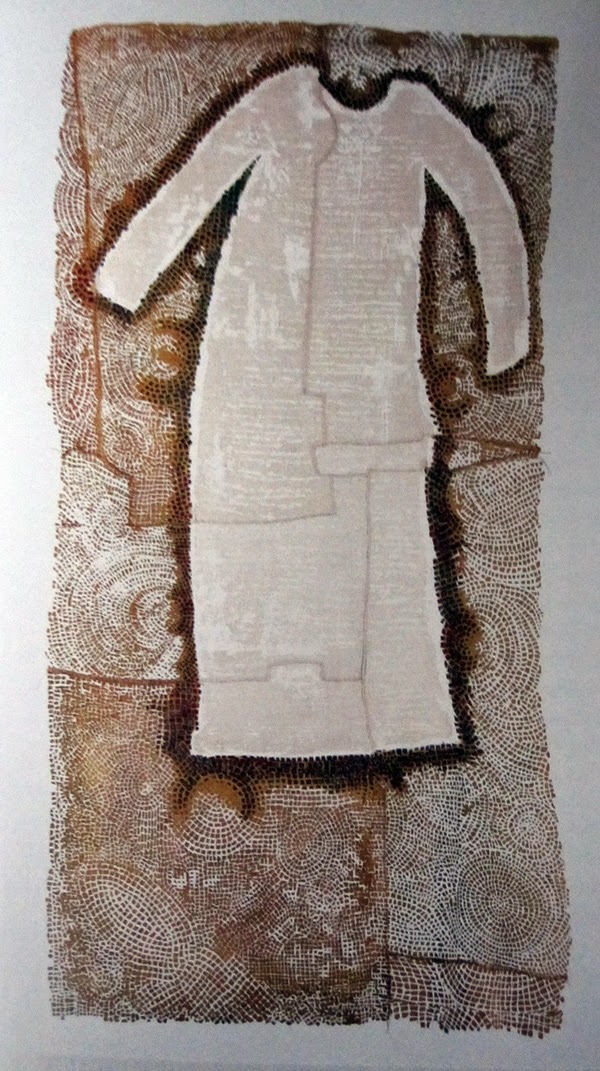
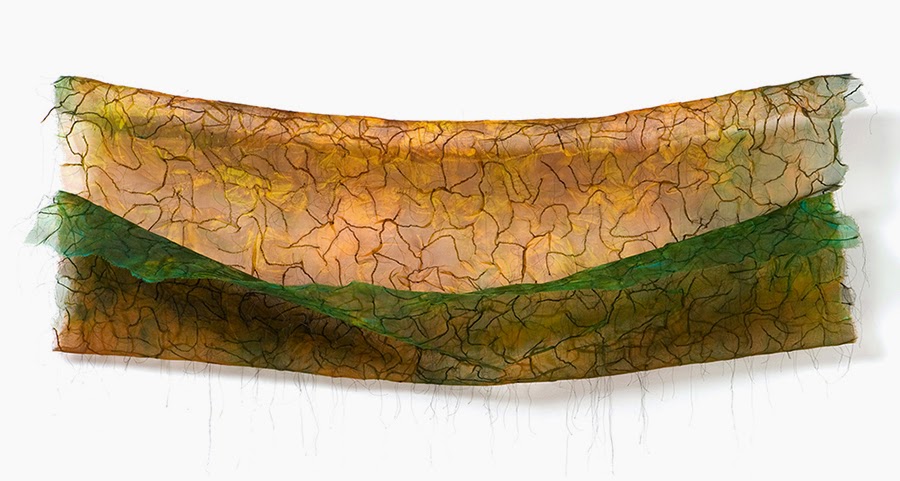
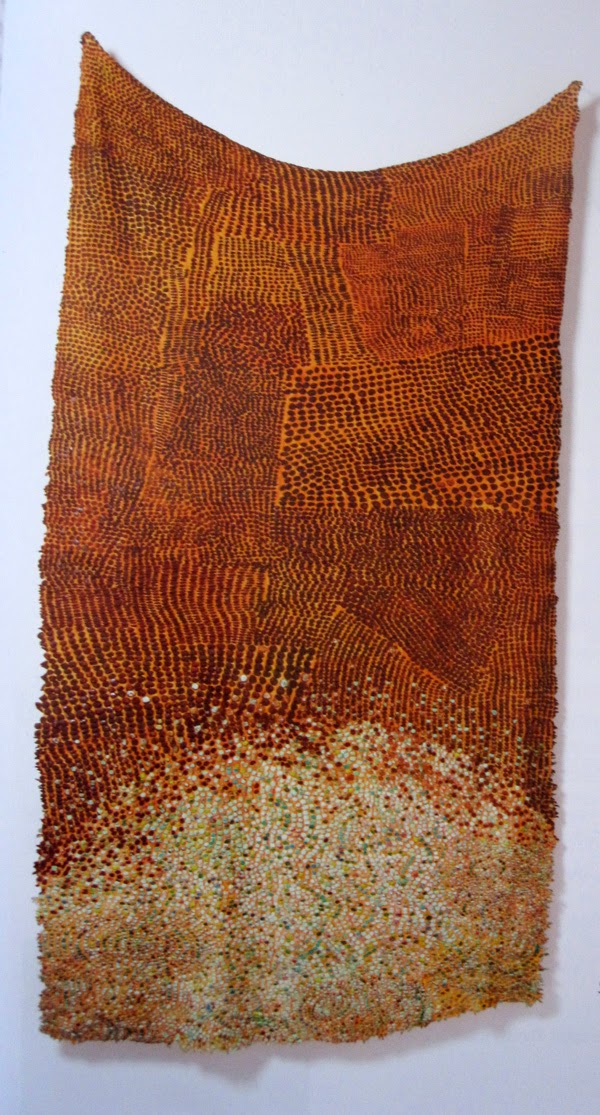
Soulskin: Seeding the Prairie  1999  nylon, iron, copper, pigment 76 x 41 x 3 inches Susan Lordi Marker
When Susan Lordi Marker was a little girl, her mother took her to museums.
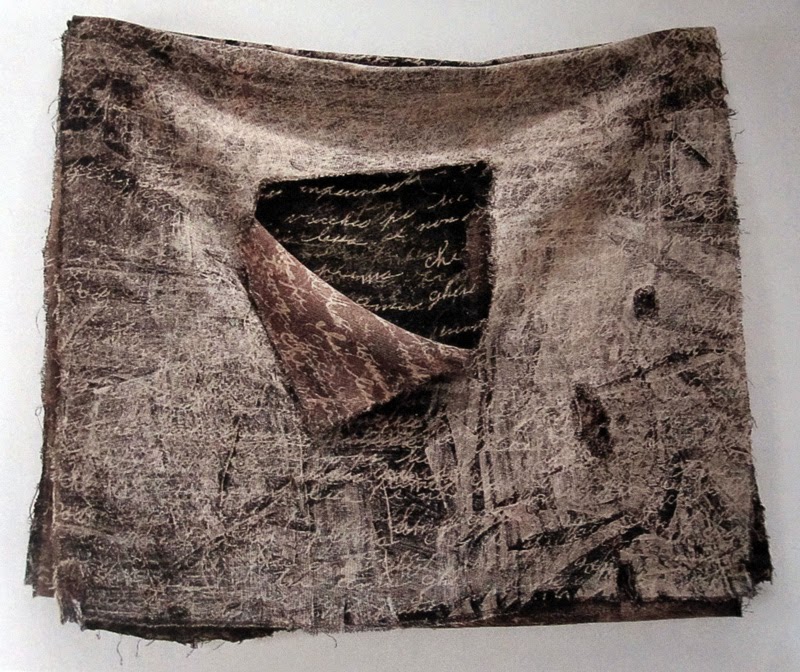
Damiana's Cloth 1991 rayon, silk, thread, 22 x 25 x 3 inches Susan Lordi Marker
She also traveled to Sicily to visit relatives.  She was given vintage garments and other textiles by the older generations she met there.  She heard their stories and the old proverbs.

Damiana is the name of Susan Lordi Marker's great grandmother.  In the piece above, although text is visible among the layers,  we can't read it.  Lordi Marker's use of text is as symbol of experience and knowledge.  It communicates without naming.
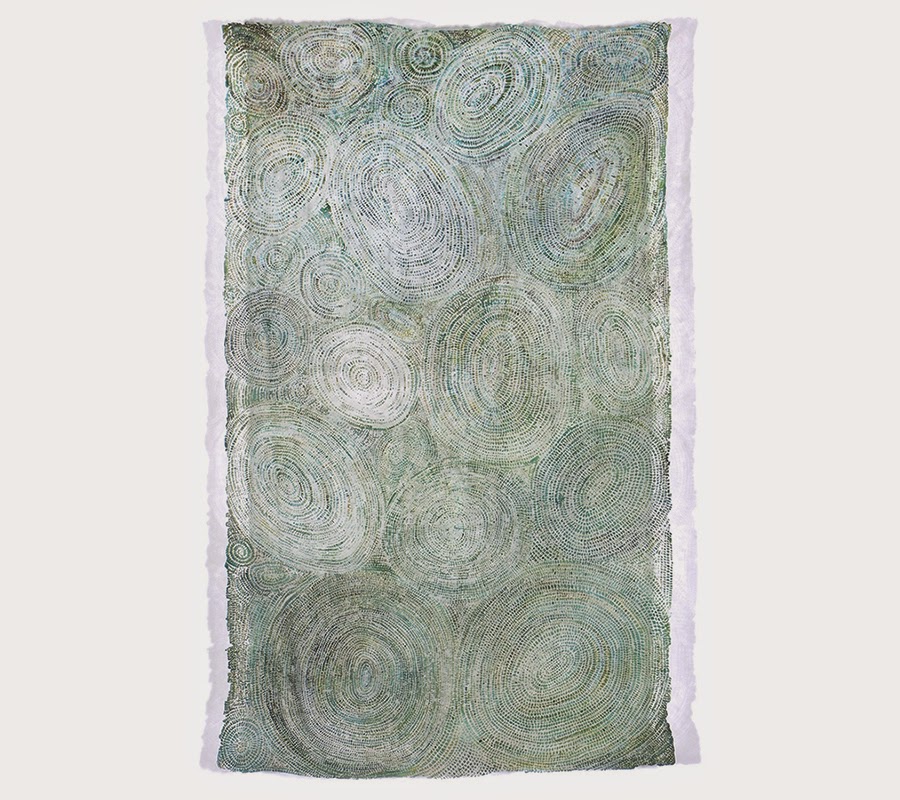
Excavation: Soulskin #11 1997  linen blend, thread, dye, pigment 66 x 34 inches Susan Lordi Marker
She realized later that the tangible objects that she was given were evidence that those people had been alive.   That they were marked by wear made them metaphors for her relatives' life experience.
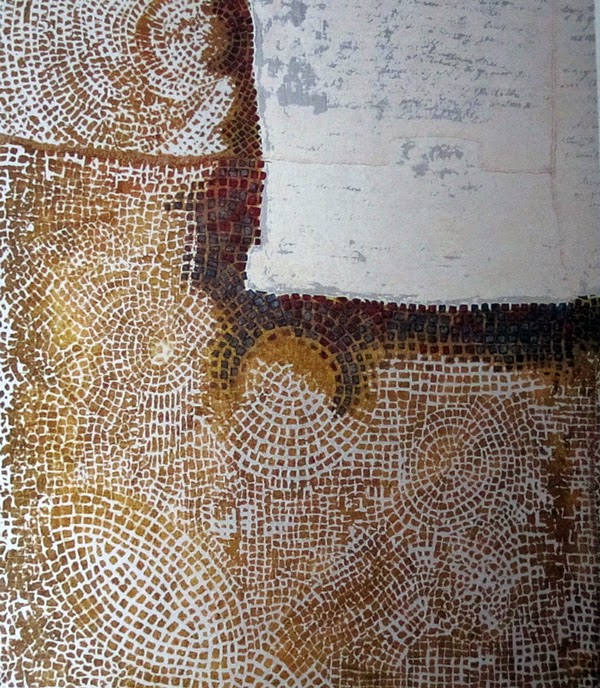
Excavation: Soulskin #11  1997 detail Susan Lordi Marker
In her early work, she experimented with using the actual clothing. Pale shapes of a woman's dress floats on a ground of asymemetrical spirals on a fabric made sheer with burn out.
a remnant: Helionthus  2010  linen blend, gold leaf, thread, dyed  48 x 84 inches  Susan Lordi Marker
Trained as a scientist in her first degree, she went back to school when her children were little and received an MFA degree with honours from the University of Kansas in 1993.
soulskin: cricket  2007  silk, dye, thread  96 x 84 inches Susan Lordi Marker
She then studied with Joy Boutrup at the Kansas City Art Institute and learned ways to layer, fuse, and otherwise manipulate cloth.  She learned about cloque (lye crimping) and devore (chemical burn-out), two methods that make her textile work unique.
the field is sewn 2010  silk, dye, thread  30 x 48 inches  Susan Lordi Marker
little marks
metals
cloth that is hung away from the wall so that it moves
it breathes
it casts a shadow
soulskin: sun, lake, dragonfly  2000  linen blend, dye, pigment, gold leaf, devore  90 x 54 inches Susan Lordi Marker
Susan Lordi Marker noticed that cloth has an ability to survive.  In fact, it became more evocative through the variety of harsh chemical processes she imposed on it.  Stronger in a way.  More unique. To the artist, this makes cloth a metaphor for life itself.

Her work is about the essence of cloth.

"You must pull from within to access the universal"  Susan Lordi Marker
soulskin: sun, lake, dragonfly detail  Susan Lordi Marker
Currently, Susan Lordi Marker is working on a line of gift ware called Willow Tree.  She makes original figures based on her observations of life models.  She speaks here about how her small sculptures are for the giver (who will purchase the piece to express an emotion) than they are about the object itself.  Lordi Marker believes that there is a personal connection for both giver and receiver. Read more about the artist's work with Willow Tree here.
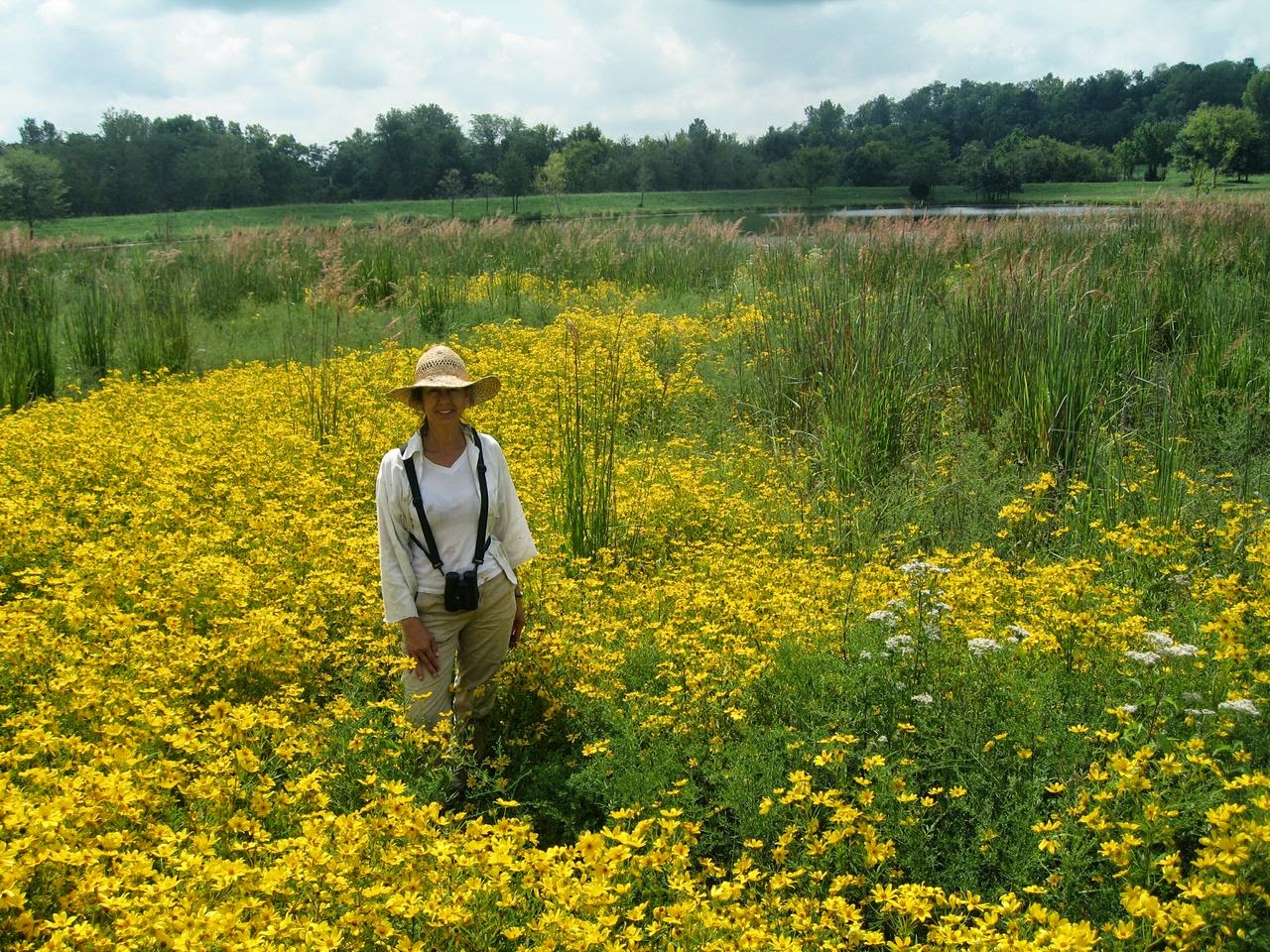
Susan Lordi Marker in her prairie
The artist continues to restore a piece of land in Missouri, re-seeding it with prairie grasses.
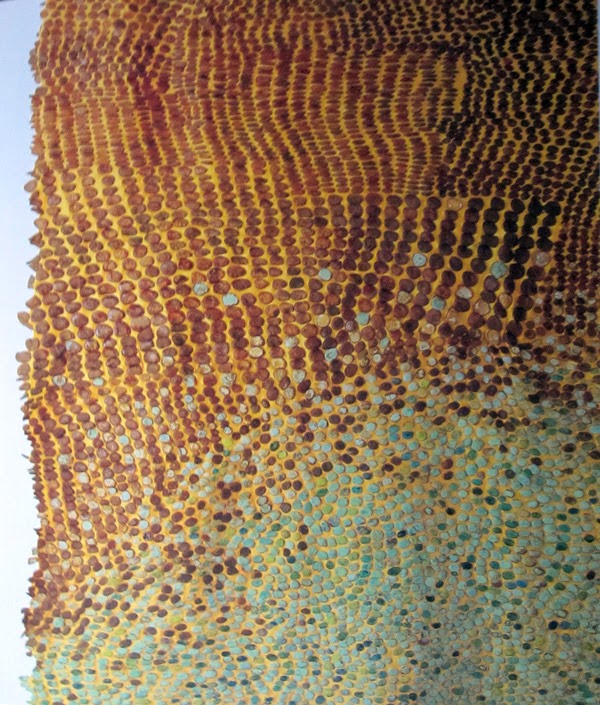
Seeding The Prairie:  Detail  Susan Lordi Marker 
Susan Lordi Marker and her powerful one of a kind cloths have left a mark in the world.
She has been an influence.

The aesthetic of time is in each piece.
The aesthetic of labour.
The work of the work.

These pieces also remind us of the organic rhythm of nature, evoked here with these small dimensional marks.

The images in this post are from the official website for Susan Lordi Marker's fine art textiles and also from the Telos Portfolio on the artist, published in 2003 with an essay by Hildreth York.  Go to the artist's website for more information and detail images.  Thank you and acknowledgements to Ms York for her informative essay.

Tuesday, March 13, 2012

Anna Torma's transverbal series

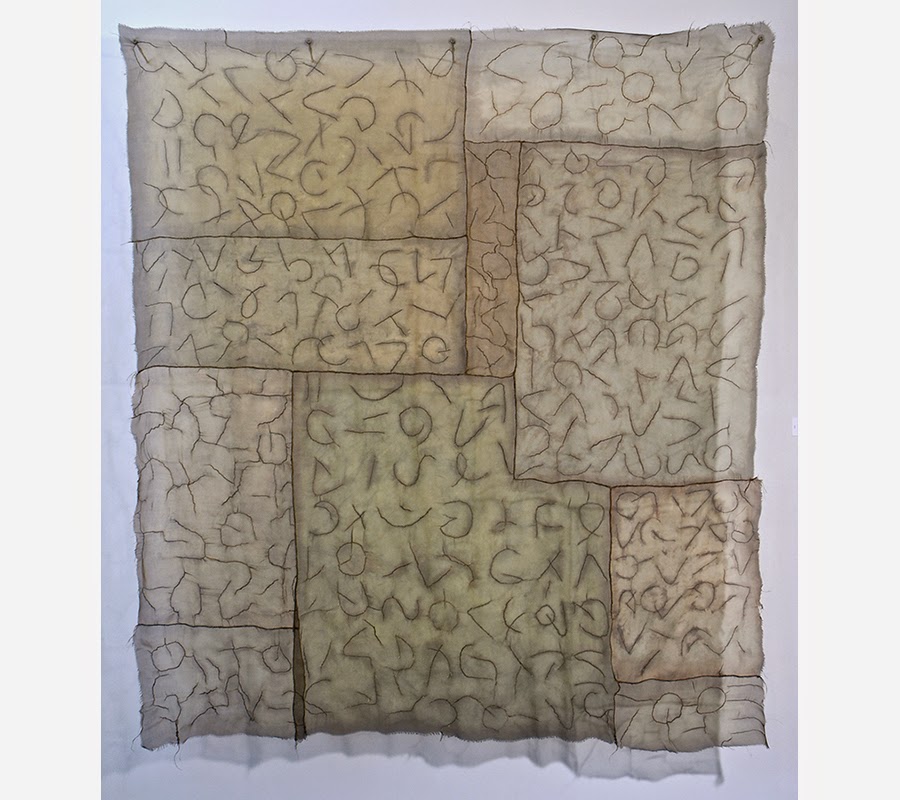
Transverbal 3, 2010, hand embroidery on three layers of silk, silk threads, 143 x 130 cm.

Anna Torma's densely embroidered wall pieces have been inspiring Canadian textile artists since she moved to Canada from Hungary in 1988. The Transverbal series highlighted in this post have recently returned from their showing at the Rijswijk Textile Biennial at the Museum Rijswijk in the Netherlands. Transverbal 4, 2010, hand embroidery on three layers of silk, silk theads, 144 x 132 cm. Detail.

These pieces seem different than the artist's previous embroideries which juxtaposed her own children's wild and wonderful drawings with traditional stitches and tumultuous colours and shapes. Those marvelous and menacing drawings appear in these pieces more like ghosts. Crowded and connected with lines and circles, they seem to be in the process of becoming something other, as if in transformation. Transverbal 2, 2010, hand embroidery on three layers of silk, silk threads, 130 x 132 cm.

Anna Torma's transverbal series uses line. Lines that cross big spaces, outlines of circles that join to each other and linear abstract imagery. It seems as if the artist has made large doodles - (the works all measure about 5 feet square). Dream-like, confident, masterful these pieces are more than ever on the threshold of inner/outer. They are liminal. Perhaps even sublime.

With this work, Anna Torma enters the magic realm of Paul Klee, Cy Twombly, or Jackson Pollock. The specifics of the drawings are not as important as the general feeling of energy we feel from the whole thing. There is a kind of distraction because the eye cannot settle that carries the viewer into their own world of memory and dream. Transverbal 1, 2010, hand embroidery on three layers of silk, silk threads. 142 x 128 cm.

The wonder that impresses the most in these artworks however, is not just that the swirling lines have been so beautifully and intuitively drawn in a transverbal manner, but that they were then stitched. One stitch at a time, in an out with the needle. In and out, like breathing. The artist used her hands and touched these pieces repetitively for hours and hours and hours. This careful and caring touch to commit a line to soft cloth makes these pieces very powerful. It's as if the line that came straight from her inner self was made true and real with slowness and intent. Transverbal 5, 2010, hand embroidery on three layers of silk, silk threads. 142 x 128 cm.

Anna Torma's embroideries are all over the internet. Googling her name will bring up many blogs and galleries that highlight her work. Here and here and here are just three of those. Her own website may be the best place to start.
All of these images are from the Rijswijk Textile Biennial 2011 catalog published by Museum Rijswijk.

Friday, September 30, 2011

Polly Binns

Intimacy and space blend in the immensity of the landscape. The whole is imbued with the memories of my body within the landscape; my step, pace and sight-line. Serial Shimmers and Shades, 1996 Acrylic paint and thread on linen canvas 185 x 125 cm, collection of Nottingham Castle museum
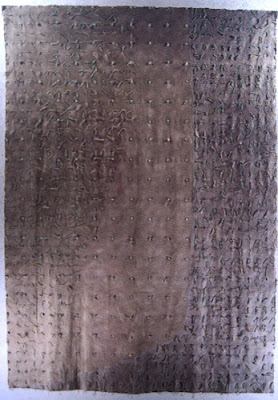
Polly Binns, a member of England's prestigious 62 group, is considered a 'maverick' in the embroidery community. She grew up in a house of artists; her father used grids to size up his modernist design work and her mother painted the surrounding landscape. Untitled 1982 black cotton with coloured thread, smocking technique. 50 x 45 x 5 cm

She started her art career in clay, but soon studied weaving as a way to understand the material essence of cloth. When she eventually began exploring artist's canvas she was influenced by minimalists like Donald Judd and Carl Andre who worked with ordinary materials for their own sake. How did canvas behave when it wasn't stretched, when it wasn't covered with oil paint? She folded, pleated, stitched the cloth to raise the surface. She worked the cloth from both sides. Sand Surface and
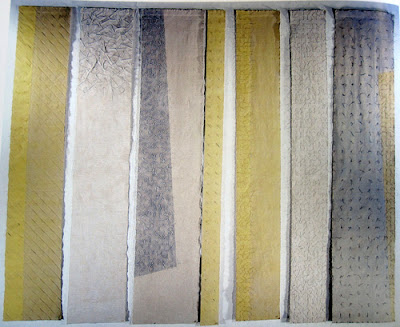
Shadows, Winter 1996
1996 artist canvas, acrylic paint, threads, surface treatments. 7 panels 280 x 210 cm

The vertical elongated rectangles in the above piece relate directly to the body and seem to represent humans within the landscape. Polly Binns says about this piece that it is "a memory of the surface from where my feet stood to the far horizon. "
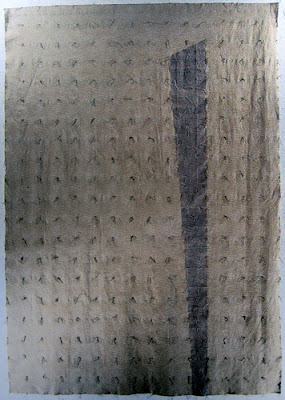
Her work from the mid 90's can be termed "post minimalist", as along with the grid geometry and attention to materials, there is also a kind of poetry.
The Poetics of Space by Gaston Bachelard is an influence. He wrote about "two kinds of space, intimacy and world space. When human solitude deepens, these two immensities touch and become identical. "
Although her work has become more poetic, it is never autobiographical. Her work is about observation and about memory of place. Before Polly Binns does any work in her studio, she walks. She repeats the same walk each time, at low tide, in the Blakeney Channel on the north Norfolk coast of England. No walk - no work.
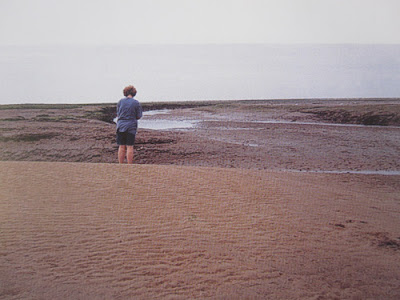
This is a phenomenological approach. Walking immerses her in a direct experience. Mud, sand, water, bird marks, light are observed and felt with all her senses. There is a tension between order and intuition, between rational knowledge and the not quite known. Inshore Curve 1996 185 x 125 cm
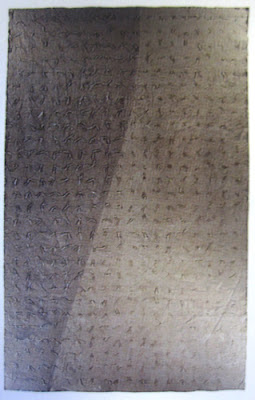
Polly Binns had a daughter in 1986. During the first five years of Katy's life, the artist mounted a solo exhibition, joined the craft council and started full time teaching. However, about those years between 1986 and 1991, the artist says that she "closed down" and that her "balance had gone".

She took time off from making art and looked at more art by others, including that of Agnes Martin. Even more important, she took her little girl on long walks in the landscape, and together they observed things closely. All of a sudden, she realized that the land had seeped into her material knowledge and she knew what to do next in her career. Study 1 1996 27 x 28 cm collection Pamela Johnson
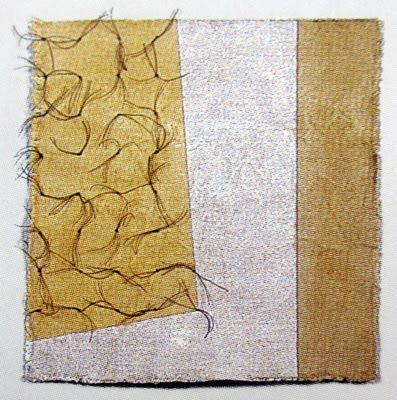
"My intention is to pare down the image: to reduce the pictorial elements of my memory landscape:
to focus on my interior vision
to recall and reference the glimpse, the half caught image,
the layered textures of memory." Polly Binns

In 1998, she received a PhD from England's University of Teesside for her new body of work entitled Vision and Process in Textile Art: a Personal Response to a Particular Landscape.
In 2001 she represented Britain at the 10th International Triennial in Lodz Poland.

The images in this post are from Surfacing, a monograph of Polly Binns that accompanied her 2003 exhibition at Bury St Edmunds art gallery. The information is gleaned from Pamela Johnson's excellent essay and the timeline of Polly Binn's career and life that is included in that book. The quotations are from Polly Binns's artist statement from the catalogue for Texture and Memory, an exhibition curated by Pamela Johnson and Peninna Barnett in 1999.
Wednesday, June 15, 2011

Louise Bourgeois

Once I was beset by anxiety.
I couldn't tell right from left.
I could have cried out with terror at being lost.
But I pushed the fear away by studying the sky, determining where the moon would come out, where the sun would appear in the morning.
2007 untitled

I saw myself in relation to the stars.

Louise Bourgeois 1911 - 2010
2005 untitled

At the age of 40, Louise Bourgeois, wife and mother, exhibited a group of painted abstract wooden figures in a gallery in New York and one of them was purchased by the Museum of Modern Art. 2008 untitled
That she did this was a challenge to the status quo of society in the late 40’s and 50’s. Her work was a challenge to modernism. Even then. 2002 The Woven Child
Louise Bourgeois’ work was looked at with renewed interest by the feminist movement in the early 1970’s. Renowned feminist art critic Lucy R. Lippard wrote: “Rarely has an abstract art been so directly and honestly informed by its maker’s psyche. It can’t be categorised. Can’t be art historicised”. 2006 untitled
Over her 70 year career Louise Bourgeois has not had a signature material and has managed to remain ‘contemporary’ for three separate generations. Famously neurotic she has been an undeniable influence on younger women artist. "Art is the guarantee of sanity" was her mantra. Her early work was made from wood and house paint and her late work was made from cloth and thread. Using these ‘low’ materials, she worked subversively from within the formal modernist
language of abstract form. She insisted that her work was always about her own personal memories. She believed that the needle is magical and has a restorative power. “It’s a claim to forgiveness” 2001 Rejection
Her most recent work was made from her own and found domestic textiles. The hand sewn fabric figurative pieces are stitched so crudely that they look mended rather than constructed. Placed in vulnerable and intimate positions they connect with the viewer on an emotional level. 2001 untitled
In 2001 she created a series of three eight foot high fabric towers. They relate to her early wooden pieces, slender and vertical, installed alone but are part of a group. One of the towers is stitched from the antique tapestry fabric that references her childhood. Louise Bourgeois has often said that all of her work is an attempt to reconcile with that traumatic childhood. Just before creating these towers she also made portraits of her parents, depicting her father as a small chair and her mother as the now famous Maman, a massive metal spider with eggs in a basket.

The evident stitching adds hands on emotional quality to this lonely narrow structure, and one reads it as an erect old lady standing stiffly alone, an
abstracted portrait of Louise Bourgeois herself, 90 years old in 2001. 2006 untitled
The pieces shown here are new, created in the last years of her long life. They seem purified. They seem resigned. 2002 untitled
Unlike many women of her generation, there are no shortages of web sites that showcase Louise Bourgeois. click here for example. She is collected by nearly every major art gallery world wide. These images are from two books. Louise Bourgeois 2008edited by Frances Morris and Louise Bourgeois The Fabric Works 2010 edited by Germano Celant.

Monday, January 4, 2010

Francoise Sullivan

Paterson 2003, diptych, acrylic on canvas 348 x 287 cm.

Francoise Sullivan is a role model for women artists. She is a mother of four and she is 85, and through sixty years she has maintained an artistic career. "For me, art is like breathing" she says.

The images and information posted here have been taken from Robert Enright's interview with Francoise Sullivan in issue no. 106 of Border Crossings Magazine. (June 2008) Enright's interviews are generally intelligent discussions although in this particular interview he seemed more interested in Sullivan's early friendships with groundbreaking painters like Jean Paul Riopelle, Paul Emile Borduas and the writing of the Refus Global in 1948 than he does in her recent oil paintings.

The above painting entitled Paterson is an homage to her late husband (and fabulous painter) Paterson Ewen. "Paterson got the biggest painting. He was the most important man in my life. I have four sons who look and walk like him. I am always reminded of him." Vert no 1 2007 oil on canvas 193 x 122 cm

Enright: "You were young but obviously learning at a galloping pace. To be involved with that kind of intellectual movement at such a young age - you were only 18 - seems rather extraordinary."
Sullivan: "Well, you know revolutions are always done by young people. This is when you have the enthusiasm, the energy and the folly."
Enright: "Did you know at the time that what you were involved in was going to transform Quebec society?"
Sullivan: "We felt like apostles. We knew we were doing something exciting and we felt like we were in the avant-garde but we were never recognized." Quand je ferme les yeux je vois no. 2 2007 oil on canvas

She has been a dancer and a sculptor but says with 'conviction and without apology that painting inhabits her, it always has'.
Enright: Has painting supplanted dance as your most passionate form of self-expression?
Sullivan: Yes, but it was always there. Everything referred to painting. My dance thoughts were painting thoughts. You might think I'm old-fashioned but for me painting has remained the major art.
In the 70's "the theoreticians upset me when they said that art was over, that painting was dead and that even museums were dead". La Tache Bleue 2007 101 x 76 cm oil on canvas

"As I go along my involvement with painting is growing. Some paintings happen in the first casting and others take a long time to work out. You have to go over and over them and that's why sometimes things happen, or colours show through. I don't think of my paintings a s monochromes because for me a monochrome is something that is completely blank. Even though they might look like a monochrome, I feel that they're alive. I feel that there's life boiling in them."

Animals don't do art like we do. The do something else. A spider web or a nest is not a work of art in the human sense. It is a physical necessity. This is more of a spiritual necessity." Danse dans la neige, photograph by Maurice Perron 1948

Images of Francoise Sullivan dancing in the snow near ont St Hilaire Quebec are famous examples of early performance art. She was filmed by Jean Paul Riopelle while Maurice Perron took still photographs. Unfortunately the film has been lost, but the photographs remain.

In 2009 Francoise Sullivan was awarded the Gershon Iskowitz prize. In 2001 she was made a member of the order of Canada and I believe that she still teaches in the fine art department at Concordia University in Montreal.