Showing posts with label acrylic painting. Show all posts

Saturday, March 23, 2024

Ann Clarke: a life in motion

Untitled (Vertical Stripes) acrylic on canvas, 1974 by  Ann Clarke

Ann Clarke was born in England and attended the Slade School of Art in London UK.  She graduated in 1966 and was awarded the prestigious Slade Painting Prize.  In December 1966, her work was included in the exhibition Five Young Artists at the Institute of Contemporary Arts, London, England.

In 1968, Ann Clarke moved to Edmonton, Alberta Canada with her then husband and two young boys. 

In 1973 she had a solo exhibition 'Ann Clarke' at the Edmonton Art Gallery.  Her studio for a period of time was in the municipal airport hanger.

glimpsed in the waves, acrylic on canvas, 1978, Ann Clarke

During the 70's and 80's, Clarke began to teach painting in various colleges and universities across Canada.  In 1975-76, she taught at NSCAD  (Nova Scotia College of Art and Design), and in 1979 - 80, she taught at Red Deer College in Alberta.   

She had several solo shows in Alberta during this period.  In 1980 she had a solo exhibition in Gallery One in Toronto.  
Inclement, Acrylic and Oil Stick on Canvas. 1980 by Ann Clarke


 Ann Clarke's painting, Inclement, was curated into a tribute exhibition for the Canadian painter, Jack Bush, by Ken Carpenter.  It took place in 1981 at the Robert McLaughlin Gallery in Oshawa, Ontario.  

Clarke moved to Toronto in 1984.

Fantasy, Acrylic on Canvas, 1985, by Ann Clarke

detail of Fantasy, 1985, by Ann Clarke


Then in 1987, Clarke moved to Tamworth, north of Kingston.  

Leaping Deer Acrylic on Canvas, 1988 by Ann Clarke

Inspired by a dream, Leaping Deer is a self portrait. 

Leaping Deer, detail

In 1988 - 89, Dorothy Farr curated a solo exhibition at the Agnes Etherington Art Gallery in Kingston that included Leaping Deer.     Ann Clarke:  Recent Work

In 1992, Ann Clarke was invited to teach in the department of Visual Arts at Lakehead University, Thunder Bay, Ontario.  She was elected to the Royal Canadian Academy of Art in 2008, and retired from teaching in 2009.  

Time, acrylic on canvas, 2000, by Ann Clarke

TIME, (above) was included in her 2000 solo exhibition, Sexta Feira, at Gallery One in Toronto. 

Ann Clarke has a website that includes recent work and also archives of her long career in painting.  Twelve artist statements reflect her commitment to continual change and growth.  Visit her website with this link.   Her work is represented by the Hatch Gallery  in Prince Edward County, Ontario, Canada.  

All images in this post are from the 6-decade retrospective Ann Clarke: A Life In Motion  currently on display in Kingston at the Agnes Etherington.  The exhibit was curated by Alicia Boutilier and Mark Birksted.  The text is taken from the wall signage.  Congratulations Ann Clarke!!!  

Friday, March 15, 2024

Vija Celmins

 My work is not meticulous, it is rigorous.  

It's like living another life.  As if you have a time here, with the work, and then you have a world in which you are living your other time.

Why do it?  The older I get, the more mysterious that seems.  

It's some kind of impulse inside you, and when you are working well there is a feeling of connectedness to the world, and occasional feelings of bliss.

It occurred to me that when I am really working well, the work has no meaning  You can work with less mind.  You see with your mind, not your eyes, because eyes are just the lenses.  But you only see what you already know, so maybe this is why I focus on something outside of me, that I don't really know  You might say it's copying , but it's re-imagining this thing in another medium.  

I thought I could fool my clever mind because it limited me.  I thought I could get to a sense of form that was more in my body - or my hand - and that comes from just making.  

I want to get in touch with something more mindless, more intuitive.  I'm not clear about the meaning.  Maybe its the spectator who puts the meaning in.  

I don't work from experiences that are fresh.  I tend to repeat things.  I've carried thoughts around in my head for months.  I have a feeling about a form that I want and I want the feeling to develop as far as it can go, and I want my work to be able to stand a lot of inspection.

The things I draw are formless, hard to grasp.  Like the ocean. Like the sky.  It's as if the ocean is like a ghost somewhere and what is in front of you is the real thing.

I have no technique. I gave it up as well as other obvious signs of self-expression.  

I never thought to call my work a pleasure.  I just felt the compulsion to do it.

They are visual chords.  They are dense, materially oriented images.  They don't really tell stories.

My feeling is that when you are not using your brain, you are not necessarily being stupid.  It's just that you're in touch with some other things in yourself.  Then they become brainy. . Because look how we talk about the art afterwards.  We can talk about these pieces in an intelligent way even though the work itself is ..... what is the work like?  I don't know..  I don't know what the work is like.

In  a way, I am building a self.  It's not really self-portraiture.  Rather, it's being able to get something out of yourself that has a life on its own.  That's step one.  And you recognize that it is step one and you're going to take another step.  You're going to try something else.

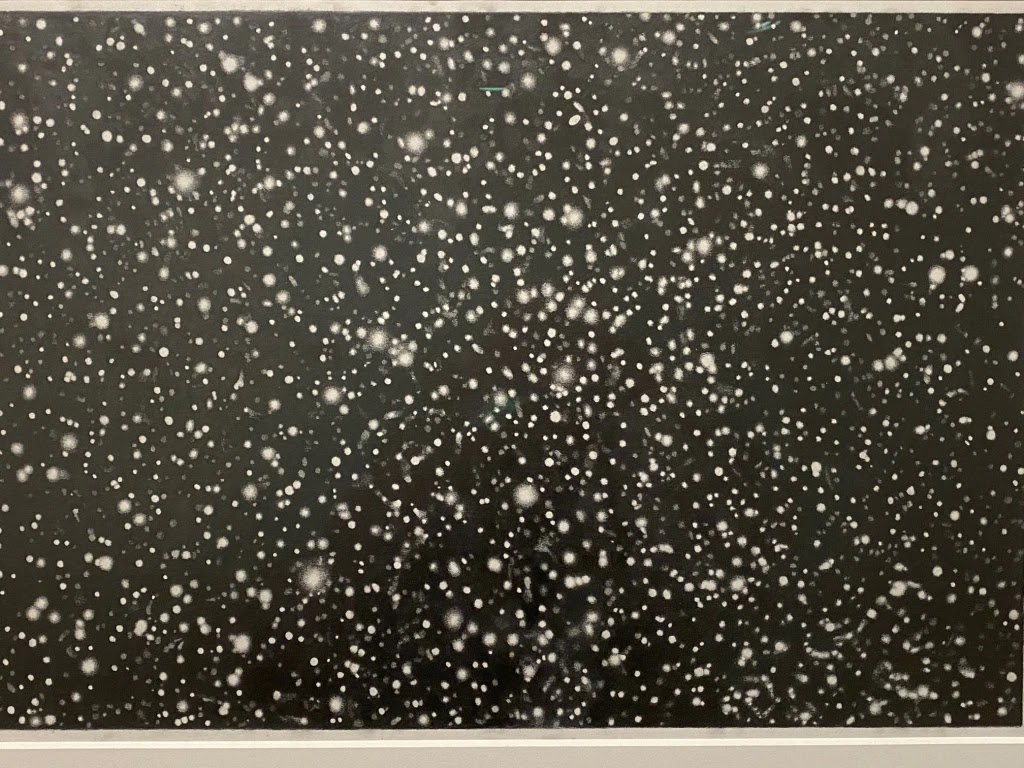
I found I had a tender touch.  I got more interested in projecting the spatial qualities.  I started doing darker things, like New Mexico night skies.  I started making the star field paintings.


The image itself has 2 or 3 qualities that you grasp at one time: a flatness, an illusionary depth, and a MADE quality.  How it's made is the thing that I think engages you in looking at my work.

But the process of making isn't an invocation of darkness.  And the making is not just busy work.  I like to leave subtle traces of the making and of the thinking, bypassing the brain but still leave signs of intelligence.  

I'm highly self-critical.  I'm critical of others too.

I want to work larger so that you can roam around  I'm finding it difficult to concentrate and make work that is so concentrated.  I'd like to make work that's a little more emotional.  I'm interested in a more ambiguous, more abstract space.  I may make some dimensional objects now.

I'm an outsider.  there is an outsider quality to everything I do.  Vija Celmins 2003 

Vija Celmins was born in Latvia in 1938 and immigrated to the USA when she was ten years old.  

There are many videos of her and her work on youtube.  

video about the surface of the ocean and the desert.

video of how she makes prints of the night sky

video of her speaking and shows her working

Vija Celmins was interviewed by Robert Enright for Border Crossings magazine in 2003 and her words were paraphrased by Judy Martin in 2024.  You can read the original in border crossing magazine #87

Tuesday, July 14, 2020

Nancy Paul: Time/Lines

Summer (Sleeping Medusa) by Nancy Paul,  Oil, acrylic, conte, 29 x 43" 1980-2020 

Despite overwhelming evidence of crises
from climate change to social injustice to pandemic

Longing by Nancy Paul,  acrylic and graphite on paper, mounted onto birch panel, 9 x 12 inches, 2020

many governments around the world seem unable/unwilling to act
even as democracy is under threat and truth-telling stifled
.
Setting by Nancy Paul, acrylic and graphic on paper, mounted on birch panel, 14 x18", 2020

 Individuals feel powerless to effect change.

The Dreamer by Nancy Paul, acrylic and graphite mounted on birch panel, 2020

As Shakespear's Lear knows,
the naked body is an enduring symbol of human vulnerability and helplessness.

Sitting Back by Nancy Paul, acrylic and graphite on paper, 12 x 16 inches, 2020

It can also, however, represent beauty, grace, and love;
an aesthetic of salvation.

Slowing Down by Nancy Paul, graphic on paper mounted on birch panel, 10 x 12 inches, 2020

The nude for me is at once surrogate seeker of truth and object of scrutiny.
In my work the female figure is both self and other;
she represents communication and compassion.

Green World (Arden Spring) by Nancy Paul  acrylic, graphic, ink on canvas, 28 x 32" 2019


"Time/Lines" is about our search for understanding.


Nereids Endangered by Nancy Paul, Acrylic, graphite, Japanese Paper on canvas, 16 x 20 inches, 2018

In 'Time' large figures lie wrapped in uncertainty while a tiny pair of Nereids explore distant lands and seas; inconspicious, they exemplify the humility needed to connect.
Life Lines/Sky Lines (I, II, III) by Nancy Paul,
acrylic and graphic on paper mounted on birch panel, triptych, each part 12 x 16 x 1.5 inches  2020

"Lines" celebrates gesture drawings done from life,quick sketches done before longer poses, they have the vitality, purpose, and direction to inspire us now.
Fall by Nancy Paul, Oil on Canvas, 1980, 24" x 36"

All images and text in this post are by Nancy Paul
from her exhibition at Art Noise Gallery,
Kingston Ontario Canada 

Monday, November 11, 2013

Agnes Martin

Agnes Martin's  Innocent Love 1999 acrylic on canvas series at the Dia Beacon, New York.  There are eight paintings in this series, four on each wall.  All are 60 inches square.


Q:  How do you start a painting?
A:  "I wait for inspiration.
I ask my mind - What am I going to paint next? and it appears in my mind.  My inspirations are in colour. "

She uses mathematics to decide the scale and relation of the colours.  She draws lines with a small ruler because a big ruler pushes the canvas down.
Happiness.  Innocent Love series 1999

Innocence.

"For twenty years I was not satisfied with my paintings and at the end of every year I had a big fire. "

Love:  Innocent Love series 1999

Waiting for inspiration.

"I was thinking of innocence, and a grid came into my mind, and so I painted it.  6 feet by 6 feet and I liked it.  It looked like innocence.  And I asked the museum of Modern Art if they wanted it and they did."

Contentment: Innocent Love series 1999

"Sometimes I take a year off so I'll know something,
because when you're painting, you just get up and do it.
You don't know it."
Innocent Love series seen through opening,  on the facing wall is The Spring, 1958. 48" square
"Artists are very fortunate.  Other working people have to talk to people all day.
You just can't be an artist if you can't be alone.
When you're alone, you are affected by everything. 
The sky, nature..   You respond."
Untitled #16, 2002.  The thin paint allows the roughness of the gesso undercoating to be more evident.
"It's not really about nature.  It's about what is known forever in the mind.

The environment doesn't have impact on my work.  I don't paint nature."

untitled 1959, 30 inches square

"When I draw horizontals  - it's expanding


I like the horizontal line better than any other.  It's not related to landscape.
It goes out.
When you look at the painting you go in over the horizontal line.

It's like music.
Some musicians compose music about music.
Beethoven composed music about experience.
Joy.
Happiness.
It has meaning.
Painters can paint about painting, but my painting is about meaning.
I use that horizontal line to get meaning."
left:  untitled 70", 1960 oil, painted when the artist was 48,  right: untitled #17,2002, acrylic, painted at 90 years

Minimalism

"They were non subjective.
No emotions were in the work.
Minimalists tried to be not there. 
They wouldn't put their names under the paintings.
They said to write their names with a number.
People call me a minimalist, but I'm not.
I'm an abstract expressionist.
I sign my name on the back."

The Beach, 6 foot square pencil on white Gesso painting from 1964 - detail. 

Empty mind

"The intellect struggles with facts.
Keep discovering facts, then make a deduction.
But this is just guess work, inadequate.
You won't find out about life.

I gave up facts in order to have an empty mind.
You have to practice an empty mind.
I gave up being intellectual.
I don't have ideas.

I'm convinced that with a soft attitude you receive more."

......................................................................................................
Agnes Martin (1912 - 2004) quotes from Mary Lance's documentary With My Back To The World. 
Images are of Agnes Martin's 2012 installation at the Dia: Beacon.  
Another excellent interview with Agnes Martin (1997) is here.

Tuesday, January 26, 2010

Patti Roberts Pizzuto

Last Days Before Dying, 2007, acrylic, ink,embroidery, hand made paper

Patti Roberts Pizzuto uses an earthy combination of acrylic, embroidery stitches and hand made paper to create poetic works that ponder the big questions about life's meaning. All images in this post are from an article about the artist by Lynn Cornelius Jablonski I found in Fiberarts, April May 2008. Waiting Vessel, 2007, acrylic, collage, beads, embroidery, handmade paper

Her imagery is empty space in combination with one or two common objects such as a bowl, bed or boat and the texture of hand stitching. The recent work shown in this article had either the form of a primitive house shape or a simple rectangle. For me, the house shape is evocative of our personal longing for the simple quietness of childhood, and I would bet that Patti Roberts Pizzuto has read The Poetics of Space by Gaston Bachelard. The artist says that the house image symbolizes comfort family, sense of self and belonging. Finding Home, 2006, acrylic, beeswax, embroidery, handmade paper

The artist worked in the library of an art and design college in Flordia for 25 years, and it was the art books she handled every day that were her inspiration (and I would guess, her education). A recent move to South Dakota in 2005 changed her palette, and fostered an interest in her own family history and the history of mid Western United States. Dance of Chance, 2007, acrylic, ink, collage, beads, handmade paper

Objects that are from our daily lives act like witnesses in her work. They are like things that occur in our dreams, meaningful and with narrative. She rarely depicts figures, but when she does they wear medieval dress.
Each Leaf a Universe, Each Night a Dream, 2007, acrylic, embroidery, collage, handmade paper

Natural items like seeds, flowers and leaves occur. The seeds are symbols of possibility, of birth, renwal and even death. She contemplates the sacred and the mundane at the same time. Existential work. Quiet Compositions.

Patti Robertsw Pizzuto has her own web site - you need Adobe flash to view it, and so I was not able to visit it. Still on dial up here on Manitoulin Island, Canada.

Monday, July 13, 2009

Sue Hammond West

Wisdom Nerve paint, wool, silk, thread, objects on felt 72" x 72" 2006-2007 In 2007, I took a four day workshop with Sue Hammond West at the Surface Design Association conference in Kansas City. The class was called "Art as Quiet" and I loved it. Each session began with meditation. We painted with acrylic on scraps of upholstry material and stitched into them afterwards. We did not make small talk while creating and this encouraged each of us to work with inner passion. Abundance Magnent paint, silk yarn stitching, gold leaf on industrial felt , 72" x 72" 2006 Sue Hammond West also had an exhibition in Kansas City at that time and I was very impressed with seeing her work. It is very large and simple with barely tangible circles and organic shapes surrounded by large quanities of space. I found myself emotionally gripped by her work. numina paint, paper, mica, stitching on cloth 49" x 50" 1999 - 2004 She currently teaches at Naropa, the Bhuddist University in Boulder, Colorado. Tacit Longing paint, paper, rocks, flower petals on industrial upholstry cloth 59" x 60" 2003-2004 These images of her work are from her 2007 self published catalog of mixed media textile paintings as well as from an article about her work by Ginger Knowlton that I read in the spring 2007 Surface Design Journal. Nectarian Moonlight paint and stitch on industrial upholstery, 79" x 38.5", 2006