 |
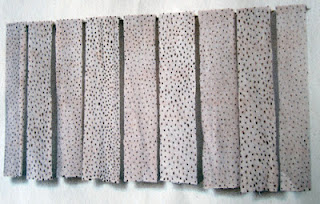
| tonal warp stripe, 2010, linen, ramie, weaving, burning, 96" x 27" see artist's website, john paul morabito |
"Of late my work has concerned itself with the actions of hand
weaving and systematic burning. The process of weaving cloth by
hand and then repeatedly burning it is an act of creation
juxtaposed with an act of destruction. This sacrifice of cloth
woven by my own hands is not a violent act. It is rather a quiet
meditation.
 |
| tonal warp stripe, 2010 |
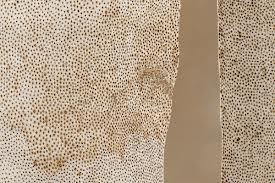
The holes are not burned quickly with ravaging flames.
Instead each hole is made individually and slowly to create a
contemplation of each moment that has been burnt away." John Paul Morabito
 |
| Plain weave with stripes, 2009, see artist's website |
John Paul Morabito turns 30 years in 2012. He is a MFA candidate (2013) in fibre and material studies at the school of the art institute of Chicago.
 |
| plain weave with stripes, detail 2009 |
The patterns of dots on the neutrally coloured hand woven grounds are intriguing. On some pieces they seem like a natural kind of dis-colouring, like mold or insect holes. On other pieces, they are measured and precisely placed. But however beautiful they are, these marks are definitely not decoration. There is a depth in this work that hits you in the heart.
"Perhaps left over from when we first realized our mortality, we
have built into us a yearning for all things impermanent. To be
human is not only to create but also to destroy. Called Thanatos,
the death drive draws us to the end. I find myself in some ways
ruled by Thanatos.
There is a need to make and a need to destroy,
neither can be ignored. " John Paul Morabito
 |
| strip construction, 2010 silk, rayon, handwoven, burned 33 x 69. image from fibrearts magazine spring 2011 |
Psychologists tell us that it is all part of the creative process. It is necessary that we destroy what we have created in order to re-create. This is natural. Creation and destruction and re-creation. It is how change happens
But this young man isn't going so far. He creates in order to destroy and stops there. He says: "
Humanness lies in the failure. The work then becomes a quiescent space of penance and finally acceptance."
It is compelling to think about this. My body thinks about it.
 |
| burned textile, detail of strip construction, 2010 |
John Paul Morabito's work has been part of two most recent fiber art internationals that are held in Pittsburgh every two years. In one of the final fiberarts magazines (spring 2011) he was featured in the emerging artist showcase.
 |
| Warp Faced Plain Weave, 2009, cotton, linen paper, weaving, burning, 55" x 47" from Fiberart international 2010 catalog |
Drawn by the simple beauty of the marks, I respond emotionally to the
slow, determined method the artist used to create them, one by one. It is then that
the philosophical ideas inherent in those marks work their way into my
head. It's all about human mortality. This work is calm acceptance of that undeniable fact.
 |
| After Penelope 2011 |
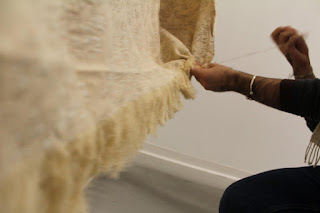
In
After Penelope, the artist deconstructs an industrially woven textile with the idea of reconstructing it. This is a switch from his earlier burned pieces. The destruction happens first, then the idea of re-creation. Is the artist becoming more positive with his meditations?
No. John Paul Morabito abandoned this project. See more images on
his website.
"I work in repetition. Finding inspiration in the devotional mindsets of
religion and masochism I undertake monumental tasks often impossible to
complete. Simple, seemingly useless actions are repeated to the point of
absurdity and stopped only when the possibility of going on without end
is suggested. The work is concerned with the impossibility of eternity."







 Posts

