Showing posts with label USA. Show all posts

Friday, March 15, 2024

Vija Celmins

 My work is not meticulous, it is rigorous.  

It's like living another life.  As if you have a time here, with the work, and then you have a world in which you are living your other time.

Why do it?  The older I get, the more mysterious that seems.  

It's some kind of impulse inside you, and when you are working well there is a feeling of connectedness to the world, and occasional feelings of bliss.

It occurred to me that when I am really working well, the work has no meaning  You can work with less mind.  You see with your mind, not your eyes, because eyes are just the lenses.  But you only see what you already know, so maybe this is why I focus on something outside of me, that I don't really know  You might say it's copying , but it's re-imagining this thing in another medium.  

I thought I could fool my clever mind because it limited me.  I thought I could get to a sense of form that was more in my body - or my hand - and that comes from just making.  

I want to get in touch with something more mindless, more intuitive.  I'm not clear about the meaning.  Maybe its the spectator who puts the meaning in.  

I don't work from experiences that are fresh.  I tend to repeat things.  I've carried thoughts around in my head for months.  I have a feeling about a form that I want and I want the feeling to develop as far as it can go, and I want my work to be able to stand a lot of inspection.

The things I draw are formless, hard to grasp.  Like the ocean. Like the sky.  It's as if the ocean is like a ghost somewhere and what is in front of you is the real thing.

I have no technique. I gave it up as well as other obvious signs of self-expression.  

I never thought to call my work a pleasure.  I just felt the compulsion to do it.

They are visual chords.  They are dense, materially oriented images.  They don't really tell stories.

My feeling is that when you are not using your brain, you are not necessarily being stupid.  It's just that you're in touch with some other things in yourself.  Then they become brainy. . Because look how we talk about the art afterwards.  We can talk about these pieces in an intelligent way even though the work itself is ..... what is the work like?  I don't know..  I don't know what the work is like.

In  a way, I am building a self.  It's not really self-portraiture.  Rather, it's being able to get something out of yourself that has a life on its own.  That's step one.  And you recognize that it is step one and you're going to take another step.  You're going to try something else.

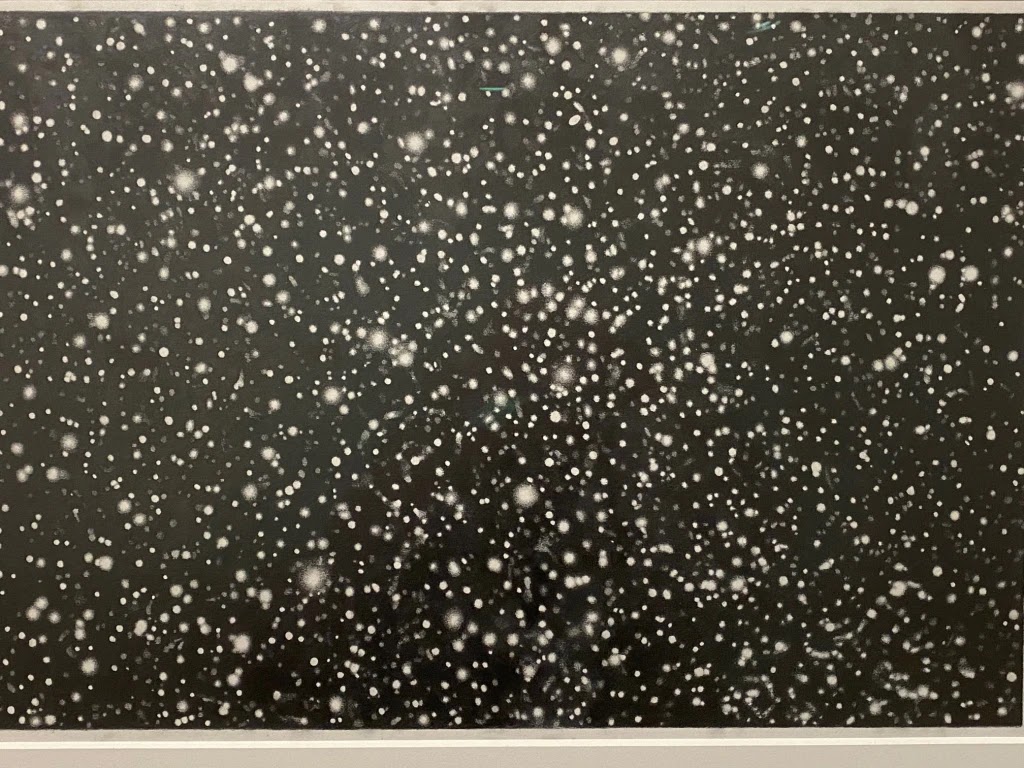
I found I had a tender touch.  I got more interested in projecting the spatial qualities.  I started doing darker things, like New Mexico night skies.  I started making the star field paintings.


The image itself has 2 or 3 qualities that you grasp at one time: a flatness, an illusionary depth, and a MADE quality.  How it's made is the thing that I think engages you in looking at my work.

But the process of making isn't an invocation of darkness.  And the making is not just busy work.  I like to leave subtle traces of the making and of the thinking, bypassing the brain but still leave signs of intelligence.  

I'm highly self-critical.  I'm critical of others too.

I want to work larger so that you can roam around  I'm finding it difficult to concentrate and make work that is so concentrated.  I'd like to make work that's a little more emotional.  I'm interested in a more ambiguous, more abstract space.  I may make some dimensional objects now.

I'm an outsider.  there is an outsider quality to everything I do.  Vija Celmins 2003 

Vija Celmins was born in Latvia in 1938 and immigrated to the USA when she was ten years old.  

There are many videos of her and her work on youtube.  

video about the surface of the ocean and the desert.

video of how she makes prints of the night sky

video of her speaking and shows her working

Vija Celmins was interviewed by Robert Enright for Border Crossings magazine in 2003 and her words were paraphrased by Judy Martin in 2024.  You can read the original in border crossing magazine #87

Tuesday, February 6, 2024

Louise Bourgeois : The Woven Child

the found child 2004

Classical statues made of permanent materials awaken our feelings of mortality as we realize they will outlive us. 

A sculpture made from soft, perishable textiles, evokes the body's vulnerability much more directly, arousing our latent awareness that we are all essentially sacks of skin hung around a structure of bones and stuffed with blood and organs.             
Ralph Rugoff (director of the Hayward Gallery in London, England) 

untitled 1999

For Bourgeois, sewing goes beyond restoration.  Instead, it is a metaphor for psychological repair and for exploring the complexity of human relationships.  

In her artworks, repairs become conspicuous scars.  Sewing is a subtle form of communication and atonement.  The gesture and labour involved evokes complex feelings in another person.  Sewing, the act of reparation, was a defence against fragmentation and disintegration.  
 Julienne Lorz, chief curator 2018-2021. Gropius Bau, Berlin. 

couple IV 1997

Louise Bourgeois makes her passage through the intimate terrain of private and chaotic experience without being destabilized by its violent emotion.  Her triumph lies in the retaining of artistic objectivity in the face of the most fiercely subjective materials.
Rachel Cusk, novelist

untitled 2001

Bourgeois renews her allegiance to the truth of her female history and its origins in her child self.  Size, scale, and the monumental can be arrived at, stitched together, organically built up, as in her series of tall fabric pillar shapes, both assertive and resolutely handmade.  
Rachel Cusk, author of several works of fiction and non fiction

the cold of anxiety 2001

"I cannot renounce the past.  I cannot and do not want to forget it."  Louise Bourgeois

the cold of anxiety detail, 2001

untitled 2005

I would like to embroider and put everything in place and in a proper and predictable manner.  To simplify, reduce, organize, round up and retire after being sure of the method.  
Drawn in and concentric I would like to be.  Louise Bourgeois

untitled, 2006

Sewing implies repairing.  
When you mend things, it allows you to have your hands occupied.  To look intensely and never meet the eyes of other people.  You can even be moral about it.  
You can appear to do things for others.
You can say, "I am repairing your clothes."  Louise Bourgeois

untitled, 2002

My subject is the rawness of the emotions, the devastating effect of the emotions you go through.  Louise Bourgeois

untitled, 2004

Bourgeois' sculptures, at once baroque and schematic, subvert any possible association with platonic completeness.  Female forms simultaneously subvert and implicate a voyeuristic gaze.  At the same time, through its use of materials that we are accustomed to feeling against our skin, a dimension of haptic sensation and tactile association is opened up, beyond purely visual engagement.  
Ralph Rugoff (director of the Venice Biennale 2019)

the mute, 2002

This final body of work counts as one of the greatest late-career chapters in the history of art.  A body of work in which lifelong concerns of Bourgeois:  destabilising of boundaries, ambiguous sexuality, and a sliding register of meaning / identity, are revisited in profoundly enlivening ways.   Ralph Rugoff   
 

All images and text in this post are from the catalogue that documented Louise Bourgeois: The Woven Child,  an exhibition that was presented at the Hayward Gallery, London England and Gropius Bau, Berlin, Germany in 2022.  All the works in the exhibition were made from LB's personal saved clothing and domestic textiles when the artist was in her 80's and 90's.  (Bourgeois died age 99 in 2010.)

Monday, March 1, 2021

Lawrence Carroll

Tom
1985-86 oil, canvas, wood, wax, staples
 13" x 10.5" x 6" 

Untitled
 1985 oil,, wax, canvas on wood
18" x 10" 

Penance
1987-88   oil, wax, canvas, staples on wood 
 9" x 9" x 7.6"
I was painting thin pieces of paper with black house paint that I would place on the white canvas.  I used staples because it allowed me to remove the painted lines and shapes if I was not satisfied, altering the composition as needed.
Breathing In
1988 89 oil, wax and paper collage on canvas on wood
  12" x  11" x 10"
Yes, like Matisse at the end of his beautiful life.  This was before I started cutting my paintings apart and using wax and other things.  

I was looking at Donald Judd. I was interested in the way that his wall and floor sculptures would come out of the wall and into the space.

Dependence
1990   oil wax, staples, canvas, wood
33" x 15" x 10"
This physical relationship between the work and the viewer started to influence how I started to think about my painting.

It slowed down the viewer.

Heaven Picasso 
1994-95 oil wax house paint newspaper, canvas on wood
55" x 42" x 3"
You could not see the painting entirely in one view.  

You could not grasp it.

Untitled
2017 oil, wax, staples, canvas on wood
19" x 1/2" x 11"
It added psychology to looking.  It opened up a world to me.

I looked at Carl Andre too - How and where to place the painting and how the placement changes the psychology of an entire room.

I felt I had everything.

installation at museo vincenzo vela in 2017
I thought of the canvas as a skin and wax as an ointment

and that there was a body of memory under the skin where things were buried for years and then for some reason they reappeared.

Lawrence Carroll 
I Have Longed to Move Away  works 1985-2017
edited by Gianna A. Mina
I started to think about cutting a painting completely apart.

And then about the futility of trying to put something that was once whole back together again, exposing all its imperfections. 

There was the revelation.   Painting does not have to be perfect

untitled  2017 
house paint and wax on canvas
19" x 19" 16"

Paintings can be flawed and vulnerable and imperfect and human.

Maybe my paintings are about my broken life.

untitled
2016 - 17  stain, house paint, wood pieces, canvas on wood 
67.7" x 108" x 1.5"
And that I'm trying to piece my life back together.

At certain times in your life, things appear.  Things come.

You look back on your life and examine it.

Last night I thought of different possibilities of what some of my paintings could be about and it shook me.

untitled 
stain, house paint, wood pieces, canvas on wood
118" x 75" x 1.5"
It's impossible for me to always know and understand exactly what I'm doing.

I need time and distance.

The gift that I have been given is to be able to explore these things and to give comfort to myself in knowing that I have a place to express things that some people may bury inside themselves and carry away with them all through their lives.

untitled 
oil, wax, house paint ,staples, canvas on wood
114" x 85" x 4" 
I like the idea that the painting can convey some of life's weight.

We all carry the weight of an imperfect life, some far greater than others.


Lawrence Carroll
I Have Longed To Move Away
Installation in Museo Vincenzo Vela, Switzerland

So what do you expose?  You have to risk.   You can't hide.   Lawrence Carroll  1954 - 2019


All text is from a Lawrence Carroll's interview with Barbara Catoir, entitled "Carry On the Light" .  

It is in the catalogue of the exhibition  I Have Longed to Move Away which was curated by Roberto Borghi for the Museo Vincenzo Vela in Switzerland during the spring of 2017.

Thursday, October 31, 2019

Lenore Tawney: Mirror of the Universe

In Utero 1985  mixed media  25 x 11.5 x 11.5 inches (chair only) Lenore Tawney
"...to seek a barer life, closer to reality, without all the things that clutter and fill our lives.  I left friends whose preconceptions of me held me to their image of me....The truest thing in my life is my work.  I want my life to be true.  Almost gave up my life for my work, seeking a life of the spirit."
 Lenore Tawney, 1967 journal entry
Installation of Lenore Tawney's weaving at John Michael Kohler Art Centre, Sheboygan Wisconsin.  On wall from left to right:  Dove 1974  linens  118 x 108 inches,  Waters Above the Firmament 1976 (small 36 x 36 " version),  In Fields of Light 1975 (orange) linens, 108 c 100.5 inches, Little Spring 1962 linen 48 x 23.5",  Tau, 1974  linen 80 x 108 inches, Hanging in foreground left to right are: The Megalithic Doorway, 1963 linen 204 x 28 inches, The Path, 1962 linen and gold, 90.5 x 24.5 inches, The Bride 1962 linen and feathers 138 x 15 inches, and in front of Tau is Untitled (Bird) 1963 linen, feathers
and wood 65 x 30 inches.
"When I was doing the woven forms, I was dancing with joy all the time.  They were so spontaneous, I didn't know what they were - they just kept going higher and higher.  I thought, No one will ever show these, they're too tall for a gallery.....so I'll keep going"      Lenore Tawney
Cloud Labyrinth 1983, canvas and linen 16 x 24 x 18 feet
An entire gallery at the John Michael Kohler is devoted to the monumental Cloud Labyrinth,  made when the artist was 76 years old.

"I sometimes think of my work as a breath"  LT

Thread can be woven into shields and cruciforms, it can also be, improbably and delicately, unwoven.  A cloud is a visible amassing of solid, liquid and gas, water at its most diffuse. The threads dance and vibrate, shifting the light, tickling the eye. The eye  follows the thread up like vapour invisibly evaporating into a cloud and then comes down, a string of droplets, back to earth.
 (wall text at JMK art centre)
cloud labyrinth 1983  detail
"It is impossible to describe the range of expression in this work.
 But it can be said that trembling and sensitive images are brought before our eyes even as we look, and also that deep, and sometimes dark and unrealizezd feelings, are stirred in us. 
There is penetration.
There is an urgency that sweeps us up, 
an originality and success that holds us in wonder.
This work is wholly done"         
Agnes Martin 
assemblages and collages made by lenore tawney, displayed at the John Michael Kohler art centre
"You have to forget time entirely, and live in eternal time"  Lenore Tawney

She was 50 when she moved to New York but looked young and passed for 30.
She let time be erased from her life story for a while.
Bach 1967  collage 12.5 x 11/5"
She operated without assistants until the very end of her life at age 100.
shelves with objects from Lenore Tawney's New York studio/home
'The weaving just grows and keeps coming.  It's all inside of me.
It was really thrilling.
I used to sing and dance all by myself there at night. 
Then I'd get up very early and work all day"
 Lenore Tawney
egg shells in a basket
Lenore Tawney's studio is now part of the unique permanent collection of artsts studio/homes that have been transformed into art environments at the John Michael Kohler Art Centre.  Until this year the studio's contents were in the care of the Lenore G Tawney foundation in New York.  Kathleen Nugent Mangan, one of Lenore Tawney's close friends is the director. 
objects from Lenore Tawney's studio
"My work is my pleasure.  It's my life, it's what I live for."       Lenore Tawney
cloud labyrinth detail
Lenore Tawney transcended any distinction between art and craft.
Her work is an important part of the visual language of 20th century art.
Lenore Tawney's studio detail

Lenore Tawney's believed that there is no division between art and life, and she created a quiet environment for art making, meditation, yoga, and focusing on the inner, deeply personal world.  Tawney is among the most impactful artists of the last half of the 20th century.  She dedicated herself to a devotional interdisplinary practice inufused with ideas of Buddhism, Zen philosophy, Jungian psychology, wanderlust and nature.  She believed that art making has the potential to usher in a lightness akin to a spiritual awakening.   (from the wall text at the Kohler Art Centre in Wisconsin)

'so new and personal that it does not have a name or classification'   (new york times  1963)

Sunday, May 22, 2016

April Anne Martin MFA graduate exhibition Art Institute of Chicago 2016

The Sun Had Not Yet Risen   2016   copper blind, 3 feet wide, 10 feet high
The Sea Was Indistinguishable from the Sky  2016
  tupperware with cyanotype printmaking in process
MFA exhibition, April Anne Martin


Simplicity is the core
pared down to the essence
not removing the poetry,
but pared down
not removing the connective tissue between all the elements
not diminishing that quality that compels us to look again
and again and again
but pared down

in the far left  window sill, The Sea Rose 2016 paper sculpture, 
on the floor, The Sea Was Indistinguishable from the Sky,
 in front of the window, The Sun Had Not Yet Risen,
(this photo taken around 6 pm) 
simplified
pared down
every unnecessary element discarded
spare
elegant
sumptuous
April Anne Martin's MFA graduate exhibition Art Institute of Chicago,
Sullivan Galleries April 29 - May 18, 2016
Like Eva Hesse,
Martin uses a complicated minimalism marked with fantasy
Like Roni Horn,
she pays attention to the physical qualities of her material
Like Mark Rothko,
she uses a vertical format marked with shimmering horizontals
Like a poet,
she wants to elicit emotional response
Like a scientist,
she asks questions about what would happen in nature and records the process
Like an artist,
she doesn't want to know the answer ahead of time

She allows nature to be her equal partner
April Martin works with the changeable daily elements that each of us experience and think we know. Water.  Air.  Natural light.  Time.

The objects in this exhibition hold the time of day within them.
Inspired by modernist women artists and poets, Martin quotes Virginia Woolf's 1931 novel The Waves, in her titles.  Quoted below are the first few lines of that poem-novel.
The sun had not yet risen.  The sea was indistinguishable from the sky, except that the sea was slightly creased as if a cloth had wrinkles in it.  Gradually as the sky whitened a dark line lay on the horizon dividing the sea from the sky and the grey cloth became barred with thick strokes moving, one after another, beneath the surface, following each other, pursuing each other, perpetually.
As they  neared the shore each bar rose, heaped itself, broke and swept a thin veil of white water across the sand.  The wave paused, and then drew out again, sighing like a sleeper whose breath comes and goes unconsciously.            Virginia Woolf
In the above photo,  Martin is installing lengths of watercolour paper that she has treated with a cyanotype process over a period of twenty days.
Nine papers were each washed and exposed simultaneously in the tub in the middle of her space. This happened every two days at times that correspond to the nine interludes in Woolf's novel where she described the coastal scene at various times of day.  April Martin isolated the first few words of each of Woolf's interludes to create titles for her cyanotypes.
The interludes were not put into the space until the final day as during most of the exhibition they were drying in her studio.  In fact there was a performance every other day as part of the exhibition.
Follow this link to see photos.

"During the 20 day exhibition I will make 10 cyano type prints that respond to the sun's changing position in the sky, using sun and water.  The prints wash and expose themselves in the gallery and then are moved to my studio in another building where they are dried and displayed."  April Martin

On May 16 (graduation day), she moved the last of the cyanotypes into the gallery..
My studio is a scaled down space to observe the perpetual motion and aliveness of things. I set up physical exchanges between dry and wet materials that appear if only for an instant, to slow or stop time. Formally it is a container for activity, and sculpturally many of my works address this contained boundary, threatening to overflow, to flood and leak. 

Outside where the scale shifts, and the permeable drywall boundaries of my studio fall away, everything is different. Weather stacks itself into the present daily form made from dry/wet and hot/cold exchanges. We experience it in the moment we spend with it, it blows our body, it drips down, burns the back of our neck; it moves itself inside of us. April Anne Martin
from left to right, The sun had not yet risen, The sun rose higher, The sun rose, The sun, risen, no longer couched on a green mattress darting a fitful glance through watery jewels, bared its face and looked straight over the waves. The sun had risen to its full height, The sun no longer stood in the middle of the sky, The sun had now sunk lower in the sky, The sun was sinking, Now the sun had sunk. 

The Sea Rose 2016  pad of graph paper with evaporated salt and miracle gro' 11" h 
Another modernist woman writer, H.D. (Hilda Doolittle)'s poem Sea Rose gave the artist a title for her paper sculpture in the window.   (shown above)
The Sun Had Not Yet Risen  2016  copper  10 ' h x 3 ' w, April Martin
this photo taken around 8 pm, the blind is closed
The vertical copper sculpture reacts to and holds the light and heat of the sun.  It changes with the time of day, but it seems to be timeless.  I will close this post with one more quote by a modernist poet.  This is from Marianne Moore's poem When I Buy Pictures

"It must be lit with piercing glances into the life of things; 
It must acknowledge the spiritual forces which have made it"