Showing posts with label environmental work. Show all posts

Sunday, May 22, 2016

April Anne Martin MFA graduate exhibition Art Institute of Chicago 2016

The Sun Had Not Yet Risen   2016   copper blind, 3 feet wide, 10 feet high
The Sea Was Indistinguishable from the Sky  2016
  tupperware with cyanotype printmaking in process
MFA exhibition, April Anne Martin


Simplicity is the core
pared down to the essence
not removing the poetry,
but pared down
not removing the connective tissue between all the elements
not diminishing that quality that compels us to look again
and again and again
but pared down

in the far left  window sill, The Sea Rose 2016 paper sculpture, 
on the floor, The Sea Was Indistinguishable from the Sky,
 in front of the window, The Sun Had Not Yet Risen,
(this photo taken around 6 pm) 
simplified
pared down
every unnecessary element discarded
spare
elegant
sumptuous
April Anne Martin's MFA graduate exhibition Art Institute of Chicago,
Sullivan Galleries April 29 - May 18, 2016
Like Eva Hesse,
Martin uses a complicated minimalism marked with fantasy
Like Roni Horn,
she pays attention to the physical qualities of her material
Like Mark Rothko,
she uses a vertical format marked with shimmering horizontals
Like a poet,
she wants to elicit emotional response
Like a scientist,
she asks questions about what would happen in nature and records the process
Like an artist,
she doesn't want to know the answer ahead of time

She allows nature to be her equal partner
April Martin works with the changeable daily elements that each of us experience and think we know. Water.  Air.  Natural light.  Time.

The objects in this exhibition hold the time of day within them.
Inspired by modernist women artists and poets, Martin quotes Virginia Woolf's 1931 novel The Waves, in her titles.  Quoted below are the first few lines of that poem-novel.
The sun had not yet risen.  The sea was indistinguishable from the sky, except that the sea was slightly creased as if a cloth had wrinkles in it.  Gradually as the sky whitened a dark line lay on the horizon dividing the sea from the sky and the grey cloth became barred with thick strokes moving, one after another, beneath the surface, following each other, pursuing each other, perpetually.
As they  neared the shore each bar rose, heaped itself, broke and swept a thin veil of white water across the sand.  The wave paused, and then drew out again, sighing like a sleeper whose breath comes and goes unconsciously.            Virginia Woolf
In the above photo,  Martin is installing lengths of watercolour paper that she has treated with a cyanotype process over a period of twenty days.
Nine papers were each washed and exposed simultaneously in the tub in the middle of her space. This happened every two days at times that correspond to the nine interludes in Woolf's novel where she described the coastal scene at various times of day.  April Martin isolated the first few words of each of Woolf's interludes to create titles for her cyanotypes.
The interludes were not put into the space until the final day as during most of the exhibition they were drying in her studio.  In fact there was a performance every other day as part of the exhibition.
Follow this link to see photos.

"During the 20 day exhibition I will make 10 cyano type prints that respond to the sun's changing position in the sky, using sun and water.  The prints wash and expose themselves in the gallery and then are moved to my studio in another building where they are dried and displayed."  April Martin

On May 16 (graduation day), she moved the last of the cyanotypes into the gallery..
My studio is a scaled down space to observe the perpetual motion and aliveness of things. I set up physical exchanges between dry and wet materials that appear if only for an instant, to slow or stop time. Formally it is a container for activity, and sculpturally many of my works address this contained boundary, threatening to overflow, to flood and leak. 

Outside where the scale shifts, and the permeable drywall boundaries of my studio fall away, everything is different. Weather stacks itself into the present daily form made from dry/wet and hot/cold exchanges. We experience it in the moment we spend with it, it blows our body, it drips down, burns the back of our neck; it moves itself inside of us. April Anne Martin
from left to right, The sun had not yet risen, The sun rose higher, The sun rose, The sun, risen, no longer couched on a green mattress darting a fitful glance through watery jewels, bared its face and looked straight over the waves. The sun had risen to its full height, The sun no longer stood in the middle of the sky, The sun had now sunk lower in the sky, The sun was sinking, Now the sun had sunk. 

The Sea Rose 2016  pad of graph paper with evaporated salt and miracle gro' 11" h 
Another modernist woman writer, H.D. (Hilda Doolittle)'s poem Sea Rose gave the artist a title for her paper sculpture in the window.   (shown above)
The Sun Had Not Yet Risen  2016  copper  10 ' h x 3 ' w, April Martin
this photo taken around 8 pm, the blind is closed
The vertical copper sculpture reacts to and holds the light and heat of the sun.  It changes with the time of day, but it seems to be timeless.  I will close this post with one more quote by a modernist poet.  This is from Marianne Moore's poem When I Buy Pictures

"It must be lit with piercing glances into the life of things; 
It must acknowledge the spiritual forces which have made it"

Monday, May 5, 2014

Dorothy Caldwell

Flying Over Salt Lakes,
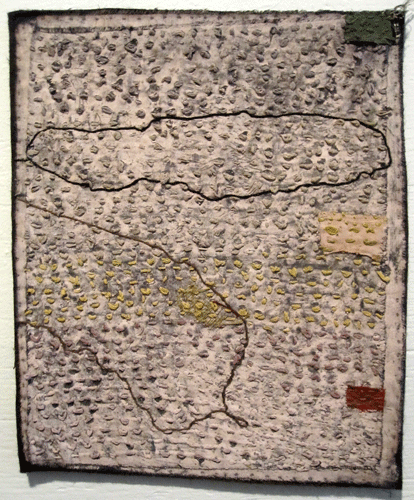
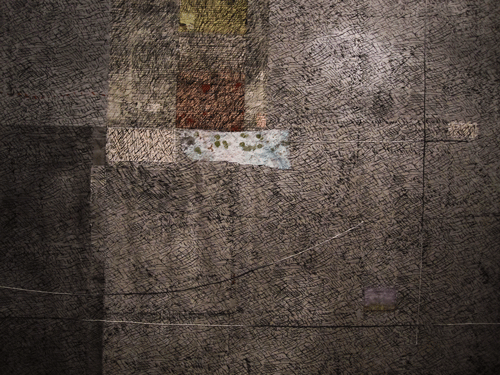
stitching on cotton with earth ochre, approximately 13" x 16",  2013
Dorothy Caldwell has become an icon for textile artists, exhibiting and teaching around the world.  We Canadians claim her as our own, as she has lived in Ontario since the mid seventies, relocating here from the USA.   The images in this post are of Dorothy Caldwell's latest exhibition, Silent Ice, Deep Patience, installed in the Art Gallery of Peterborough March 21 until June 22, 2014.
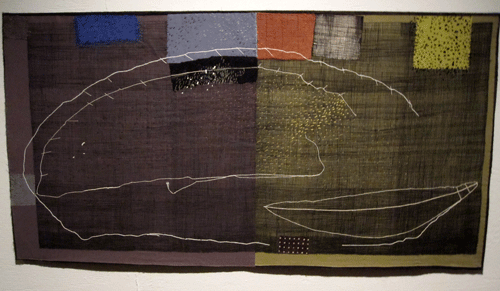
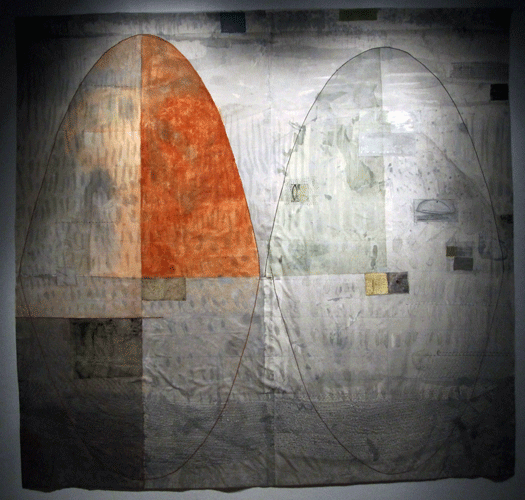
Left: Map Without Words
9 feet, 4 inches, x 8 feet, 5 inches, Right: Silent Ice/Deep Patience, 23" x 23". both 2013
Upon entering, the viewer descends a long ramp towards the main exhibition space, welcomed by five small paintings made with hand stitch and earth ochres (see top photo) on the ramp's wall.  Then, through an opening in that wall, the two pieces shown above beckon.  Large scale, empty space, intimate marks.   We are in Caldwell country.
Wandering Time,
approximately 24" x 18", wax and silkscreen resist on cotton with stitching, 2011
In many of her pieces, Caldwell lines up coloured patches along edges.  She draws our eye up to the sky, then over to the west and the east, and then brings it back to the centre.  Line drawings are couched onto the surfaces, like trails.  Archetypal vessel shapes resonate.
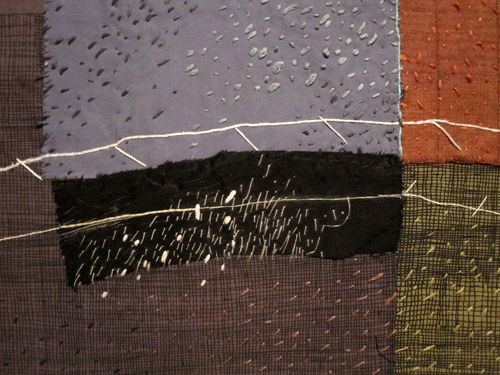
wandering time, 2011, detail
Dorothy Caldwell's stitches recall the random repetition of the small marks we are familiar with in nature. Leaves fluttering in the wind, ripples in the water.  Some large, some small, some linear, some a splotch, some widely spaced, others packed together.  Footprints on a beach.
wandering time,  2011, detail

"My work is an ongoing investigation of the meaning of place.  I investigate how  humans mark and shape the land and how those human marks interact with the natural geology."  Dorothy Caldwell
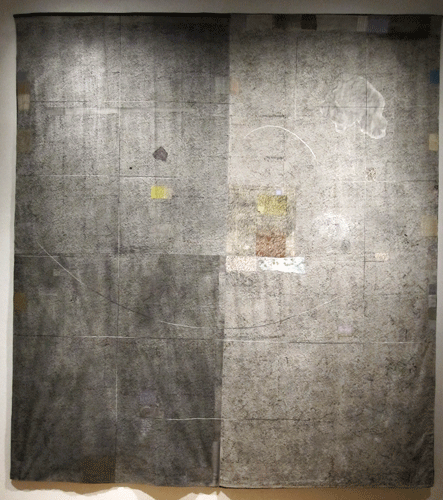
Map Without Words,
wax and silk screen resist on cotton, stitching, applique, 9'4" x 8'5", 2013
We often meet in the centre in Dorothy Caldwell's world.  Four corners, four patch, grids, crosses, grid the large unknown to make sense of it. There is order within chaos here.  Human geography.  

This body of work is the result of the artist's travels to the Australian Outback and the Canadian Arctic. Interested for decades in how humans mark the land, (previous exhibitions Field Notes (1998) and Ground Cover (2000) this current exploration of wilderness landscapes is a continuation for the artist.  
Map without Words, detail
Dorothy Caldwell uses cloth as a vehicle to translate her observations because cloth is like the land. Cloth reacts as land does to human intervention.  Simple actions like wearing, mending, stitching and patching make marks on cloth just as farming, road building, and daily walks mark the earth.
A Red Hill, A Green Hill,
 ink wash, earth ochre on cotton with stitching and applique, 9'4" x 9'8" 2012
In the large scale tactile painting shown above, Caldwell applied ink wash and earth pigments to the cloth as a change from her usual resisted dye or discharge methods.   Thoughtfulness is evident.  The aesthetics of time and touch, evident.
A Red Hill, A Green Hill, detail
Small patches and marks that drift into atmospheric hazes when seen at a distance, are unique and very real human habitations upon close inspection.  The big thread used in the waves of rugged stitching along the lower quarter of this wall piece was rubbed with earth and connects with the viewer on many levels.
A Red Hill, A Green Hill , detail
"I am intrigued by maps and by the organization of land through patterns of settlement and agriculture.  I have come to see the dichotomy between conventional mapping that identifies intimate landmarks and simplifies them into abstract shapes and textures."  Dorothy Caldwell
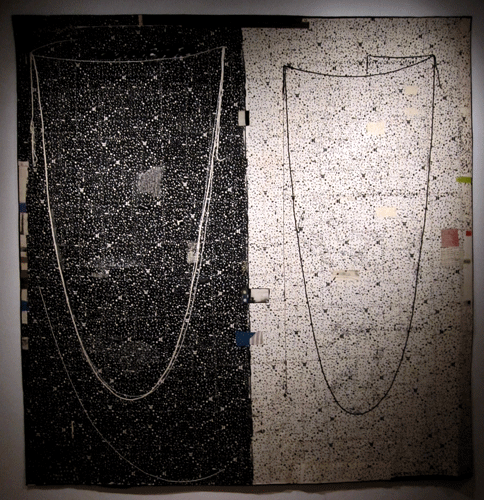
How Do We Know When It Is Night?
wax and silkscreen resist on cotton, stitch and applique, 10 feet by 9 feet 6 inches, 2010
Little patches along each edge and down the centre,
bowls drawn as if with a giant pencil,
duality, in and out
How Do We Know It' Night?  detail
"Caldwell tells students that what an artist needs to learn more than anything is how to make time for their art"  Ann Jaeger
How Do We Know It's Night?  Detail
Caldwell's large pieces have balance, stillness
They cause us to think beyond the gallery
about the vastness of nature and how nature has its own system.
The larger seasonal cycles, the many small parts within vastness.
That human marks are revealed by time and accumulation,
then erased by wind, eroded by water, hazed over by weather.
Stain of earth, footprint of man, animal tracks through the forest,
like poetry, these things occur one by one and resonate with personal experiences that don't always have anything to do with land, more with relationships.
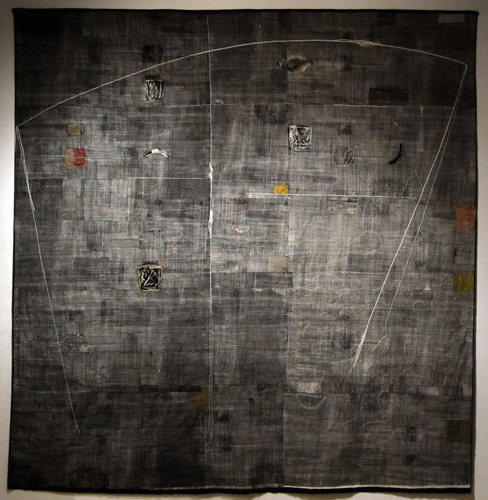
Signs,
wax and silkscreen resist on cotton,stitching, applique,  8'9" x 8'0", 2014
The artist's most recent large work returns to her preferred methods of marking large pieces of cloth with resist techniques.  The subtle grid of the ground, a new linear shape, and the painted squares and crescents dotting the interior are atmospheric.

"Maps give a viewpoint of the land filtered through what is important to the mapmaker.  I am mapping unfamiliar territory, identifying my personal landmarks through gathering, touching and recording the contents of the landscape.  In this way I form a sense of place for myself."  Dorothy Caldwell
Signs, detail
This post is about the large scale work but there are also many small pieces exhibited as well as an entire room devoted to the artist's collections of shells, lichens, bones, rusty wires, journal pages, iron nails, and her many books of marks and collected earth pigments.  How the artist works with the land to make these 'maps' deserves its own write up.  The video of Dorothy Caldwell (click here) perhaps fills the gap.

Other internet sources for this artist:
Ann Jaeger's informative review of Caldwell;s life and work on trout and plaid online journal,
Barbara Lee Smith's curated exhibition catalog Traces ,
as well as Caldwell's own website and the CCCA artist profile .

Caldwell's exhibition was shown at the Idea Exchange in winter 2015 and went on to St Mary's University gallery in Halifax for March and April of the same year.  This review by akimbo halifax correspondent Daniel Higham was published april 7 2015.  Good to see some writing about this artist.  Joe Lewis also wrote a review in Fibre quarterly....have to find that for you and shall insert it here when I do. xx

The Dorothy Caldwell quotes in this post are from her statement found in Barbara Lee Smith's essay in the Traces catalog.  All photos are from the exhibition and are by Judy Martin with permission from Dorothy Caldwell.

Friday, September 30, 2011

Polly Binns

Intimacy and space blend in the immensity of the landscape. The whole is imbued with the memories of my body within the landscape; my step, pace and sight-line. Serial Shimmers and Shades, 1996 Acrylic paint and thread on linen canvas 185 x 125 cm, collection of Nottingham Castle museum

Polly Binns, a member of England's prestigious 62 group, is considered a 'maverick' in the embroidery community. She grew up in a house of artists; her father used grids to size up his modernist design work and her mother painted the surrounding landscape. Untitled 1982 black cotton with coloured thread, smocking technique. 50 x 45 x 5 cm

She started her art career in clay, but soon studied weaving as a way to understand the material essence of cloth. When she eventually began exploring artist's canvas she was influenced by minimalists like Donald Judd and Carl Andre who worked with ordinary materials for their own sake. How did canvas behave when it wasn't stretched, when it wasn't covered with oil paint? She folded, pleated, stitched the cloth to raise the surface. She worked the cloth from both sides. Sand Surface and
Shadows, Winter 1996
1996 artist canvas, acrylic paint, threads, surface treatments. 7 panels 280 x 210 cm

The vertical elongated rectangles in the above piece relate directly to the body and seem to represent humans within the landscape. Polly Binns says about this piece that it is "a memory of the surface from where my feet stood to the far horizon. "
Her work from the mid 90's can be termed "post minimalist", as along with the grid geometry and attention to materials, there is also a kind of poetry.
The Poetics of Space by Gaston Bachelard is an influence. He wrote about "two kinds of space, intimacy and world space. When human solitude deepens, these two immensities touch and become identical. "
Although her work has become more poetic, it is never autobiographical. Her work is about observation and about memory of place. Before Polly Binns does any work in her studio, she walks. She repeats the same walk each time, at low tide, in the Blakeney Channel on the north Norfolk coast of England. No walk - no work.

This is a phenomenological approach. Walking immerses her in a direct experience. Mud, sand, water, bird marks, light are observed and felt with all her senses. There is a tension between order and intuition, between rational knowledge and the not quite known. Inshore Curve 1996 185 x 125 cm

Polly Binns had a daughter in 1986. During the first five years of Katy's life, the artist mounted a solo exhibition, joined the craft council and started full time teaching. However, about those years between 1986 and 1991, the artist says that she "closed down" and that her "balance had gone".

She took time off from making art and looked at more art by others, including that of Agnes Martin. Even more important, she took her little girl on long walks in the landscape, and together they observed things closely. All of a sudden, she realized that the land had seeped into her material knowledge and she knew what to do next in her career. Study 1 1996 27 x 28 cm collection Pamela Johnson

"My intention is to pare down the image: to reduce the pictorial elements of my memory landscape:
to focus on my interior vision
to recall and reference the glimpse, the half caught image,
the layered textures of memory." Polly Binns

In 1998, she received a PhD from England's University of Teesside for her new body of work entitled Vision and Process in Textile Art: a Personal Response to a Particular Landscape.
In 2001 she represented Britain at the 10th International Triennial in Lodz Poland.

The images in this post are from Surfacing, a monograph of Polly Binns that accompanied her 2003 exhibition at Bury St Edmunds art gallery. The information is gleaned from Pamela Johnson's excellent essay and the timeline of Polly Binn's career and life that is included in that book. The quotations are from Polly Binns's artist statement from the catalogue for Texture and Memory, an exhibition curated by Pamela Johnson and Peninna Barnett in 1999.

Saturday, December 12, 2009

Joyce Wieland

O Canada Animation (1970)
The 71 mouths forming the words to the national anthem are embroidered in red lips and white teeth on cotton.

In 1987 Joyce Wieland, one of Canada's most beloved artists, was given a retrospective at the Art Gallery of Ontario, the first for a living woman artist. The images in this post are taken from the catalogue for that exhibition.

Lucy Lippard's catalogue essay states: "Joyce Wieland is a wild card that saves the contemporary art world from its straight and narrow conformity to institutionalized ‘wildness’. She moves back and forth between mediums and as well, she has a breadth of content. Her art has been criticized for being awkward, sentimental and naïve. She has always had a centre. Her work unifies a personal, sexual, domestic landscape that has grown to be a transcontinental landscape."
Reason Over Passion, cotton construction, (1968)
Joyce Wielend made this quilt for the prime minister of Canada, Pierre Elliot Trudeau.
Collection of the National Gallery of Canada

Pierre Elliot Trudeau’s confident assertion of the need for government to place reason above passion juxtaposed with the softness of a bed covering (with its connection to the passion of birth, death and love making) makes a thought provoking yet sensual piece of art.

In 1960 she said about the Dada artists. “It’s not just painting, not just art – they’re artistic in a general way. They see things whole. Their jokes are about life." She wanted that same wholeness in her work.

I Love Canada - J'aime Canada, cotton construction (1970)

In 1971 she had a retrospective called True Patriot Love at the National Gallery of Canada. She was 40. Joyce Wieland was a born again Canadian and part of the feminist wave. “I think of Canada as female” she said having recently travelled from Toronto to Vancouver and saw a land that 'amazed' her. It was a nationalistic time in a Canada still euphoric from the 1967 centennial.

For "True Patriot Love” Wieland received Canada Council funding to produce new pieces with help from expert craftswomen in knitting, embroidery, rug hooking, and sewing. She wanted to emphasize the collaborative aspect of art and the value of traditional domestic arts. 10 out of 36 pieces in the show were from cloth. “I wanted to elevate and honour craft, I wanted to join women together and make them proud of what they have done”. It was also symbolic of a way that the country might work together. (p.s. Judy Chicago's Dinner Party did not happen until 1979).

Squid- jigging hole (1971)
The words to this east coast song are shown with embroidered lips on cotton

Harold Rosenberg once said that if art went backwards it would become handicraft and if it went forward, it would become media. "She was like Eva Hesse who responded to minimalism in her unique way. Wieland is not a primitive but she is an outsider. She thrives on tension. " writes Lucy Lippard. Joyce Wieland worked with both craft and with new media, she revelled in her femaleness, she was able to combine opposites like earth and spirit, fact and feeling, pain and pleasure.

Her work is intimate because it offers places for the viewer to enter with her/his own associations. She uses words to ‘illustrate’ the visual instead of the other way around. Her speaking mouths are a good example.

The Water Quilt (1970-71)
Embroidery of arctic wild flowers and sewn plastic construction
Text from James Laxer's book The Energy Poker Game, about the alleged plot by the Americans to take over Canada's water resources.

She said that irony was too frivolous. “We have to get to the very essential thing now, the land, and how we feel about it. It’s important to feel the beauty of everything, to be as positive as possible.’ Joyce Wieland made art for thirty years, and she was always considered eccentric.

Her sister helped her make her quilts. “I cut things out, basted the quilt and my sister completed it.” Wieland wanted to make art that was accessible to everyone, and at the same time invest it with many levels of meaning.”

“I thought that the quilts should be used for special occasions or have a celebratory use – first day of spring and such like. Getting into the making of quilts as woman’s work was a conscious move on my part" Wieland and her husband Michael Snow lived in New York for a period of time. "It was a highly competitive scene with men artists in New York and it polarized my view of life, made me go right into the whole feminist thing.” the water quilt DETAIL

Wieland used quilts because we know and trust them. Quilts mean hearth and home, they keep us warm.

Joyce Wielend was born in 1931 and died in 1998. Several websites promote Joyce Wielend. This one calls her Canada's greatest female artist of the 20th century. There is an excellent biography of the artist on this Canadian government site. In 1983 she was awarded Canada's highest honour, The Order of Canada.

Thursday, May 28, 2009

Ase Ljones

Thread Suns, 1999

Ase Ljones is from Norway. She uses hand stitching to make very contemplative surfaces relating to nature. I read about her work in Embroidery magazine Sept-Oct 2008 in an article by Jessica Hemmings.

Wandering Towards the South, 1999, 288 x 255 cm, cut rubber

The things she makes have a material beauty that she is able to combine with an ethical stance. She often uses recycled materials such as old inner tube rubber. Her work shows an extraordinary committment of time that is directly related to labour.
Intention is prioritised over speed.