It's like living another life. As if you have a time here, with the work, and then you have a world in which you are living your other time.

Why do it? The older I get, the more mysterious that seems.
It's some kind of impulse inside you, and when you are working well there is a feeling of connectedness to the world, and occasional feelings of bliss.
It occurred to me that when I am really working well, the work has no meaning You can work with less mind. You see with your mind, not your eyes, because eyes are just the lenses. But you only see what you already know, so maybe this is why I focus on something outside of me, that I don't really know You might say it's copying , but it's re-imagining this thing in another medium.

I thought I could fool my clever mind because it limited me. I thought I could get to a sense of form that was more in my body - or my hand - and that comes from just making.
I want to get in touch with something more mindless, more intuitive. I'm not clear about the meaning. Maybe its the spectator who puts the meaning in.
I don't work from experiences that are fresh. I tend to repeat things. I've carried thoughts around in my head for months. I have a feeling about a form that I want and I want the feeling to develop as far as it can go, and I want my work to be able to stand a lot of inspection.
The things I draw are formless, hard to grasp. Like the ocean. Like the sky. It's as if the ocean is like a ghost somewhere and what is in front of you is the real thing.

I have no technique. I gave it up as well as other obvious signs of self-expression.
I never thought to call my work a pleasure. I just felt the compulsion to do it.
They are visual chords. They are dense, materially oriented images. They don't really tell stories.
My feeling is that when you are not using your brain, you are not necessarily being stupid. It's just that you're in touch with some other things in yourself. Then they become brainy. . Because look how we talk about the art afterwards. We can talk about these pieces in an intelligent way even though the work itself is ..... what is the work like? I don't know.. I don't know what the work is like.

In a way, I am building a self. It's not really self-portraiture. Rather, it's being able to get something out of yourself that has a life on its own. That's step one. And you recognize that it is step one and you're going to take another step. You're going to try something else.
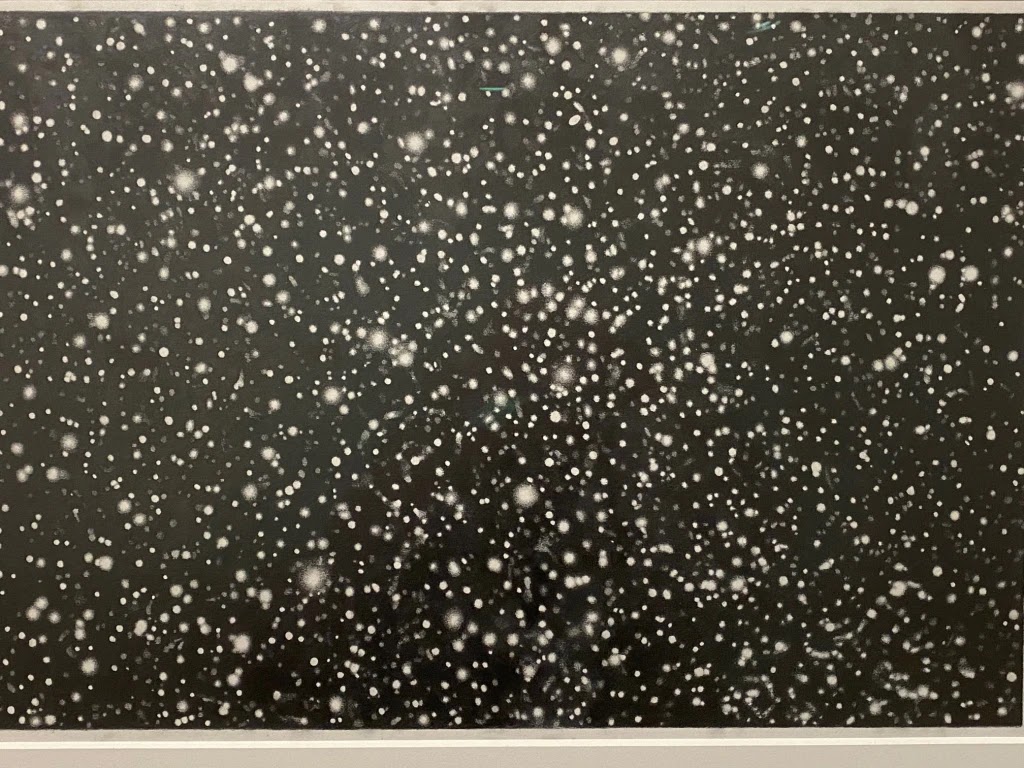
I found I had a tender touch. I got more interested in projecting the spatial qualities. I started doing darker things, like New Mexico night skies. I started making the star field paintings.

The image itself has 2 or 3 qualities that you grasp at one time: a flatness, an illusionary depth, and a MADE quality. How it's made is the thing that I think engages you in looking at my work.
But the process of making isn't an invocation of darkness. And the making is not just busy work. I like to leave subtle traces of the making and of the thinking, bypassing the brain but still leave signs of intelligence.
I'm highly self-critical. I'm critical of others too.

I want to work larger so that you can roam around I'm finding it difficult to concentrate and make work that is so concentrated. I'd like to make work that's a little more emotional. I'm interested in a more ambiguous, more abstract space. I may make some dimensional objects now.
I'm an outsider. there is an outsider quality to everything I do. Vija Celmins 2003
Vija Celmins was born in Latvia in 1938 and immigrated to the USA when she was ten years old.
There are many videos of her and her work on youtube.
video about the surface of the ocean and the desert.
video of how she makes prints of the night sky
video of her speaking and shows her working
Vija Celmins was interviewed by Robert Enright for Border Crossings magazine in 2003 and her words were paraphrased by Judy Martin in 2024. You can read the original in border crossing magazine #87





 Posts

