Showing posts with label dyeing. Show all posts

Monday, February 6, 2017

Colleen Heslin

girl friday 2016 colleen heslin dye on linen
Colleen Heslin's exhibition Needles and Pins
McMichael Canadian Art Collection Gallery  June 4 2016 - February 20 2017
organized by the Esker Foundation in Calgary
curator Naomi Potter
girl friday detail colleen heslin
sewn paintings
constructed colour fields
false start 2016 colleen heslin dye on linen
Colleen Heslin won the 2013 RBC Canadian Painting Prize
earth be earth 2015 colleen heslin dye on linen
Colour field paintings or modern quilts?
A Jack Bush solo exhibition runs concurrently at the McMichael
earth be earth detail colleen heslin
Art equals craft, Craft equals art.
The importance and meaning of materials
monochrome 2016 colleen heslin dye on  linen
 Colleen Heslin soaks fabric in dye, and then skillfully cuts and pieces these striking compositions.
They 'resonate with the tension of material and gestural complexity.'  (wall text)
dash 2015 colleen heslin ink and dye on cotton and linen
The work in this exhibition is recent, most from 2016.
Those from 2015 give more evidence about her mark making process.
She allows the fabrics that she stains with dye or ink to dry naturally, and then responds to the marks left behind without her hand touching them.
Not paintings then.
dash 2015 colleen heslin detail
Yet the viewer feels touched.
This artist is exploring and using cloth as a language and cloth is intimate.
counterpose 2015 colleen heslin ink and dye on cotton and linen
 We understand cloth.
log cabin 2016 colleen heslin dye on canvas
Cloth is like the human body.
It's malleable.
runaay 2016 colleen heslin dye on canvas
Most of the pieces are human scale.
The cloth is pulled around stretcher bars. 
seafoam 2016 colleen heslin dye on canvas
Not quilts then.  

Thursday, February 19, 2015

Reiko Sudo and Nuno

A post about the recent exhibition at the Mississippi Valley Textile Museum, Almonte Ontario, Reiko Sudo and Nuno: Textiles from Japan
Curated by Alan C. Elder from the Canadian Museum of Civilization, the exhibition was designed by Reiko Sudo in the wabi sabi - beautiful  Norah Rosamond Hughes Gallery, a re-configured space in what used used to be a working woolen weaving factory .    In the above photo, one of the twenty -two columns is wrapped red polyester fabric, Paper Roll 2002, a chemical lace embroidery designed by Reiko Sudo in 2002.
When Alan C, Elder showed Reiko Sudo images of the gallery, she focused her attention on the columns that line up in the temporary exhibition space and dressed them in her original fabrics.  The white pleated and slashed polyester screen on one of the walls is named Tanabata, and was designed in 2004 by Reiko Sudo and Hiroko Suwa.  (Tanabata is a traditional annual festival.  On the seventh day of the seventh lunar month, girls pray to become good at sewing by decorating bamboo with folded paper charms.
 Scrapyard, 1994 designed by Reiko Sudo and Hiroko Suwa.  Rust dyeing, 100% rayon and iron.
This exhibition was not only serenely beautiful, it was also very informative for those of us interested in surface design.  A dedicated wall of samples served to explain the variety of processes used to create the fabrics was an integral part of the exhibit.   Scrapyard was made by laying damp fabric on a square of rusty iron, shown above.
 Length of time was the variable in how densely the material would be coloured.
The exhibition was in Canada from July 11 - November 22, 2014) and celebrated the 30th anniversary of NUNO, the Tokyo based textile studio, and Reiko Sudo's association with it.
The natural light and the decrepit stone walls of the historic building added to the elegance and mystery of these minimalist yet sensuous fabrics.  Above, Cracked Denim Rounds, 2010 designed by Reiko Sudo and Hiroko Suwa. Burnout and bonding, cotton and polyester.
Denim was originally a French twill called serge de Nimes.
 Flower Almanac , 2006 designed by Reiko Sudo.  Jacquard weave, 100 percent cotton.
A double weave in threads of different hefts and twists.
detail of Skylights, 2012 designed by Reiko Sudo.  Another double weave.  98% cotton, 2% polyurethane.
left: Kamaboko Stripe, 2014  Designed by Reiko Sudo, jacquard weave, 100% cotton, Right: Skylights 2012.
Visitors were invited to touch the samples.
 By handling the cloth and reading the details, we learn.
Congratulations to Michael Rikley-Lancaster, Executive Director and Curator of the Mississippi Valley Textile Museum, and to all of the many who were involved in bringing such an important international exhibition to Almonte.    A catalog of the exhibition is available from the museum, with essays by Alen C. Elder, Naomi Pollock and Yoko Imai accompanying photographs of each cloth.

Friday, February 7, 2014

Chiyoko Tanaka

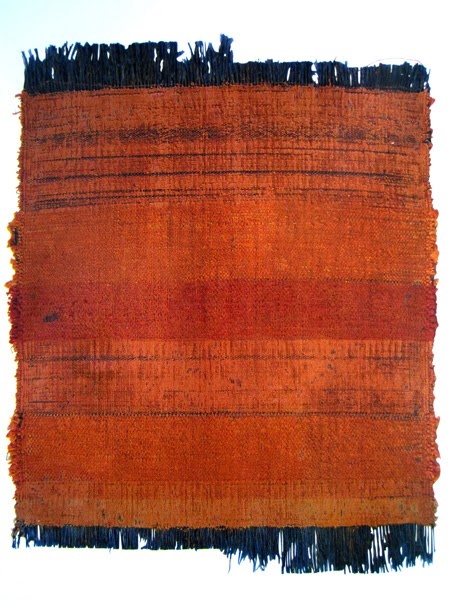
red stripe #262 1988  24 x 18 cm, hand woven ramie, linen, silk, rubbed with brick
"Many of my pieces, once woven by hand, are laid down outdoors on the ground or on a rock.  I then rub them carefully with a stone or brick.  I want to touch the earth through this process, to trace the texture of the ground".  Chiyoko Tanaka

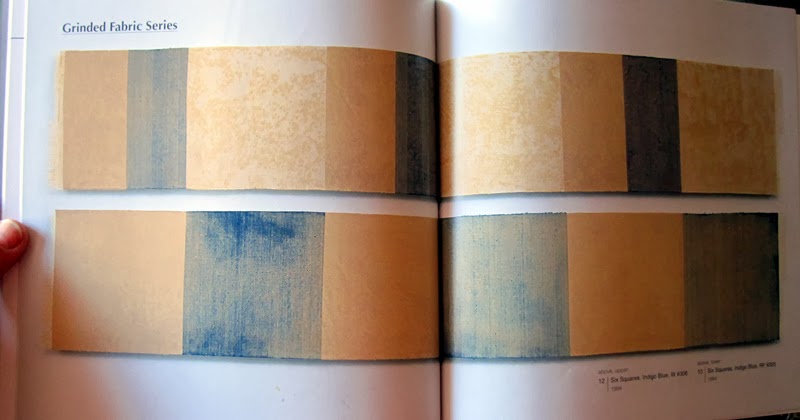
 upper: six squares, indigo blue, W #306 1994  lower: six squares, indigo blue, RF #305 1994
Chiyoko Tanaka, born 1941 Kyoto Japan, is a weaver who thinks about her work philosophically, comparing it to the human condition.   British curator, Lesley Millar's, essay about Tanaka is included in the Telos portfolio about the artist and informs this post.  The images of Tanaka's work are from that portfolio and from Art Textiles of the World Japan also published by Telos.  
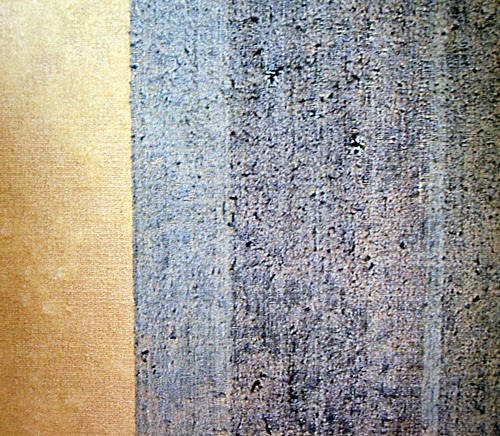
six squares indigo blue W #306 detail
Chiyoko Tanaka uses linen, silk, and ramie threads.  She lays out a long warp which gradually disappears during the weaving process, covered by the weft.

Trace of a Leaf #151 1988

She considers the vertical warp threads to represent time and the horizontal weft threads to represent space.
The crossing points of warp and weft physically disappear from view, but continue to exist as integral to the fabric.  The accumulation of the weft threads represents time passing.  When she weaves, she thinks about the process as one of transformation.
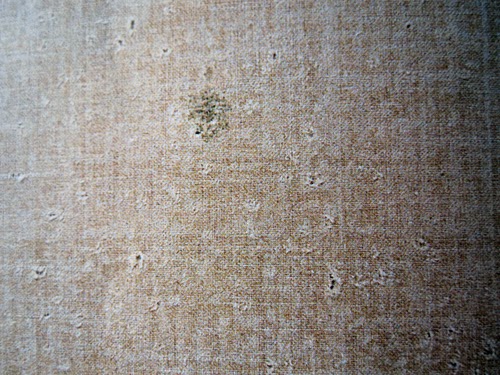
Trace of a Leaf #151 detail

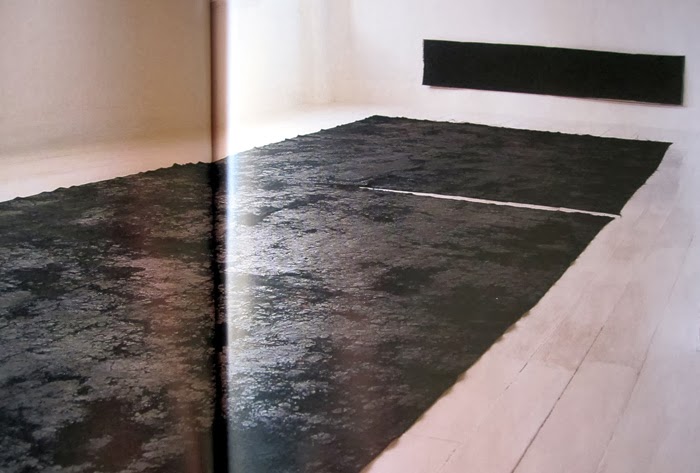
By grinding her newly woven cloth with earth, she exposes that original warp.  She unveils the essence of the fabric. "I feel that my woven work is about time and the human condition."  Chiyoko Tanaka
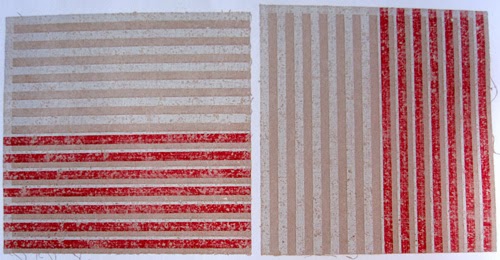
red stripes on white stripes #646 and #647. both 1985
Sometimes, instead of grinding her finished fabrics, she permeates them with mud or oil.  Tanaka distresses her fabrics, as if they were human beings going through a life time of both happy days and days filled with hard ships.
Trace of White Line #641 above, White Line #642 below, both 1985
"I want to see a spirituality behind a piece of my work."  Chiyoko Tanaka
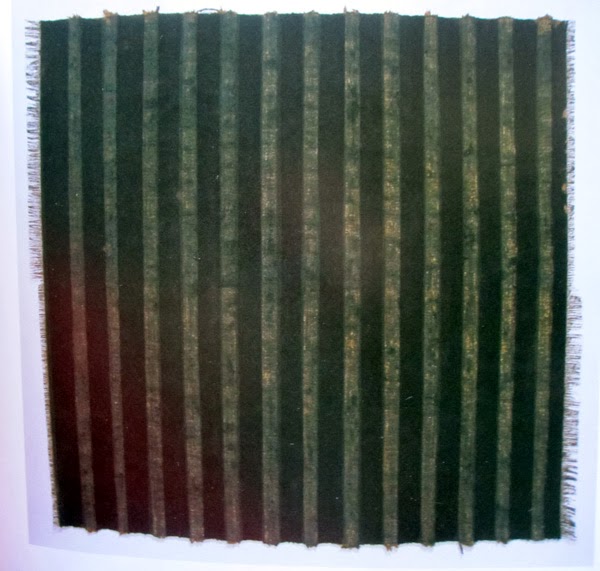
Black Stains on Deep Green Stripes #52 1990
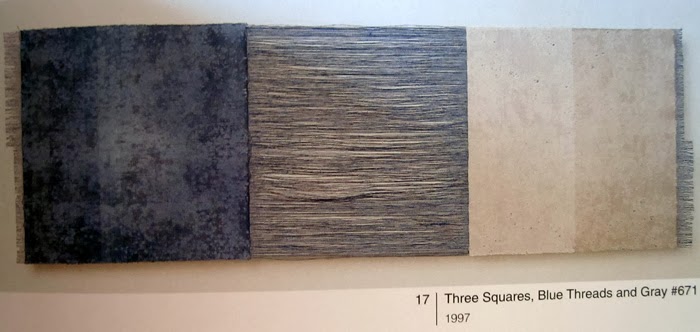
Tanaka uses bricks of clay from different parts of the world.  The brick is rubbed into the back of the fabric until it changes colour and at the same time, the face of the material takes on the patina of the ground.
It's like a performance. 
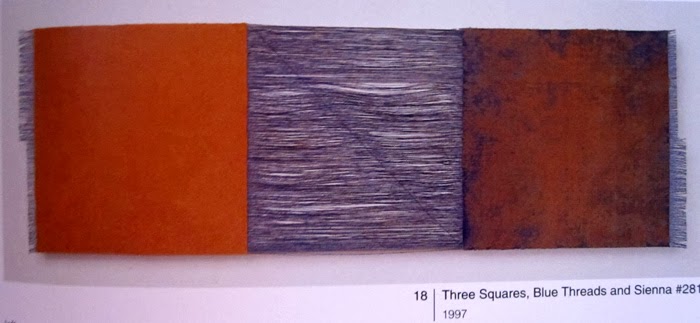
Three Squares, Blue Threads, Sienna #281 1997
The structural integrity of the warp and weft is revealed.   We can see time passing with the erosion of materials, but it is all done in the present moment. 
Three Squares, Blue Threads and Gray, #671 1997
Tanaka's work makes us aware of time passing, "neither looking for death, nor denying it, but accepting its place in the cycle of renewal"  Lesley Millar
left: red earthy clay #200 1985, right: permeated black #400 1986
Chiyoko Tanaka has an intimacy with nature.  She lives on the outskirts of Kyoto, close to natural space.  She has an awareness of the tempo of the natural world and this is the basis of her work.
Permeated Black #400  1986
When mud is used as a dye, it is left for a period of time so that it can 'permeate' the cloth.  Time is one of Tanaka's most important materials.
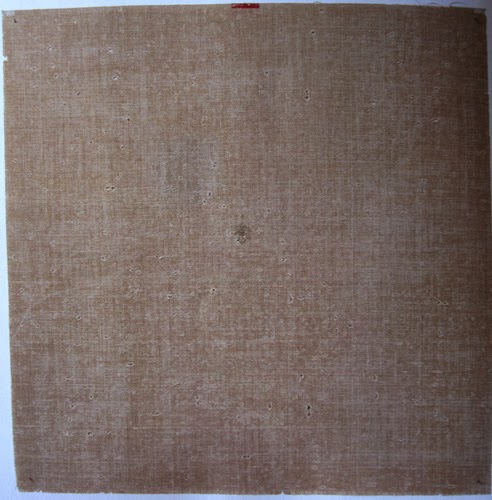
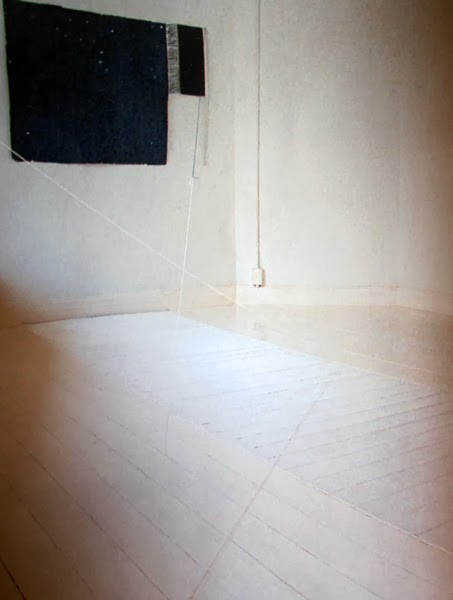
wall:  Blue #100-2 1983,  floor:  White, B #100-1 2983
What are you weaving, Chiyoko?
"I am weaving time"
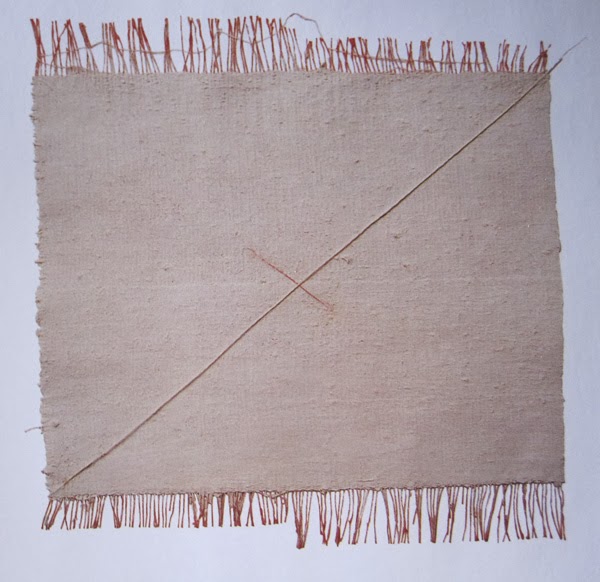
 white mud cross, red thread #652 1992 19 x 19 cm hand woven ramie
"At the still point of the turning world.
...neither from nor towards.
At the still point, there the dance is."  T S Eliot

Chiyoko Tanaka was profiled in 2003 on Culturebase and again in 2010 by Kate Barber who visited her. 

mud dots on brown stripes #742, hand woven linen, ramie, dyed with mud  2009
She is represented by Brown Grotta  source of the above image.  (the most recent I could find)